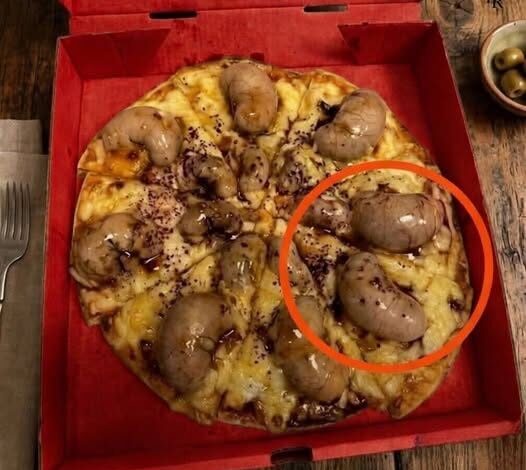
One evening, my pizza arrived looking slightly unusual, enough to make me pause before even thinking about taking a bite. At first glance, everything seemed normal—the crust had a good color, the toppings were evenly spread, and the cheese was melted in the familiar way you would expect from a freshly baked pizza. But something about the surface immediately stood out. Underneath the layer of cheese were small, raised bubbles scattered across the top, giving it a texture I had never really noticed before.
Instead of eating right away, I found myself studying it more closely. The bubbles weren’t uniform or messy, but smooth and slightly domed, almost like air pockets trapped beneath a thin layer. That made me hesitate. I started wondering if something had gone wrong in the kitchen. Was the pizza undercooked in certain areas? Had it been left in the oven too long? Or worse, was something off with the ingredients? The uncertainty was enough to make me set the slice down and start looking for answers before taking another bite.
Curiosity quickly took over, and I decided to search online to see if anyone else had experienced the same thing. It didn’t take long before I realized I wasn’t the only one who had noticed this strange-looking cheese pattern. In fact, there were plenty of explanations describing exactly what I was seeing.
What I learned completely changed my perspective.
The bubbles were not a sign of something wrong at all—they were actually a natural result of how pizza is baked. As the dough cooks in a hot oven, tiny pockets of air and moisture trapped inside begin to expand due to the heat. At the same time, the cheese on top melts and softens, sometimes forming a thin layer that traps those expanding gases underneath. This combination creates the smooth, inflated bubbles that appear on the surface.
Different factors can make the effect more noticeable. For example, dough that has been properly fermented often contains more natural air pockets. Higher baking temperatures can cause faster expansion. Even the type of cheese used can influence how many bubbles form, since some cheeses contain more moisture or melt in ways that encourage this effect. In certain styles of pizza—especially those baked quickly at very high heat—these bubbles are not only common but expected.
As I kept reading, I began to realize that what had initially looked like a mistake was actually part of the cooking process. In some cases, those bubbles are even considered a positive sign, indicating that the pizza was baked at the right temperature and that the dough reacted properly in the oven. What I had assumed was a flaw was actually evidence of technique and timing working together.
With that understanding, my concern faded completely. I picked up the slice I had been studying, a little amused at how seriously I had questioned it just moments earlier. The first bite confirmed what I now already suspected—it tasted exactly like a well-made pizza should. Crispy in some places, soft in others, with melted cheese and balanced flavor throughout.
The experience stayed with me longer than expected, not because of the pizza itself, but because of what it revealed in a small, simple way. I had seen something unfamiliar and immediately assumed it might be wrong. Only after taking a moment to investigate did I realize it was completely normal.
It became a quiet reminder that appearances can be misleading. Not everything unusual is a problem waiting to be fixed. Sometimes it is simply the result of natural processes we don’t immediately recognize. In this case, a few strange-looking bubbles on a pizza turned into a small lesson in curiosity, patience, and not rushing to judgment before understanding the full picture.