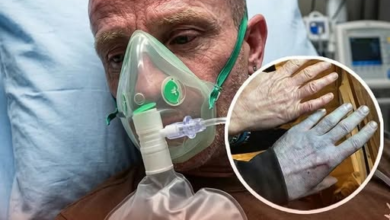
The first breath never fully arrived the way it should have. One moment there was an ordinary afternoon inside a crowded shopping mall—people moving between stores, conversations blending into background noise, the steady rhythm of daily life—and the next, everything collapsed into confusion. The air felt heavier, sound became distorted, and the world narrowed to something sharp and frighteningly small. A stranger stood in the middle of it all, suddenly trapped in a body that refused to cooperate, while panic rose fast and uninvited.
Around them, life could have continued uninterrupted. People could have kept walking, shopping bags swinging at their sides, unaware of how quickly a normal day can fracture. But one woman did not keep walking. She stopped.
At first, it was just hesitation—an instinctive pause when something feels wrong. Then it became a decision. Then a responsibility she never asked for but accepted anyway. She stayed.
By the time sirens began to echo through the mall corridors, the situation had already changed shape. It was no longer just a moment of public disturbance; it had become something intimate and urgent. The kind of emergency that strips away all distance between strangers. She followed as the situation moved through long hallways and service doors, past confused onlookers and shifting attention, never stepping away even when she easily could have.
In the sterile brightness of a hospital ward later that day, she remained present. Fluorescent lights hummed overhead. Monitors blinked with steady, indifferent precision. Medical staff spoke in controlled, careful language—words meant to measure, categorize, stabilize. But beneath those words was a human being still struggling to catch hold of something as basic as breath.
In that space, she became something different than a bystander. She became continuity. A steady presence in a place where everything else felt uncertain. A hand offered without hesitation. A voice that did not rush or disappear when things became uncomfortable. She listened when explanations blurred into fear, and she stayed when staying offered nothing in return except the weight of someone else’s uncertainty.
There were no photographs of her in that moment. No recognition. No audience. Just a simple, repeated choice: to remain.
It would have been easy to leave. There were errands waiting, obligations forming in the background of her day, a life that was supposed to continue on schedule. But she set all of it aside without ceremony. In doing so, she became part of someone else’s survival in a way that would likely never be recorded anywhere beyond memory.
Meanwhile, across town, a very different kind of difficulty was unfolding for two teenagers: April Webster and Nathan Fishbourne. Their experience did not begin in a mall or a hospital, but in the complicated intersection of adolescence, attention, and consequences they had not fully understood before they arrived.
At fourteen, their lives were abruptly pulled into a spotlight that neither had chosen nor were prepared to carry. What should have been private confusion became public discussion. What should have been personal growth became subject to outside interpretation. Headlines and commentary reduced their situation into simplified narratives—warnings, labels, assumptions—none of which captured the complexity of what they were actually living through.
But behind those headlines, another reality existed—quieter, less visible, and far more human.
Their families did not respond with certainty or perfection. They responded with presence.
Parents adjusted their routines without hesitation. Grandparents stepped in where needed. Siblings learned to share space with uncertainty. They attended appointments that were difficult to sit through, endured conversations that offered more questions than answers, and absorbed the weight of judgment that came from outside their home.
There were no dramatic speeches or polished solutions. Instead, there was consistency. Showing up again and again, even when nothing felt resolved. Sitting beside them in silence when words were not enough. Protecting what little stability could be preserved in a situation that felt unstable by nature.
It did not erase consequences. It did not undo complexity. But it ensured that none of it was faced alone.
And in that, a shared truth begins to emerge between these very different stories.
Heroism is rarely loud.
It does not always arrive with recognition or clarity. It does not always look like strength in the traditional sense. More often, it appears as something quiet and easily overlooked: a stranger choosing to stay beside someone in crisis, a family refusing to withdraw support when things become difficult, a presence that does not disappear when discomfort begins.
It is the ride that no one planned to take. The waiting room chair that is never acknowledged. The steady voice in a moment when everything else feels unstable. The decision, repeated in different forms, to remain when leaving would be easier.
From the outside, none of it may seem extraordinary. There are no medals for it, no headlines that fully capture it, no clear markers that separate it from ordinary life.
But for the people on the receiving end of that choice, it changes everything.
Because sometimes the most important form of strength is not action, control, or resolution.
It is simply not walking away.