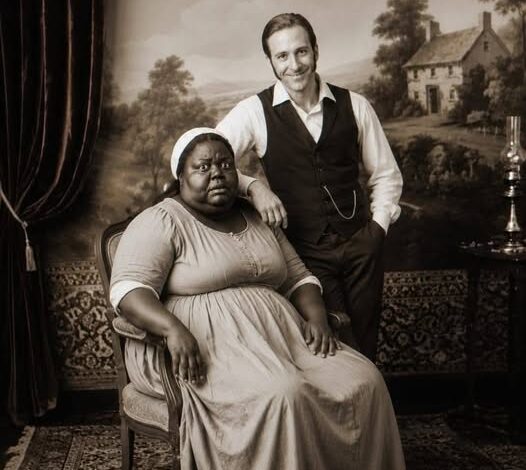
In the world of Vassouras in 1857, Benedita lived under a system designed to deny her individuality before it could ever be acknowledged. Strength in her body, presence in her posture, and resilience shaped by years of survival should have been recognized as signs of endurance. Instead, the society around her filtered everything through the rigid and dehumanizing logic of slavery, where human beings were reduced to categories of labor, risk, and control.
Even before words were spoken about her, assumptions had already been made. Her physical strength was interpreted not as survival, but as something to be managed or feared. In such an environment, perception became another form of confinement. People did not see the full scope of her life, her memories, or her interior world. They saw only what the system allowed them to see.
But Benedita existed beyond those limits, even when the world refused to acknowledge it.
Every moment of scrutiny, every judgment imposed from the outside, revealed more about the society observing her than about her own worth. The act of reducing a person to usefulness exposed the moral fractures of the system itself. It showed how easily cruelty can be disguised as order, and how deeply injustice depends on forgetting a person’s humanity.
And yet, even within such a constrained world, there were moments when perception shifted. At times, someone would look beyond the surface and recognize not an object or a category, but a human being shaped by strength and experience. These moments did not erase the structure of oppression, nor did they undo its violence. But they revealed something fragile within it—the inability of even the harshest systems to fully extinguish recognition.
For Benedita, strength was not only what others noticed; it was what she continued to carry internally. It existed in the quiet persistence of survival, in the refusal of identity to be fully consumed by external definitions, and in the fact that she remained more than what any system attempted to make of her.
Her story is not defined by the labels placed upon her, but by the fact that those labels were never enough to contain her humanity.
In remembering lives like hers, it becomes clear that oppression depends on narrowing vision—on convincing the world that a person can be fully known through a single imposed frame. But human existence resists that narrowing. It always exceeds it.
And in that excess—in everything that cannot be reduced or fully explained—is where dignity survives.