The Uniform of Courage: How My Father’s Final Gift Silenced the Bullies Who Laughed at My Prom Dress

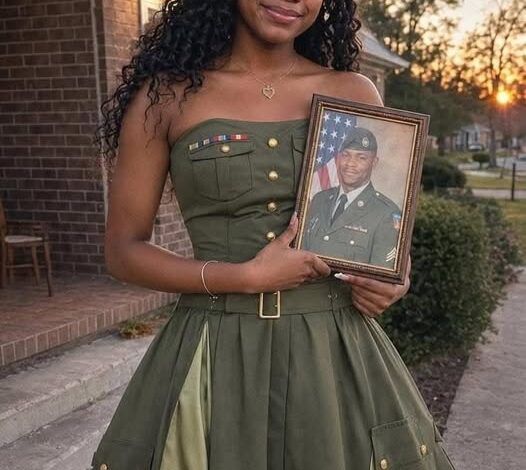
The ballroom glittered with sequins, satin, and expensive perfume, but I felt like the only person standing there with a story stitched into my clothes.
I had walked into prom wearing a dress made from my late father’s old army uniform.
The reaction came immediately.
My stepmother’s face tightened with disgust. My stepsisters leaned toward each other, smirking and whispering just loud enough for others nearby to hear. To them, I looked ridiculous. Poor. Out of place. A girl who had shown up to the most glamorous night of the year wearing something old, strange, and embarrassing.
They laughed at the fabric.
They laughed at the shape.
They laughed at me.
What they didn’t understand was that the dress was never meant to impress them.
It was never about fashion.
It was about my father.
For years after his death, I had lived in a house where his memory was treated like an inconvenience. His photographs were moved into drawers. His stories were interrupted. His medals were boxed away as if they belonged to someone unimportant. My stepmother had never said outright that she wanted him erased, but every day, she made it clear that his presence in our home was something she resented.
So when prom came, I made a choice.
I would not wear something bought with her money or chosen to please her standards. I would wear something that carried my father’s memory. I would carry him with me into a room where he should have been watching me smile, taking too many pictures, and telling me I looked beautiful.
The dress had been made carefully from the uniform he had worn with pride. Every seam felt meaningful. Every fold of fabric held something of him. To everyone else, it may have looked unusual. To me, it felt like protection.
Their laughter hurt, but it did not surprise me.
I had heard that kind of laughter for years.
I had learned how to stand still while people tried to make me feel small.
So I lifted my chin, straightened my shoulders, and refused to cry.
Then came the knock.
It was sharp, firm, and impossible to ignore.
The music seemed to fade beneath it. The whispers stopped. Everyone turned toward the entrance.
A man in a crisp military uniform stood in the doorway. His posture was straight, his expression serious, and his presence immediately changed the room. He did not scan the crowd with uncertainty. He seemed to know exactly who he had come for.
His eyes found me.
My stepmother stiffened.
My stepsisters stopped smiling.
I walked toward him slowly, feeling every stare follow me across the floor. For the first time that night, the room was not laughing. It was waiting.
The officer spoke my full name.
The way he said it made my chest tighten. There was respect in his voice. A quiet dignity. A tone that reminded me painfully of my father, especially in the moments when he had been proud of me.
He handed me an envelope.
The paper was thick, official, and sealed with importance.
My hands trembled slightly as I opened it.
Inside were documents.
At first, I did not understand what I was seeing. Then my eyes caught my father’s signature. Again and again, it appeared across the pages. Legal forms. Scholarship paperwork. Housing arrangements. Letters of instruction. Everything carefully prepared, dated, and witnessed.
The room around me seemed to shrink.
My father had planned this.
He had known.
Somehow, long before I understood how badly I would need saving, he had prepared a way out for me.
There was a letter too.
I unfolded it with shaking hands.
In it, my father explained that if anything ever happened to him, he wanted to make sure I would never be trapped in a place where I was unwanted or mistreated. He had arranged funds for my education. He had secured housing. He had left instructions with people he trusted. He had made certain that when I turned eighteen, I would have choices.
Real choices.
A future.
A life that did not depend on my stepmother’s permission.
The officer stood quietly while I read.
No one spoke.
The same people who had mocked my dress only minutes earlier now stared at the papers in my hands with confusion and fear. My stepmother’s face had gone pale. My stepsisters looked at each other, their smirks gone.
They had thought I was powerless.
They had thought I was just a grieving girl wearing old fabric because she had nothing better.
They had no idea that the man they tried to erase had left behind a shield strong enough to reach me even after death.
I folded the papers carefully, treating them with the same reverence I had given the dress. Every document felt like another piece of my father’s love made visible. Every signature felt like his hand on my shoulder, steadying me.
I looked at my stepmother.
For years, I had imagined what I might say if I ever had the chance to stand above her cruelty. I thought I would want to shout. To accuse. To make her feel even a fraction of what she had made me feel.
But in that moment, I felt no need.
Her silence was enough.
The truth was enough.
I thanked the officer, picked up my small purse, and turned toward the door.
No one tried to stop me.
Outside, the night air felt cool and wide. For the first time in years, I did not feel trapped inside someone else’s house, someone else’s rules, someone else’s version of who I was allowed to be.
The fabric of my father’s uniform brushed against my legs as I walked. It smelled faintly of starch, storage, and something I could only describe as memory.
It was not just a dress.
It was armor.
It was proof.
It was my father’s final embrace.
As I stepped toward the waiting car, I realized something with perfect clarity. They could laugh at the fabric. They could mock the style. They could sneer at the sentiment.
But they could not touch what it meant.
They could not take the love woven into it.
They could not undo the strength it gave me.
For years, I had been treated like a shadow in my own life. That night, I stopped being the quiet girl hiding at the edge of someone else’s story.
I became my father’s daughter again.
And with every step I took away from that ballroom, I walked closer to the future he had protected for me.
A future where I was no longer begging to belong.
A future where I was free.