My Son Built a Ramp for the Boy Next Door – Then an Entitled Neighbor Destroyed It, but Karma Came Faster than She Expected

I thought it was going to be just another quiet afternoon—until my son noticed something no one else had. By the next day, our entire street felt different.
My son Ethan is 12. He’s the kind of kid who can’t ignore something that feels wrong, even if it has nothing to do with him.
Across the street lives Caleb, a nine-year-old boy who spends most of his time sitting on his front porch in a wheelchair. He’s quiet, always watching the neighborhood like it’s a world he isn’t allowed to be part of.
At first, I didn’t think much of it. Kids make do with what they have. But Ethan saw something more.
“He just watches,” Ethan said one afternoon as we unloaded groceries.
Caleb was sitting there again, hands resting on his wheels, staring at kids riding their bikes.
Ethan frowned. “Mom… why doesn’t he ever come down?”
I glanced over and saw the sadness in Caleb’s eyes.
“I’m not sure,” I told him. “But we can go ask later if you want.”
That was all Ethan needed.
That evening, we walked over to their house—and that’s when I finally understood.
There were four steep steps leading down from the porch. No railing. No ramp. No safe way for Caleb to get down on his own.
We knocked. His mother, Renee, opened the door. She looked worn out, but kind.
I explained why we came.
She gave a small, tired smile. “He wants to go out more than anything… but without a ramp, someone has to carry him every time.”
Ethan’s expression changed instantly.
“We’ve been trying to save for one,” she added. “But it’s slow. Insurance won’t help.”
We said goodbye and walked home in silence.
But Ethan wasn’t done thinking about it.
That night, instead of games or his phone, he sat at the kitchen table with paper and a pencil, sketching.
“What are you working on?” I asked.
Without looking up, he said, “I think I can build a ramp.”
His father—who passed away just three months ago—had taught him how to build things. It started small… but Ethan had always loved it.
Now I saw that same focus in him again.
The next day after school, he dumped out his savings.
Coins. Bills. Everything.
“That was for your bike,” I reminded him gently.
“I know.”
“You’re sure?”
He looked at me. “He can’t even leave his porch, Mom.”
I didn’t argue after that.
At the hardware store, Ethan took it seriously—measuring, asking questions, double-checking everything.
He wasn’t guessing.
He had a plan.
For three days straight, he worked after school until dark.
Cutting. Measuring. Sanding. Adjusting.
I helped where I could, but he led the whole thing.
By the third evening, his hands were scratched and sore—but when he stepped back, he smiled.
“It’s not perfect… but it’ll work.”
We carried it across the street together.
Renee came outside, confused at first—then completely stunned.
“You made this?” she asked.
Ethan nodded shyly.
We installed it, and then she turned to Caleb.
“Want to try?”
He hesitated… then rolled forward.
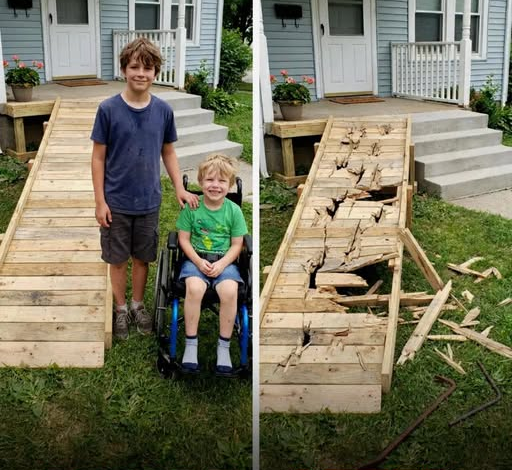
For the first time, he made it down to the sidewalk on his own.
The joy on his face was unforgettable.
Within minutes, other kids gathered around him. Someone invited him to race.
And just like that—he wasn’t watching anymore.
He was part of it.
The next morning, everything changed again.
I woke up to shouting and ran outside barefoot.
Mrs. Harlow—our neighbor down the street—was standing in front of Caleb’s house, furious.
“This looks terrible!” she snapped.
Before anyone could react, she grabbed a metal bar and swung it.
The ramp cracked.
Caleb screamed.
She kept hitting it until it collapsed completely.
Then she dropped the bar.
“Clean up your mess,” she said coldly—and walked away.
Silence took over.
Caleb was back at the top of the steps.
Watching.
Just like before.
Inside, Ethan sat quietly on his bed.
“I should’ve built it stronger,” he muttered.
I sat beside him. “No. You did something good.”
“But it didn’t last.”
I didn’t know what to say.
The next morning, three black SUVs pulled up.
Men in suits stepped out—calm, serious.
They went straight to Mrs. Harlow’s door.
At first, she looked confident—like she was expecting important guests.
Then everything changed.
Her smile disappeared.
Her hands started shaking.
“We need to talk about your application,” one of the men said.
They introduced themselves as representatives of the Foundation for Global Kindness.
Mrs. Harlow had been a finalist for CEO.
But part of their process, they explained, involved observing candidates in real-life situations.
Then they showed her a video.
The sound of wood breaking.
Caleb’s scream.
Her own voice: “This is an eyesore!”
Her face went pale.
“You destroyed a wheelchair ramp built for a child,” the man said.
Another added, “We don’t want a leader who values appearances over people.”
Her job offer was gone—just like that.
Then the man said something unexpected.
“Your actions made one thing clear. We need to do more.”
He pointed to the empty lot behind her house.
They were going to build a fully accessible community park—with ramps, adaptive playground equipment, and pathways.
Something permanent.
Something no one could take away.
Renee stepped forward.
Mrs. Harlow stared at her. “You sent that video.”
Renee didn’t deny it.
“You took something from my son,” she said calmly. “I made sure someone saw it.”
Then the man turned.
“Is Ethan here? The boy who built the ramp?”
Ethan stepped forward.
The man smiled slightly.
“There will be a dedication in your father’s honor. And we’ll be building a new ramp for Caleb.”
Tears filled my eyes.
Ethan squeezed my hand.
Later, Renee explained everything.
She used to work for the Foundation—and still had a contact.
When she saw what happened, she made sure the right person saw it too.
Caleb was still on the porch.
But this time, he wasn’t just watching.
He was smiling.
And for the first time since everything happened…
it felt like something better was already on its way.