SADNESS FLOODS GMA OVERNIGHT – Michɑel Strɑhɑn, Robin Roberts And George Stephɑnopoulos!

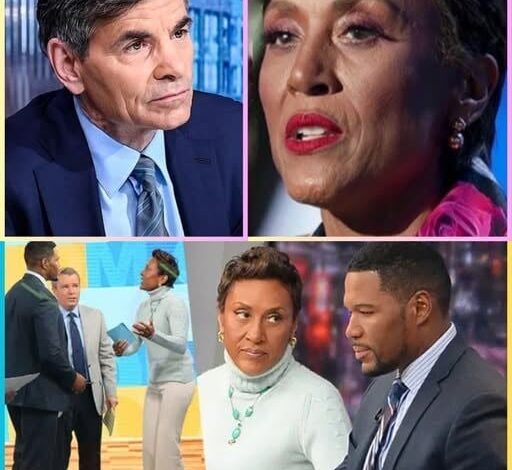
For millions of Americans who tune in daily to Good Morning America, the broadcast offers a reassuring rhythm in a world that often feels chaotic and unpredictable. We see the anchors, the bright studio lights, and the polished segments—but rarely do we consider the unseen scaffolding that keeps such a sprawling production from collapsing. On February 25, 2026, that scaffolding trembled as the ABC News family gathered to honor a figure who never sought the spotlight but whose influence was felt in every frame: Michele Mayer. A veteran producer and the quiet force behind the network’s most iconic broadcasts, Mayer concluded a storied three-decade career, leaving a void that Michael Strahan, Robin Roberts, and George Stephanopoulos all acknowledged would be nearly impossible to fill.
To grasp the weight of Mayer’s departure, one must understand the unique alchemy of live television. Anchors are the public-facing personas, but the producer is the conductor of the entire orchestra. For more than 30 years, Mayer was that steady hand behind the camera, the voice guiding legendary journalists through chaos, crises, and breaking news. She managed the frenzied energy of live broadcasts, navigated the delicate egos of high-profile guests, and ensured that, regardless of national upheaval or cultural shifts, the show remained a beacon of professional excellence. Her retirement is not just the end of a career—it marks the conclusion of an era that defined the very architecture of ABC’s morning and nightly news.
The tributes that flowed in were a testament to the breadth of her influence. Robin Roberts, whose resilience has become synonymous with the show itself, called Mayer a “steadying North Star.” In a live studio, where seconds stretch and mistakes are instantly magnified, Mayer provided an unshakable anchor. George Stephanopoulos, known for his analytical rigor, recalled how Mayer’s fearless honesty kept the broadcast grounded. She possessed a rare ability to tell the most powerful figures in media exactly what was wrong and how to fix it—without ever losing their respect.
Perhaps the most memorable recollections came from ABC’s legends. Diane Sawyer shared a humorous yet revealing anecdote: printed signs taped to monitors simply read, “Sit up straight.” It was a small gesture, yet it encapsulated her philosophy of discipline and excellence. Charles Gibson, former anchor of World News Tonight, noted that being “coached” by Mayer was a rite of passage—her tough love tempered by a deep devotion to the craft. If she was stern, it was because she held the mission of journalism in the highest regard.
David Muir, current anchor of World News Tonight, described Mayer as his “partner in crime,” a collaborator who guided him through some of the most challenging reporting cycles in recent memory—from pandemics to political upheaval. For Muir and countless others, Mayer’s presence meant that no matter how dark or complex the story, someone in the control room always had clarity. Her decision to return home to Kentucky may mark a personal new chapter, but for New York studios, it feels like a tectonic shift. The professionals she guided didn’t just lose a boss—they lost the anchor that held their careers together.
The sadness sweeping GMA isn’t born from scandal or tragedy, but from the recognition of how much we rely on those who operate behind the scenes. In an age dominated by digital influencers and social media sensationalism, Michele Mayer represented the “Old Guard”—a generation of broadcasters committed to the sanctity of the edit, the precision of the lead-in, and the small, quiet gestures that keep a newsroom functioning. She was there for the first nervous nights of correspondents who are now household names, offered a calming word during the terror of 9/11, and guided anchors through the uncertainty of election nights. To watch her depart is to see thirty years of history walk out the door.
Michael Strahan, who transitioned from professional sports to a television set, credited Mayer with helping him navigate a notoriously difficult medium. He called her the “coach no viewer ever saw,” highlighting the selfless nature of her work. In television, if a producer performs perfectly, the audience never notices. They are the editors of reality, the silencers of chaos. That her name is now spoken with such reverence across networks is the ultimate acknowledgment of her impact.
As GMA prepares for its first morning without Mayer’s voice in the headsets, the mood in Times Square is one of quiet existential reflection. The lights will still turn on, the scripts will still roll, but the “soul” of the operation—the calm, precise, and unwavering presence Mayer curated—will have to be rediscovered. Tributes continue from across the country, from interns to senior executives, all reflecting on Mayer’s “Kentucky kindness” and “Manhattan moxie.” She leaves behind a legacy of mentorship, shaping an entire generation of producers who will carry her standards forward. The show must go on, but for those in the anchor chairs, the view will never feel quite the same.
Michele Mayer’s departure reminds us that the stories that shape our days are delivered by humans—professionals with families, histories, and an unwavering sense of duty. As she trades New York’s frenetic pace for Kentucky’s rolling hills, she leaves behind a masterclass in leadership from the shadows. The “unseen force” has finally been seen, and the gratitude of an entire network is the well-deserved standing ovation for a woman who helped America wake up, every morning, for thirty years.