Truth revealed after rumors of White House’s bizarre excuse for Barron Trump not joining the U.S. army

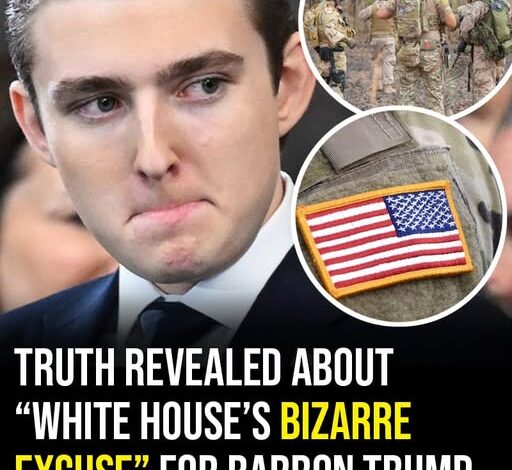
The circulating story about Barron Trump receiving a military exemption because he is “too tall” says far more about the speed and power of online misinformation than it does about Barron himself. There has been no official White House statement, no archived press briefing, and no credible reporting confirming that such an exemption was ever requested or granted. The claim appeared online, spread rapidly through social media and commentary threads, and eventually hardened into something many people accepted as fact—despite the absence of a verifiable source.
What makes the rumor particularly revealing is not the supposed detail about height, but the emotional response it triggered. Conversations about military service often carry deep feelings about fairness, sacrifice, and responsibility. For many Americans, the question of who serves in the armed forces—and who does not—can be tied to long-standing frustrations about privilege, politics, and inequality. When a rumor like this appears, it can quickly become a vessel for those frustrations, regardless of whether the claim itself holds up to scrutiny.
Barron Trump, who has spent most of his life outside the public spotlight compared with other members of his family, suddenly became the focus of a narrative he had no role in creating. As a young person who has not publicly commented on military service or future career plans, he was turned into a symbol in a debate largely driven by speculation. In many ways, the story illustrates how easily individuals—especially those connected to political figures—can become targets of assumptions and projections online.
The reality is far less dramatic. The U.S. Army and other branches of the military do maintain certain physical requirements, including height ranges, for new recruits. However, those requirements are part of broader medical and physical standards that can sometimes involve waivers depending on circumstances. Barron Trump’s exact height measurements are not officially confirmed by any government source, and there has been no documented case of him applying for service or seeking any form of exemption. Without those basic facts, the narrative collapses under its own lack of evidence.
In the end, the rumor’s persistence highlights a broader pattern in the digital age. A claim can begin as speculation, evolve into a viral talking point, and eventually become treated as established truth by some audiences—simply through repetition. Once a story aligns with existing frustrations or political attitudes, it becomes even more difficult to correct.
Rather than revealing anything meaningful about Barron Trump, the episode offers a glimpse into how quickly narratives form and spread online. It reflects the collective anxieties people carry about power, fairness, and national service. The controversy ultimately says less about a teenager connected to a former president and far more about how society processes information, emotion, and belief in an era where rumors can travel faster than facts.