My Son Took the Mic at the Wedding I Paid for and Praised His Mother-in-Law as His “Real Mom,” Leaving the Room in Shock—I Stayed Silent Through the Applause, the Stares, and the Hurt, Until I Finally Spoke and Changed the Night Forever

I spent nineteen thousand dollars on my son’s wedding—every cent I had saved across decades of careful living—believing it would be the ultimate proof of my love. I told myself it was worth it: money could be replaced, but moments like this could not. Yet, as I sat there amid crystal glasses, pristine tablecloths, and strangers who barely knew my name, I realized I hadn’t bought gratitude or respect. I had bought my own invisibility. My name is Stephanie. I am seventy years old, and I have been a mother for forty-five years in the deepest, most exhausting sense of the word.
I adopted Ethan when he was five. A social worker brought him to my tiny apartment with a trash bag of clothes and eyes that flinched at every sound. He cried for parents who would never return, and I held him through nights of terror, illness, and grief until his sobs softened into sleep. I worked double shifts in a factory, returned home with aching hands, and still helped with homework and scraped knees. I never remarried—not because I couldn’t, but because every ounce of energy went into giving him stability. I sacrificed comfort, travel, and dreams without resentment, because loving him was my life’s purpose. And yet, in a single sentence spoken into a microphone, he made it clear that none of it mattered.
When Ethan met Ashley, the shift was subtle at first, like a draft you don’t notice until it chills your bones. Ashley was polished, confident, and seemed to inhabit a world where bills and scarcity never existed. Her mother, Carol, radiated effortless privilege—tailored dresses, charity boards, and a voice that always sounded lightly amused. From the start, I felt like a relic from a life Ethan no longer wanted. Ashley’s smiles never reached her eyes around me, and Carol spoke as one might to hired help—cordial, but distant. Gradually, Ethan’s calls grew shorter, his visits more infrequent. He stopped asking for my advice. When I hugged him, he stiffened. Slowly, I watched him drift into a life where I had no place.
One afternoon, he asked for money for the wedding—not with hesitation or apology, but with expectation. When I told him it was my entire savings, he said love shouldn’t hesitate. I handed it over, swallowing the quiet truth: my love had become a transaction he felt owed. I told myself that after the wedding, things would return to normal, that he would remember who I was.
The months leading up to the wedding shattered that illusion. Ashley controlled every detail: where I stood, how I dressed, and who I could invite. When I asked to include three women who had supported Ethan and me—women who brought meals and watched him while I worked late—Ashley dismissed them as “not fitting the aesthetic.” Ethan said nothing. At the rehearsal, I was placed far from the immediate family. In photos, I was to the side, barely visible. On the wedding day, I arrived in a coral dress I had chosen with care, something that made me feel dignified. Ethan frowned, suggesting something more “subtle.” I complied silently, convincing myself peace was more important than pride.
The ceremony was beautiful. I cried quietly, clinging to memories of the little boy who believed I was his whole world. But the worst moment was yet to come.
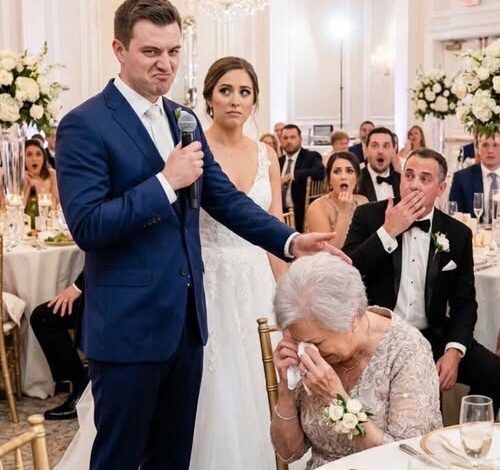
At the reception, Ethan took the microphone. I leaned forward, expecting a routine thank-you. Instead, he thanked his “real mother” and raised a glass to Carol. Applause erupted. Carol glowed, gracious and radiant, as if this recognition were her birthright. People looked at me with a mix of pity and confusion. I smiled—the practiced smile of someone who has survived humiliation quietly. Later, Carol approached me, thanking me for what I did “when Ethan was little,” assuring me they would take it from there. Ethan beamed, calling her “Mom Carol,” praising her love and support. Ashley gushed about a European honeymoon Carol had arranged. I sat there, unseen, as decades of sacrifice were rewritten as a footnote. When Ashley casually asked if I had more money to help them buy a house, dismissing my age, something inside me finally went still—not broken, simply finished.
That night, I returned to my quiet apartment, surrounded by photographs that suddenly felt like evidence from a life no one acknowledged. I did not sleep. The next morning, Ethan called from the airport, impatiently telling me they were leaving for their honeymoon. He did not ask how I was. He did not apologize. I made the most difficult decision of my life. I contacted my lawyer. Within days, I rewrote my will. Every asset, modest as it was, was reassigned. I canceled my life insurance naming Ethan and instead dedicated it to a local children’s shelter. I sold the apartment I had intended to leave him and placed the proceeds in a trust for adopted children aging out of foster care. I withdrew entirely from being his financial safety net. I sent a single, calm, factual letter explaining that, since I was no longer considered his real mother, I would no longer play that role. No anger, only clarity.
Months later, Ethan called. His voice was uncertain. Carol’s businesses had suffered losses. Ashley’s lifestyle had proven expensive. They needed help. I calmly told him I was unavailable, that my resources were committed elsewhere. Silence. He asked what I meant. I reminded him of his speech, of his words, of his choice. He cried—truly cried—and said he hadn’t meant it the way it sounded. I told him intentions do not erase consequences. I wished him well and ended the call. I did not raise my voice. I did not insult him. I simply stepped away.
That was the moment he regretted forever—not because I embarrassed him publicly, but because I finally chose myself. For the first time in my life, I slept peacefully, knowing that my love, though real, no longer had to be limitless to be valid.