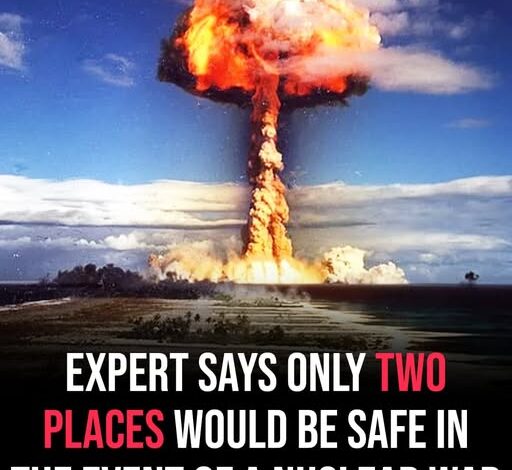
If the nightmare ever becomes real, survival in America won’t hinge on patriotism, politics, or bravado — it will hinge on geography, timing, and sheer luck. The missile fields of the Midwest, long touted as symbols of strategic strength and deterrence, would instead become instant death zones. Cities and towns across Kansas, Missouri, Nebraska, and the surrounding states could be obliterated in minutes, leaving behind searing heat, annihilated infrastructure, and radiation that lingers in soil, rivers, and the atmosphere for decades. In those first horrifying hours, the concept of “safe zones” would be little more than a cruel illusion; proximity to a target would mean the difference between survival and immediate oblivion.
Even the coasts, often imagined as refuges due to distance from primary military targets, would offer only temporary reprieve. The destruction of supply chains, power grids, and transportation networks would ripple across the country, making fuel, food, and medicine scarce. A city like Boston or San Francisco might avoid the initial blast, but the indirect consequences — societal collapse, contaminated imports, and mass displacement — would quickly turn urban landscapes into perilous environments. Survival would be dictated not by preparation or ideology but by the arbitrary luck of where one happened to be when the unthinkable happened.
The Fallout That Spreads Beyond Borders
Radiation does not respect state lines. Wind currents and atmospheric patterns would carry radioactive particles far beyond the initial blast zones. Fallout would descend on communities hundreds or even thousands of miles away, contaminating water supplies and arable land. In the weeks following, the Midwest and Northeast would see fields rendered barren, rivers carrying toxic runoff, and forests poisoned from canopy to soil. Chronic exposure to radiation would increase disease risk, reduce fertility, and destabilize ecosystems already struggling under climate change. The specter of invisible, pervasive contamination transforms familiar landscapes into arenas of slow, inexorable danger.
In the absence of modern logistics, communities would face collapse in seconds. Grocery stores would empty in hours, hospitals would be overwhelmed by the injured, and emergency services — if they even remained functional — would be paralyzed by scale. Social order, dependent on infrastructure and trust, would unravel, leaving survival in the hands of adaptability, local knowledge, and the willingness to do whatever is necessary to endure.
Looking Beyond: The Southern Hemisphere as the Last Bastion
For those able to think globally in the aftermath of nuclear escalation, survival increasingly becomes a planetary problem rather than a national one. Experts point to the Southern Hemisphere — particularly Australia, New Zealand, and parts of South America — as the least likely to experience direct devastation. These regions are distant from likely nuclear targets, and in a post-blast world, their position relative to global wind and ocean currents could mean enough sunlight and temperature stability to grow food and sustain human populations.
This calculation is not about comfort or returning to normalcy; it is about identifying the slivers of habitable land where life might continue, however fragile. A post-apocalyptic Southern Hemisphere would rely on local agriculture, water management, and the remnants of global knowledge networks. Survivors there would contend not just with a changed climate but with the psychological weight of knowing that millions — perhaps hundreds of millions — of people had perished elsewhere.
The Human Factor: Luck, Mobility, and Adaptation
Ultimately, the question of survival in such a scenario is mercilessly egalitarian. No political office, military rank, or historical heroism could shield anyone from the laws of physics and biology. Those fortunate enough to be outside direct target zones would still confront scarcity, disease, and social collapse. Mobility — having access to safe routes, vehicles, or seafaring options — could determine life or death. Communities that had practiced self-reliance, with knowledge of agriculture, water purification, and first aid, would have an advantage, but luck would always remain a wild card.
In such a reality, preparation is not heroic; it is pragmatic. The mental and physical agility to adapt, improvise, and endure becomes the primary currency of survival. The lessons of geography, ecology, and resilience override ideology and planning: where the wind blows, where the sun shines, where water flows — these factors dictate the contours of what remains of human life.
A Grim but Necessary Reckoning
The thought is uncomfortable but necessary. Nuclear conflict is not about abstract politics or historical grudges; it is about physics, biology, and environment. When modern civilization collapses, the metrics of survival are elemental: radiation levels, arable soil, water safety, and climate stability. For America, and indeed the world, the lesson is stark: technological and military power can protect against some threats, but not all. When the unthinkable arrives, only geography, foresight, and adaptability will count.
In the end, the Southern Hemisphere — distant, fertile, and relatively insulated — may represent the last fragile threads of continuity for humanity. It is not a story of victory, patriotism, or moral triumph; it is the cold arithmetic of survival, and a haunting reminder of how delicate the balance of civilization truly is.