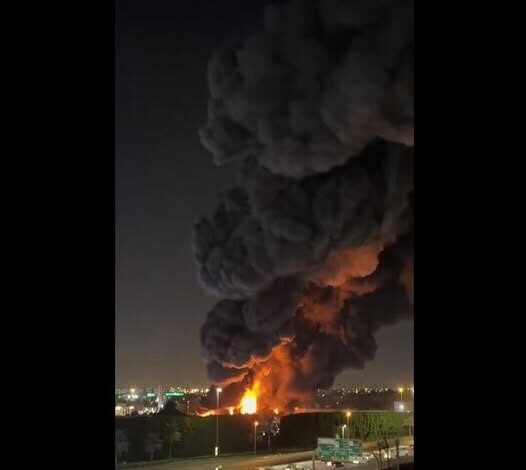
As evening descended over the Eastern Mediterranean on March 2, 2026, the skyline of Tel Aviv became the backdrop to a new and violent chapter in an already escalating regional crisis. Hours after reports surfaced of a joint U.S.–Israeli operation that allegedly eliminated Iran’s Supreme Leader, the long-anticipated retaliatory response materialized with alarming force.
Israeli authorities, operating under a nationwide emergency posture, confirmed that a large-scale barrage of ballistic missiles had entered Israeli airspace. Launched from Iranian territory — and possibly from proxy positions in Lebanon and Iraq — the attack penetrated defensive systems and resulted in multiple strikes across civilian-populated areas.
A Rapidly Unfolding Assault
At approximately 4:10 PM local time, red alert sirens echoed across Central Israel. Residents from Tel Aviv’s coastal neighborhoods to communities near the Judean Hills had scarcely more than 90 seconds to reach shelters.
Interceptor systems, including Iron Dome and David’s Sling, were activated immediately. Trails of defensive missiles lit the sky as they attempted to neutralize incoming threats. Yet the sheer scale of the attack overwhelmed the layered defense network, allowing several warheads to break through.
Beit Shemesh: The Deadliest Impact
The most severe strike occurred in Beit Shemesh, a growing city west of Jerusalem. Emergency teams from Magen David Adom and Home Front Command rushed to a residential zone where a heavy ballistic missile — believed to be from Iran’s Fattah-class arsenal — struck a religious complex.
The destruction was extensive.
Authorities confirmed nine fatalities and at least 28 injuries. Among the wounded, two individuals remain in critical condition, with others suffering moderate to minor trauma, largely from debris and shockwaves. Hospitals across the Jerusalem district initiated mass casualty protocols, mobilizing surgical teams and freeing operating rooms in anticipation of further arrivals.
A Shelter Turned Fatal
According to Jerusalem District Police Chief Avshalom Peled, the missile directly impacted a synagogue, triggering a catastrophic structural collapse. The upper levels of the building pancaked downward onto a reinforced public shelter beneath it.
In a tragic twist, the very space intended to protect lives became a deadly trap.
Many of the victims were reportedly inside the shelter when the structure above gave way. The immense weight of the collapsed concrete crushed the ceiling, complicating rescue efforts and requiring heavy engineering equipment and thermal imaging to locate survivors.
First responders — many of them local volunteers — now face not only physical recovery operations but profound emotional strain as they work within the ruins of what was once a sacred space.
A Wider Strategic Crisis
The attacks form part of a broader escalation that has intensified over the past month — beginning with strikes on Iranian nuclear infrastructure and culminating in the alleged targeting of Iran’s leadership.
Israeli officials describe the situation as “fluid,” signaling expectations of further attacks.
Security forces have deployed across major cities and sensitive areas to maintain stability. Civilian directives now include remaining close to shelters at all times, suspension of public activities, school closures, and strict limits on gatherings.
Coordination with strategic partners has intensified. U.S. military assets in the region are reportedly assisting with satellite intelligence to help predict launch origins and trajectory patterns.
Behind closed doors, speculation grows that a coordinated multinational response is under active consideration.
The Uncertain Road Ahead
As rescue teams continue their work in Beit Shemesh, the implications of this confrontation are becoming increasingly stark. What was once a shadow conflict has now entered the realm of direct state confrontation — with the potential to pull in additional regional and global actors.
Officials are urging the public to rely only on verified information amid a surge of conflicting reports online.
For now, priorities remain focused on saving lives and stabilizing affected areas.
But for residents across Israel’s urban centers, the future is measured not in days — but in the brief, tense moments between sirens.
The world watches closely, uncertain whether diplomacy can still intervene — or whether the region has crossed into a defining and dangerous new phase.