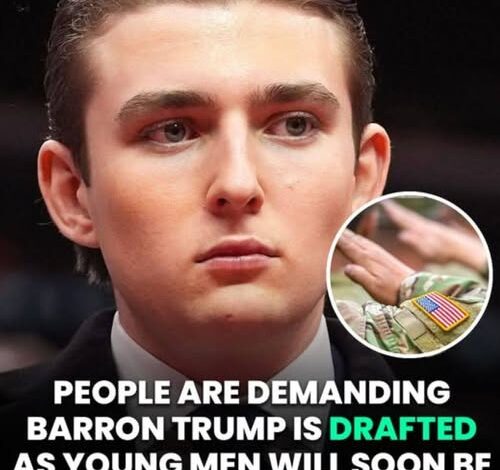
The federal government’s push to automatically register young men for potential conscription has stirred a debate that goes far beyond paperwork. For many Americans, tying registration to something as routine as a driver’s license application feels less like administrative efficiency and more like a quiet expansion of obligation—one that raises deeper questions about consent, responsibility, and who ultimately carries the burden when a nation goes to war.
The reaction isn’t just about policy mechanics; it’s about memory. Conscription, even as a distant possibility, still carries the weight of past conflicts where entire generations were called, sometimes unwillingly, into service. Folding that possibility into everyday systems has made it feel closer, more real, and for some, more unsettling.
Against that backdrop, discussions around individuals who might be exempt—whether for medical, physical, or other eligibility reasons—have taken on symbolic weight. Barron Trump’s name has surfaced in that conversation, not because of any confirmed decision about his status, but because he represents something larger in the public imagination: the idea of privilege intersecting with national duty. Claims about height restrictions or other technical disqualifiers have circulated online, though such details are often more nuanced than they appear and vary depending on role and evolving military standards.
Still, perception often moves faster than policy. The emergence of sites like “DraftBarronTrump.com,” blending satire with criticism, reflects a broader unease that isn’t really about one person. It’s about fairness. About whether systems designed to apply universally are experienced that way in practice. And about a long-standing suspicion that the costs of war—physical, emotional, generational—are not always distributed evenly.
It’s important to note that automatic registration does not signal an imminent draft. The Selective Service system has existed for decades without activation, and any move toward conscription would require significant political and legal steps. But even without immediate action, the conversation itself matters. It forces a kind of collective reflection—on civic duty, on trust in institutions, and on whether the expectations placed on citizens feel shared or selectively applied.
In the end, the intensity of the reaction reveals something deeper than disagreement over a policy change. It highlights a lingering question that surfaces whenever the possibility of conflict enters the public consciousness: if the country were to call on its people again, would that call truly reach everyone equally—or would some always stand further from it than others?