If the 22nd Amendment Disappeared and Donald Trump Faced Barack Obama in a Hypothetical 2028 Presidential Election, Here Is What Artificial Intelligence Predicts About Voter Behavior, Incumbency Fatigue, Polarization, Policy Messaging, Demographics, and Who Might Actually Win in This Purely Theoretical Political Showdown

Donald Trump has at times declined to categorically dismiss the idea of pursuing a third term in office, despite the clear language of the U.S. Constitution. The 22nd Amendment, ratified in 1951, states that no person may be elected president more than twice. Its wording is direct and leaves little ambiguity under current law.
Even so, political discourse often ventures into “what if” territory. What if the Constitution were amended? What if the two-term limit were removed? And in a purely theoretical scenario, what if Trump were eligible to run again in 2028—and faced off against former President Barack Obama, who is also constitutionally barred from seeking a third term?
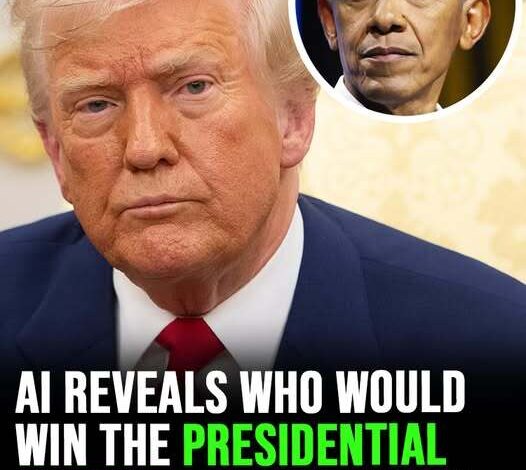
It’s the kind of hypothetical that energizes political commentary and online debate. Recently, a popular YouTube channel posed that exact scenario to an artificial intelligence model, asking: If the 22nd Amendment didn’t exist, who would win a 2028 election between Trump and Obama?
While entirely speculative, the AI’s response offers insight into how analysts might think about voter behavior, campaign framing, and demographic shifts in a modern presidential race.
The Constitutional Baseline
Before examining the scenario, it’s essential to reiterate the legal reality: under current constitutional law, neither Trump nor Obama can run for president again if they have already been elected twice. Changing that would require amending the Constitution—a process that demands approval by two-thirds of both the House and Senate and ratification by three-fourths of the states.
That threshold is extraordinarily high, especially in today’s polarized political environment. So any discussion of a Trump-Obama rematch is strictly hypothetical.
Still, political hypotheticals can illuminate underlying dynamics in the electorate.
Why an Obama vs. Trump Rematch Resonates
Whenever Trump hints at extended political ambitions, Obama’s name often surfaces as a symbolic counterpart. The two men represent sharply contrasting styles and philosophies of governance.
Obama is frequently associated with measured rhetoric, multilateral diplomacy, and technocratic policy framing. Trump, by contrast, is known for combative messaging, nationalist themes, and populist appeals that challenge political institutions.
In the AI-generated thought experiment, Obama was cast as the natural ideological foil to Trump—a figure who could frame a campaign around stability, continuity of democratic norms, and coalition-building across demographic groups.
Campaign Narratives in the Hypothetical
According to the AI model’s simulated analysis, a 2028 Obama campaign might focus on themes of institutional trust, global alliances, economic steadiness, and restoring political civility. Trump, meanwhile, would likely emphasize economic nationalism, border security, deregulation, and a confrontational approach toward political elites and international rivals.
The race, the AI suggested, would not hinge solely on policy differences but on contrasting governing philosophies. It would be framed as a referendum on tone, leadership style, and the direction of national identity.
In that scenario, both candidates would enter with unmatched name recognition and loyal voter bases, potentially driving historically high turnout.
Incumbency and Voter Fatigue
One factor the AI highlighted was the concept of voter fatigue. If Trump were hypothetically finishing a second term and seeking a third, traditional incumbent advantages—such as fundraising networks and institutional leverage—might be offset by public exhaustion with prolonged political tension.
American voters have historically shown mixed reactions to extended political eras. While stability can be reassuring, prolonged polarization or controversy can prompt segments of the electorate to seek a reset.
In that modeled environment, the AI suggested Obama might benefit from positioning himself as a stabilizing alternative, particularly if swing voters expressed fatigue with confrontational politics.
Demographic Evolution by 2028
Demographics also play a role in long-term projections. By 2028, younger voters—including a larger share of Generation Z—would represent a growing portion of the electorate. Recent voting trends suggest younger cohorts often prioritize different issues than older generations, including climate policy, social issues, and institutional trust.
At the same time, Trump has maintained strong loyalty among rural voters and many working-class constituencies. Any outcome would depend heavily on turnout intensity across these blocs.
The AI reportedly factored in demographic modeling and coalition-building patterns, concluding that Obama could potentially assemble a broader cross-sectional coalition in the imagined scenario.
Its projected outcome leaned toward an Obama victory—not necessarily a landslide, but not razor-thin either. However, such conclusions depend entirely on modeling assumptions.
The Limits of AI Forecasting
Artificial intelligence does not predict the future; it analyzes patterns and simulates outcomes based on data inputs. Change the assumptions—economic growth rates, international crises, health concerns, media narratives—and the projection changes.
Elections are shaped by unpredictable forces, including:
- Economic downturns or booms
- Foreign policy crises
- Major legislative battles
- Unexpected scandals
- Candidate health and performance
- Shifts in public mood
History shows that even well-established political dynamics can shift rapidly in response to unforeseen events.
The Broader Constitutional Debate
Beyond electoral strategy, the thought experiment raises a deeper constitutional question: should presidents ever be allowed to serve more than two elected terms?
Supporters of the 22nd Amendment argue that term limits protect democratic rotation of power and prevent excessive consolidation of authority. Critics occasionally contend that voters—not constitutional caps—should determine how long a leader remains in office.
The amendment was adopted after Franklin D. Roosevelt served four terms, reflecting a post-war consensus that prolonged executive tenure carried risks.
Reversing that decision would require overwhelming national agreement—an unlikely prospect in a deeply divided political climate.
Why These Hypotheticals Persist
Speculative matchups captivate audiences because they simplify broad ideological divides into familiar personalities. Trump and Obama remain two of the most recognizable political figures of the 21st century, and both continue to influence party identity long after leaving office.
A rematch—even imaginary—symbolizes competing visions of leadership style, institutional trust, and national direction.
The Bottom Line
Under current law, neither Donald Trump nor Barack Obama can run for president again if they have already served two elected terms. Any scenario imagining such a race would require constitutional change.
Still, the AI thought experiment highlights enduring questions about voter fatigue, coalition-building, generational shifts, and the power of political branding.
Whether or not such a contest could ever happen, the debate surrounding it reflects a broader reality: American politics remains deeply shaped by personality, polarization, and contrasting visions of governance.
And sometimes, even impossible matchups can reveal very real divisions.