Multiple crises are heightening international anxiety
Over the past several weeks, geopolitical tensions have intensified across several regions, prompting renewed concern among policymakers and analysts around the world.
Conflicts in the Middle East, the continuing war in Ukraine, and increasingly confrontational rhetoric from Russian officials have all contributed to a climate of uncertainty. Governments from Washington and London to Kyiv and Moscow are closely monitoring developments as global stability appears increasingly fragile.
Many international relations experts describe the current environment as one of the most volatile in recent decades. While some commentators warn that escalating crises could eventually lead to a larger confrontation, others emphasize that fears of global war are often amplified by political rhetoric and media speculation.
Nevertheless, recent events show how multiple geopolitical pressures are unfolding simultaneously.
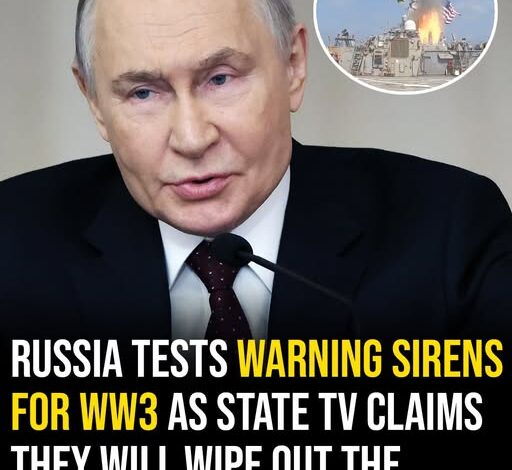
Russia Conducts Nationwide Emergency Siren Test
One development that captured international attention was a large-scale test of Russia’s public emergency alert system.
Earlier this week, authorities activated warning sirens across the country’s eleven time zones. The drill was organized by Russia’s Ministry of Emergency Situations and included interruptions to national television and radio broadcasts.
Residents in cities including Yekaterinburg saw messages advising them that the system was undergoing testing. One broadcast message read:
“ATTENTION EVERYONE! THE PUBLIC ALERT SYSTEM IS BEING TESTED! PLEASE REMAIN CALM!”
Officials stated that the exercise was part of routine civil defense preparations. According to the ministry, the alert network is designed to quickly notify citizens in the event of natural disasters, industrial accidents, or other emergencies.
Citizens were instructed that if the sirens sound during a real emergency, they should remain calm and immediately turn on television or radio for official instructions.
Many countries maintain similar warning systems, which are tested periodically to ensure they function during potential crises. However, the timing of Russia’s nationwide drill—amid heightened international tensions—has attracted significant attention abroad.
Medvedev Issues Warning About Potential Global Conflict
The siren test followed remarks by Dmitry Medvedev, a senior figure in Russia’s national security leadership.
Medvedev, who previously served as Russia’s president from 2008 to 2012 and currently serves as deputy chairman of the Security Council, warned in a recent interview that global conflict could occur if U.S. foreign policy remains unchanged.
Speaking with the Russian news agency TASS, Medvedev said that continued efforts by the United States to influence political systems abroad could potentially trigger a wider war.
“If [U.S. President Donald Trump] continues his course of changing political regimes,” Medvedev said, “it will undoubtedly begin. Any event could be the trigger.”
In the same remarks, he accused Western governments of pursuing global dominance and destabilizing international politics.
While Medvedev remains a prominent political figure, analysts note that statements from individual officials do not necessarily reflect immediate policy decisions by the Russian government.
Still, such remarks often attract attention because they contribute to the broader narrative of geopolitical rivalry.
The Middle East Conflict Adds to Global Strain
Russia’s internal drills and rhetoric come amid escalating tensions in the Middle East.
Recent military actions involving the United States, Israel, and Iran have heightened fears of a broader regional confrontation. Retaliatory strikes and escalating rhetoric from multiple sides have increased uncertainty across the region.
Although Russia maintains diplomatic and strategic relationships with Iran, it has not directly joined the current conflict.
Russian leaders have publicly criticized Western military actions while simultaneously calling for diplomatic solutions. President Vladimir Putin recently condemned attacks on Iranian leadership figures, describing them as unjustified and urging restraint.
At the same time, Moscow has avoided committing to direct military involvement.
State Media Intensifies Confrontational Messaging
While official government statements remain relatively measured, some Russian state-aligned media outlets have adopted more aggressive rhetoric.
Television commentator Vladimir Solovyov, known for strongly pro-Kremlin positions, recently sparked controversy by making remarks about the United Kingdom’s military capabilities.
During a broadcast, Solovyov mocked the size of the British armed forces and suggested that Russia could defeat them in a conventional conflict within a short period of time.
Statements like these are part of a broader pattern in which state-linked media outlets promote nationalist narratives during periods of geopolitical tension.
Although such commentary does not represent official military policy, it can influence public opinion and intensify international debate.
Ukraine Responds to Russian Statements
Ukrainian President Volodymyr Zelenskyy has also commented on Russia’s recent rhetoric.
In interviews with international media, Zelenskyy argued that Moscow’s public statements do not always translate into concrete action.
He suggested that Russia’s criticism of Western military operations, particularly those involving Iran, may not reflect genuine strategic commitments.
From Ukraine’s perspective, the ongoing war on its territory remains the central conflict shaping global security.
Ukrainian officials have warned that growing instability in other regions could divert international attention and resources away from their defense against Russia’s invasion.
Why Analysts Expect Russia to Avoid Direct Middle East Involvement
Despite heated rhetoric, most independent analysts believe Russia is unlikely to intervene militarily in the Israel–Iran confrontation.
Several factors help explain this assessment.
Ongoing War in Ukraine
Russia’s military remains heavily engaged in its long-running war with Ukraine. The conflict has placed significant pressure on both military resources and the national economy.
Avoiding NATO Confrontation
Direct involvement alongside Iran could lead to confrontation with the United States and NATO allies—an outcome Russia generally seeks to avoid.
Maintaining Relations With Israel
Despite political differences, Russia and Israel maintain practical coordination in certain regional matters, particularly in Syria.
Economic Considerations
Instability in the Middle East can drive up global oil prices, which can benefit Russia’s energy-based economy.
Taken together, these factors make direct Russian military involvement in the Middle East unlikely in the near future.
Calls for Restraint From Global Leaders
International organizations and governments around the world continue urging restraint as tensions remain high.
The United Nations and other diplomatic bodies have repeatedly called for dialogue and de-escalation in multiple conflict zones.
While discussions about a possible “World War III” frequently appear in public discourse, experts emphasize that such outcomes would require far more direct military confrontation between major powers.
For now, the situation reflects a complicated mix of regional conflicts, strategic rivalries, and political messaging.
Understanding the Current Global Climate
Russia’s emergency siren test and Medvedev’s warnings have drawn significant attention because they touch on long-standing fears about global instability.
However, experts stress the importance of interpreting such developments carefully.
Civil defense exercises are common preparedness measures in many countries. Political rhetoric does not necessarily signal immediate military action. And despite rising tensions, diplomatic efforts and economic connections between nations continue to serve as stabilizing forces.
The current moment highlights how interconnected crises can create the perception of looming global conflict—even as governments continue working to avoid it.
For now, the international community remains focused on managing multiple flashpoints while searching for paths toward diplomatic solutions.