My High School Bully Became My Daughter’s Science Teacher – At Her Project Night, She Humiliated My Child in Front of Everyone So I Finally Put Her In Place

For most of my adult life, I genuinely believed that high school drama had a built-in expiration date. I imagined it fading away somewhere between graduation ceremonies and the first real responsibilities of adulthood. The cruelty, the petty hierarchies, the whispered insults that echoed through crowded hallways—I thought all of that stayed behind under fluorescent lights and dented lockers where it belonged. Adulthood, I assumed, had a way of smoothing those rough edges, replacing them with professionalism, maturity, and a basic respect people learn once they leave teenage life behind.
But life doesn’t always follow the clean timelines we expect. Sometimes the past waits quietly, only to reappear years later wearing a new face of authority. Old wounds can return in strange ways, disguised as ordinary moments until suddenly they’re not ordinary at all. I learned that the hard way the day my daughter Lizzie casually mentioned her new science teacher.
At first, it sounded like the typical anxieties that come with adjusting to a new school year. Every student goes through that phase—figuring out new teachers, new expectations, new classroom dynamics. Lizzie had always been a confident kid, the kind who took pride in her schoolwork and didn’t scare easily. So when she mentioned feeling nervous about one particular class, I assumed it was just the normal pressure that comes with a challenging subject.
Then she used a word that made me pause.
“Personal.”
The way she said it—quietly, almost like she wasn’t sure she should say it at all—shifted the entire conversation.
She explained that her teacher, Ms. Lawrence, had been making little comments about her in class. Not outright insults, not anything dramatic enough to trigger an immediate complaint. Instead, they were small remarks about her clothes, her hairstyle, the way she answered questions. The kind of comments that are technically harmless on paper but land differently when they’re delivered with a certain tone. Each remark was subtle, but always made just loud enough for other students to hear.
And, as Lizzie told me, the class often laughed.
Anyone who has ever been on the receiving end of that kind of attention understands how quickly laughter can turn a moment into humiliation. When an adult sets the tone, even the most ordinary room can transform into a stage where one person becomes the punchline.
I asked Lizzie something important.
“Does she treat anyone else that way?”
She didn’t hesitate.
“No.”
That answer stayed with me longer than anything else she said.
Over the next couple of weeks, I began noticing changes that might have gone unnoticed by someone who didn’t know Lizzie as well as I did. Confidence doesn’t always disappear in obvious ways. Sometimes it erodes quietly. She hesitated before getting ready for school, suddenly worrying about what she wore. She studied longer but seemed less certain about her answers. Her usual enthusiasm for science—once her favorite subject—slowly faded into something closer to dread.
Parents develop an instinct for these things. You start recognizing shifts in mood the same way you recognize familiar footsteps in the house.
Eventually, I decided to do what most parents would do: request a meeting.
Principal Harris welcomed me into her office with professional warmth. She listened carefully as I explained what Lizzie had been experiencing. To her credit, she didn’t dismiss my concerns outright. She nodded, took notes, and assured me that she would “look into it.”
But she also mentioned something that gave me pause.
Ms. Lawrence, she said, had an excellent reputation. Strong reviews from both students and staff. No previous complaints. In fact, she was considered one of the more reliable teachers in the department.
For a moment, I wondered if maybe the situation had been misunderstood. Maybe the comments were meant jokingly. Maybe Lizzie had simply been more sensitive than usual.
For a short time after that meeting, things seemed to improve. Lizzie said the comments had stopped, and the classroom atmosphere felt more normal again. I allowed myself to believe that the conversation with the principal had resolved whatever misunderstanding had been happening.
But then something else started happening.
Lizzie’s grades began dropping.
Not dramatically, but enough to raise questions. The strange part was that her study habits hadn’t changed. If anything, she was working harder than before. When I asked her about it, she explained that Ms. Lawrence had started calling on her with questions about material the class hadn’t covered yet. When Lizzie struggled to answer, the teacher would shake her head or make a comment suggesting Lizzie hadn’t prepared enough.
That was the moment my concern shifted into something heavier.
This wasn’t about academic standards. It felt like something else entirely—something more personal.
The turning point came during the mid-year Climate Change presentation night, an event where parents were invited to watch students present their projects. Lizzie had worked on hers for weeks. She practiced in the living room, carefully explaining research and statistics with the kind of focus that made me proud every time I listened.
The school auditorium buzzed with quiet conversations as parents settled into folding chairs. When Ms. Lawrence stepped to the front of the room to begin the presentations, I glanced up casually.
And then my stomach dropped.
Recognition can be strange. Sometimes it arrives instantly, like a flash of memory snapping into focus. Other times it creeps in slowly, piece by piece, until the realization becomes unavoidable.
Ms. Lawrence wasn’t just a teacher I’d never met before.
She was someone I knew.
Or rather, someone I had known a long time ago.
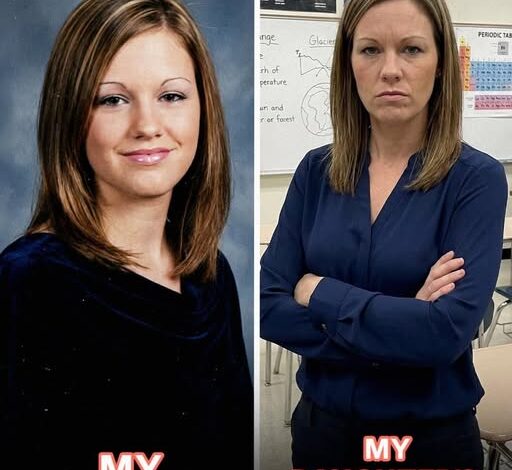
We had attended the same high school back in 2006. Not as friends. Not even as acquaintances. She had been part of a group that thrived on the social hierarchy that defined those years—the kind of hierarchy where confidence could be dismantled with a single sarcastic comment.
She had been one of the reasons I spent parts of my teenage years learning how to become invisible.
And now she was standing in front of my daughter’s classroom.
When Lizzie finished her presentation, she looked relieved. Her voice had been steady, her research thorough. I felt proud watching her return to her seat.
Then Ms. Lawrence began announcing grades in front of the room.
When she reached Lizzie’s project, she paused.
“Perhaps she takes after her mother,” she said, her tone light but unmistakably pointed.
The room chuckled politely, unsure of the meaning.
But I understood exactly what she meant.
In that moment, something strange happened inside me. For a split second, I felt seventeen again—the old reflex to stay quiet, to avoid attention, to pretend the comment hadn’t happened.
But that feeling lasted only a second.
I stood up.
When I spoke, my voice was calm, but it carried further than I expected.
I explained, briefly, that Ms. Lawrence and I had attended the same high school. I mentioned that her comment wasn’t a coincidence and that this wasn’t the first time she had singled out my daughter.
The room grew very quiet.
Then something unexpected happened.
Another parent spoke up.
Then another.
Students began murmuring, confirming similar experiences. What had seemed like isolated moments suddenly formed a pattern visible to everyone in the room.
Principal Harris, who had been standing near the doorway, stepped forward.
She addressed the room directly, announcing that Ms. Lawrence would be placed on immediate suspension pending a formal investigation.
The shift in atmosphere was immediate. The tension that had been quietly building dissolved into something else entirely—accountability.
For the first time that evening, Ms. Lawrence looked genuinely unsettled.
Later that night, after we returned home, Lizzie thanked me.
Her voice carried both relief and a kind of amazement, as if she hadn’t fully believed anyone would challenge the situation.
I told her something I wish someone had told me when I was younger.
Silence doesn’t always protect you. Sometimes it only protects the person causing harm.
After she went to bed, I sat alone for a while thinking about how strange the day had been. I had walked into that school expecting to defend my daughter. What I hadn’t expected was the quiet sense of closure that followed.
The shame I once carried from high school—the feeling of having been small or powerless—no longer felt like something I had to keep hidden.
It had been brought into the open and answered, finally, with something stronger.
Healing, I realized, doesn’t always arrive quietly.
Sometimes it stands up in a crowded room, looks the past directly in the eye, and calmly says, “That’s enough.”