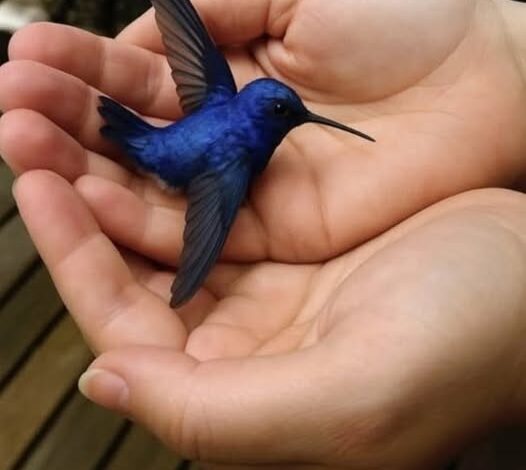
The appearance of a hummingbird is never quite ordinary. It doesn’t glide gently into view like other birds—it seems to arrive out of nowhere, a sudden spark of motion and color that interrupts whatever you were doing. One moment you’re lost in routine, thinking about work, errands, or worries, and the next, there it is—hovering, shimmering, almost unreal. Its tiny body moves with impossible speed, wings beating so fast they blur into invisibility, as if it exists just slightly outside the normal rules of the world. In that brief encounter, everything else fades. The noise of daily life quiets, and for a few seconds, you are fully present.
Across cultures and generations, people have attached deep meaning to this moment. The hummingbird is often seen as a symbol of renewal—a quiet sign that something is shifting, especially after a difficult period. Life has a way of becoming heavy at times, stretching into long phases where joy feels distant and everything seems muted. In those moments, the sudden presence of something so vivid and alive can feel like a reminder that beauty hasn’t disappeared—it’s simply been waiting. The hummingbird doesn’t announce change loudly; it suggests it gently, offering a glimpse of color where there was once only gray.
For those experiencing loss, that moment can feel even more profound. Grief has a way of reshaping how we see the world, making us more aware of small, unexpected signs. A hummingbird’s quiet visit can feel like a bridge between what was and what remains—a fleeting connection that carries a sense of comfort. Whether viewed as symbolic or simply coincidental, it offers something rare: a pause in the heaviness, a moment where love feels present again, even if only for an instant.
Yet, beyond symbolism or belief, the true power of the hummingbird lies in what it awakens within us. In a world driven by constant distraction, where attention is divided and moments pass unnoticed, the hummingbird demands something different. It pulls you into the present. You can’t scroll your phone or think about tomorrow while watching it—you’re simply there, witnessing something delicate and extraordinary. That sense of wonder is something many people forget they still have.
And with that wonder comes a kind of softness. Over time, it’s easy to become guarded—focused on responsibilities, hardened by disappointments, cautious about feeling too much. But the hummingbird cuts through that. It reminds us that even the smallest things can hold immense beauty, and that being open to those moments doesn’t weaken us—it reconnects us.
There’s also a quiet lesson in its existence. Despite its fragile size, the hummingbird lives with incredible intensity. It survives by constantly moving, constantly seeking, adapting to challenges that would overwhelm something larger. It is delicate, yet resilient. Watching it, even for a moment, offers a subtle kind of encouragement—a reminder that strength doesn’t always look the way we expect it to.
In the end, a hummingbird’s visit isn’t about providing answers. It’s about offering a moment—brief, unexpected, and meaningful. It invites you to notice, to pause, to feel something beyond the usual rhythm of the day. And when it disappears as quickly as it came, it leaves something behind: a shift in perspective, however small.
Because the real impact isn’t just the bird itself.
It’s the reminder that even in the most ordinary moments, something extraordinary can still find its way to you—if you’re willing to look up and see it.