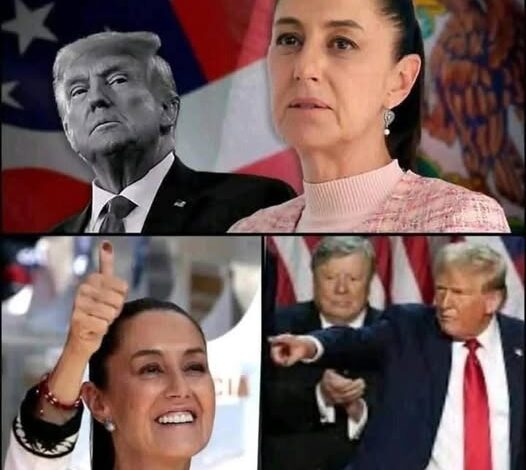
North American diplomacy appears to be entering a volatile new phase in early 2026, as relations between the United States and Mexico face significant strain. At the center of this tension is the Trump administration’s decision to designate eight major Mexican drug cartels—including the Jalisco New Generation Cartel (CJNG) and the Sinaloa Cartel—as foreign terrorist organizations. The move represents a major shift in U.S. policy and has sparked a serious dispute over sovereignty, security cooperation, and responsibility for the global fentanyl crisis.
Mexican President Claudia Sheinbaum has responded forcefully, defending her country’s autonomy and criticizing the U.S. decision as an intrusion into Mexico’s internal affairs. In public statements from the National Palace, she emphasized that Mexico remains open to cooperation with Washington but insists that such collaboration must be based on equality and mutual respect rather than unilateral action. According to the Mexican government, labeling cartels as terrorist organizations risks damaging the very security partnerships both nations rely on.
The significance of the designation lies in the legal powers it grants the United States. Classifying the cartels as terrorist entities allows U.S. authorities to freeze financial assets worldwide, prosecute individuals accused of supporting them, and potentially justify military action against cartel targets. The debate intensified further after Elon Musk—serving in his role leading the Department of Government Efficiency (DOGE)—suggested that cartel infrastructure and leadership could become targets for precision drone strikes.
While most analysts consider a large-scale military incursion into Mexico unlikely, Washington has already expanded technological surveillance operations. Reports suggest a sharp increase in the use of advanced reconnaissance and strike drones aimed at locating clandestine fentanyl laboratories within Mexican territory. These efforts form part of the administration’s broader “War on Fentanyl,” which frames the synthetic opioid epidemic as a national security threat.
Mexico has also begun preparing a legal response. President Sheinbaum’s administration has indicated it may pursue action against U.S. firearms manufacturers, arguing that American gun companies supply a large portion of the high-powered weapons used by criminal groups in Mexico. By highlighting the southbound flow of weapons from the United States, Mexico aims to broaden the conversation beyond drug trafficking and emphasize the shared responsibility underlying the violence.
This diplomatic tension is unfolding amid a wider series of global developments dominating headlines in March 2026. The release of a massive 3.5-million-page archive linked to Jeffrey Epstein has reignited debates over accountability among powerful elites, with numerous public figures facing renewed scrutiny. At the same time, the unexpected death of actor James Ransone at the age of 46 has drawn attention across the entertainment industry.
Political divisions within the United States have also surfaced in response to recent military actions involving Iran. Reports indicate that President Trump has distanced himself from longtime ally Tucker Carlson following the commentator’s criticism of the intervention. These developments suggest growing fractures within parts of the political movement that previously supported the administration’s foreign policy.
Meanwhile, economic and travel implications could soon follow the cartel designation. Increased application of enhanced screening protocols—such as the Secondary Security Screening Selection (SSSS) process—may affect travelers arriving from regions associated with cartel activity. For ordinary travelers, security procedures at airports may increasingly reflect broader counterterrorism policies tied to border security.
Taken together, the dispute between Washington and Mexico reflects the evolving nature of modern geopolitical conflict. Today’s security strategies combine technology, intelligence networks, legal measures, and economic pressure alongside traditional diplomacy. President Sheinbaum’s firm stance signals Mexico’s determination to defend its sovereignty, while the United States continues to frame cartel activity as a direct threat to its national security.
In the coming weeks and months, decisions made by leaders in both countries will likely shape the trajectory of this relationship. Whether through legal battles, expanded surveillance operations, economic pressure, or new diplomatic negotiations, the struggle over cartel violence and fentanyl trafficking is poised to remain a defining issue in North American security throughout 2026.