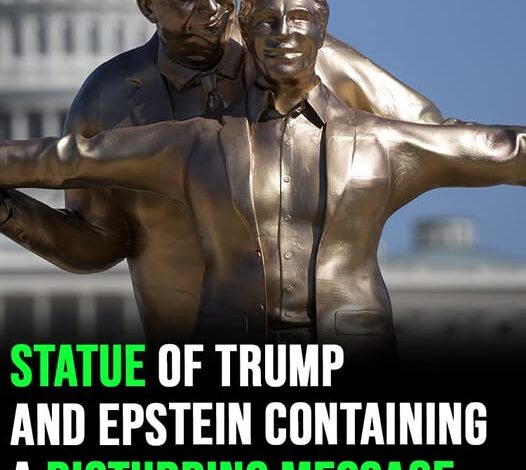
Under the cover of darkness, the arrival of the “KING OF THE WORLD” statue transformed the National Mall into more than just a public space—it became a stage for a fierce cultural and political debate. By morning, the installation had already sparked a flood of reactions. To some observers, the statue felt like a crude provocation or an act of disrespect aimed at stirring outrage. To others, it functioned as a deliberate piece of political art, meant to confront viewers with uncomfortable questions about power, influence, and the narratives society chooses to celebrate.
The sculpture’s pose—clearly echoing the famous Titanic moment where two lovers stand at the bow of the ship, arms stretched toward the horizon—once represented youthful freedom and romantic optimism. In this new context, however, that familiar image was deliberately repurposed. What once symbolized innocence now carried a far heavier undertone. The imagery, cast in bright gold, juxtaposed glamour and spectacle with darker associations surrounding allegations, hidden relationships, and the enduring perception that certain powerful figures remain insulated from accountability.
The anonymous collective Secret Handshake, which claims responsibility for the installation, says the piece is meant to provoke reflection rather than simply outrage. According to statements attributed to the group, the statue is intended as a commentary on collective memory—how societies decide who deserves admiration, who is allowed redemption, and whose controversies fade into the background of public life.
They argue that the artwork arrives at a moment when political symbolism is already everywhere. Donald Trump’s image and name remain prominent in the American political landscape, appearing in campaign rallies, media coverage, and even displays in government spaces. By placing a golden depiction of Trump alongside the late Jeffrey Epstein in such an exaggerated and theatrical pose, the artists say they are attempting to force a deeper conversation about the relationship between fame, wealth, and accountability.
For supporters of the piece, the statue functions like a mirror held up to society. It challenges viewers to confront the way public figures are mythologized, and how uncomfortable truths can sometimes be overlooked in favor of loyalty, nostalgia, or political identity. In their view, the work is less about any single individual and more about the broader systems that allow powerful people to shape their own legacy.
Critics, however, see the installation very differently. Some argue that the statue is inflammatory and disrespectful, designed more to provoke anger than meaningful discussion. Others question whether such provocative symbolism contributes anything productive to public discourse or simply deepens existing divisions.
Regardless of where people fall in that debate, the statue has already achieved one undeniable outcome: it has forced attention. Passersby on the Mall, tourists snapping photos, and millions of people encountering the image online are all drawn into the same uncomfortable question the artists intended to raise.
In the end, the controversy surrounding the “KING OF THE WORLD” statue circles back to a broader issue that extends far beyond a single installation. Public monuments have always been about more than stone and metal; they represent choices about what—and who—a society chooses to remember. The piece challenges viewers to consider whether admiration and criticism can coexist in the public memory of influential figures, and whether the stories told through monuments reflect truth, myth, or something in between.
By reframing a universally recognized cinematic pose into a symbol loaded with political and cultural implications, the installation pushes viewers to reconsider the power of imagery itself. It asks a difficult question that lingers long after the initial shock fades: who do we decide to immortalize, and what parts of their story are quietly left out when we do?