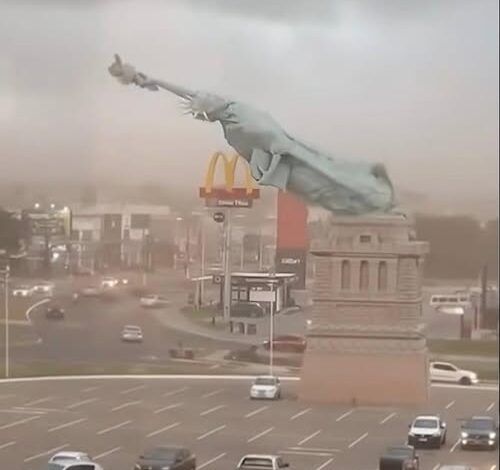
Late Tuesday night, the skyline of a local community changed dramatically after a powerful storm brought down one of its most recognizable landmarks. A towering 115-foot replica of the Statue of Liberty—long a symbol of regional pride and a familiar roadside sight—collapsed under the force of intense winds and heavy rain. The structure, which had stood for years as a welcoming icon for residents and travelers alike, ultimately gave way just before midnight as the storm reached its peak. While emergency crews quickly moved in to manage the debris and secure the area, the emotional impact of the landmark’s sudden loss has been deeply felt across the community.
The storm system developed earlier in the evening as atmospheric conditions shifted rapidly. Meteorologists reported a sharp drop in barometric pressure when a cold front collided with warm, moisture-laden air. What began as light rainfall soon intensified into a severe downpour. By around 10:00 p.m., strong straight-line winds were sweeping across the area, placing increasing stress on the statue’s massive frame. Wind gusts reached levels comparable to those seen during strong tropical storms, creating sustained pressure against the structure. For hours the statue remained standing, illuminated intermittently by flashes of lightning, but the relentless battering eventually proved too much.
Residents living nearby described the moment of collapse as both shocking and disorienting. Many recalled hearing a loud sequence of metallic grinding followed by a thunderous crash as the towering structure fell from its base. One neighbor said the impact felt similar to an earthquake, with vibrations shaking homes and causing objects to fall from shelves. As the statue hit the ground, it pulled down nearby power lines, producing bright electrical arcs across the rain-soaked debris. Within minutes, the surrounding neighborhood lost power, leaving the scene lit only by lightning and the flashing lights of arriving emergency vehicles.
First responders worked overnight in difficult weather conditions to secure the area. Their immediate priority was preventing additional hazards, including fires sparked by damaged power lines or further structural failures within the wreckage. Authorities closed off several surrounding streets and established a safety perimeter extending roughly three blocks. Despite the scale of the collapse and the dangerous conditions, officials confirmed that no injuries were reported. By sunrise, the full extent of the damage was visible: the once-towering statue lay broken into sections, its crown, torch, and framework scattered among fallen trees and shattered signage.
Attention has now turned to determining exactly why the structure failed. Structural engineers have been assigned to examine the site and conduct a detailed investigation. Their goal is to determine whether the storm alone caused the collapse or whether underlying issues—such as corrosion, weakened supports, or foundation deterioration—may have contributed. Although the replica was designed to resemble the original Statue of Liberty, it relied on a different internal support system and construction materials. Investigators are closely studying the points where the structure fractured to identify any signs of metal fatigue or prior damage.
The storm that brought down the statue also caused widespread disruption throughout the region. Thousands of residents experienced power outages as strong winds knocked down trees and utility lines. City officials reported significant property damage across several neighborhoods, including damaged roofs and broken storefront windows. Cleanup crews have been working around the clock to clear roadways and restore essential services. While the fallen statue has become the most visible symbol of the storm’s power, it represents only part of the broader damage left behind.
City leaders are now debating what should happen to the site where the statue once stood. For many residents, the replica was more than just a roadside attraction; it was a defining landmark and a source of local identity. Travelers often used the statue as a reference point when approaching the city, and longtime residents associated it with the feeling of returning home. The question facing officials is whether rebuilding the monument is practical. Given the extent of the destruction, reconstruction would likely require a major financial commitment as well as a redesigned support structure capable of meeting modern wind-resistance standards. Others have proposed transforming the area into a memorial park dedicated to the community’s resilience.
In the aftermath of the storm, the absence of the statue has created a noticeable void in the local landscape. Many residents say it feels strange to look toward the horizon and no longer see the familiar torch rising above the trees. Yet amid the destruction, a strong sense of community spirit has emerged. Neighbors have been helping each other clear debris, restore damaged property, and support those who were affected by the storm. While the physical monument has fallen, the ideals it represented—strength, perseverance, and unity—continue to resonate among those who live there.
Cleanup operations are expected to continue for several weeks as crews remove debris and transport the statue’s remains to a secure location for storage and evaluation. Salvage teams are carefully cataloging each section of the structure while officials deliberate over its future. For now, the site remains closed off, with residents occasionally gathering nearby to reflect on the landmark that once dominated the skyline.
The storm of March 2026 will likely be remembered not only for its destructive power but also for the way it reshaped a beloved part of the city’s identity. Whether the statue is eventually rebuilt, redesigned, or replaced with something entirely new remains uncertain. What is clear, however, is that the monument left a lasting impression on the community. Even though the skyline may appear emptier today, the spirit of the people who lived in its shadow remains strong—much like the torch that once stood high above the landscape.