The 98th Academy Awards was designed to be an evening dedicated to the celebration of cinema—an elegant gathering meant to honor the creativity, craftsmanship, and storytelling that shape the global film industry. Yet as the audience filled the seats inside the Dolby Theatre, it quickly became clear that the ceremony would once again reflect the broader cultural conversations happening far beyond Hollywood. In recent years, award shows have increasingly become places where entertainment, politics, and satire intersect, and this year proved no different.
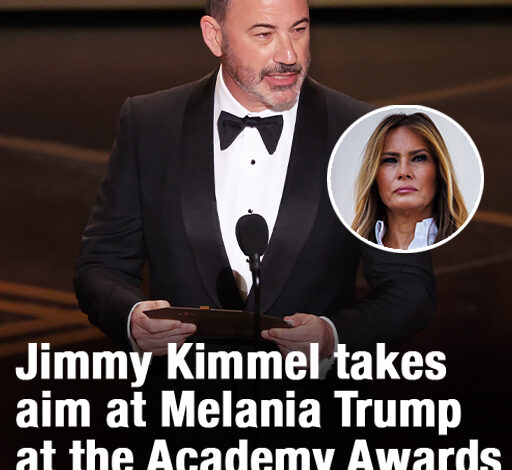
At the center of one of the night’s most talked-about moments was host Jimmy Kimmel, who returned to the Oscars stage with the confident rhythm of a veteran master of ceremonies. Known for blending lighthearted humor with pointed commentary, Kimmel paused between awards to deliver a monologue that immediately rippled through the audience and across social media. This time, his remarks turned toward Melania Trump and a recently released documentary centered on her life and public role.
The documentary had been promoted as a rare and personal look at the former First Lady as she navigated public life and the possibility of returning to the White House alongside her husband, Donald Trump. Marketed as an intimate portrait, the film promised viewers access to moments behind the scenes of one of the most closely watched political families in modern American history. But when Kimmel addressed the project during his monologue, he framed it in far less flattering terms.
With his characteristic timing, Kimmel joked about the film’s content, suggesting it felt less like a revealing documentary and more like a series of stylized moments—reducing the premise to an image of Melania walking through the White House trying on shoes. The line drew laughter throughout the theater, a reaction fueled not only by the joke itself but also by the broader cultural conversation that had surrounded the project since its release. Kimmel then added another layer to the joke by implying that Donald Trump might be frustrated that the film had not received any Oscar recognition, turning the moment into a playful critique of celebrity-style political storytelling.
The humor resonated partly because of the controversy that had surrounded the documentary in the months before the ceremony. Reports circulated within the entertainment industry suggesting that the project had been acquired for a price close to $40 million—an enormous sum for a documentary film. That figure alone sparked debate among producers, critics, and audiences about whether the film represented a meaningful piece of storytelling or a carefully packaged public-relations effort.
When the documentary finally became widely available, the critical response was sharply divided. Many professional reviewers argued that the film offered limited journalistic depth, describing it as a polished but tightly controlled portrayal that avoided difficult questions. Critics suggested it resembled a piece of personal branding rather than a traditional documentary investigation. Audience reactions were similarly mixed, with some viewers intrigued by the rare access to a former First Lady’s life and others disappointed by what they saw as a lack of substance.
Against that backdrop, Kimmel’s brief joke on the Oscars stage acted as a kind of cultural shorthand. In a single line, he condensed months of criticism and debate into a punchline that reflected Hollywood’s broader skepticism about the project. For many in the entertainment world, documentaries are expected to reveal something new or challenging about their subjects—peeling back layers rather than reinforcing carefully managed images.
The moment also highlighted the complicated relationship between Hollywood and political power. Award ceremonies like the Academy Awards have long been platforms where entertainers express opinions about social and political issues. While some viewers welcome those moments as expressions of artistic freedom, others see them as examples of the entertainment industry stepping beyond its traditional role.
Reactions to Kimmel’s joke reflected those divisions. Critics of the Trump family interpreted the remark as a humorous but pointed commentary on a project they believed prioritized image management over meaningful storytelling. Supporters of Donald Trump and Melania Trump, however, viewed the joke as another example of Hollywood’s long-standing political bias, arguing that award shows frequently use humor to target conservative public figures.
Beyond the political reactions, the moment also illustrated how quickly narratives can shift in the modern media landscape. In an era dominated by social media and instant commentary, a single joke delivered on a global broadcast can redefine how a cultural product is remembered. The documentary, which had been carefully marketed and distributed, suddenly found itself reduced to a brief comedic reference shared across digital platforms within minutes.
Yet the Oscars themselves continued on, moving into the evening’s major awards—celebrating performances, directing achievements, and groundbreaking technical work in filmmaking. Still, Kimmel’s remarks lingered in conversations both inside the theater and online, becoming one of the night’s defining talking points.
Ultimately, the episode demonstrated the unique power of satire in contemporary culture. Comedy has long served as a way to challenge public narratives, especially when those narratives involve powerful figures or carefully constructed public images. By addressing the documentary during one of the film industry’s most prestigious events, Jimmy Kimmel turned what might have remained a niche controversy into a widely discussed cultural moment.
In the end, the night will likely be remembered not only for its awards and emotional speeches but also for how it captured the complicated intersection of politics, celebrity, and storytelling. The 98th Academy Awards once again showed that Hollywood’s biggest stage is not just about honoring films—it is also a place where cultural narratives are debated, challenged, and occasionally punctured by the sharp edge of a well-timed joke.