My Elderly Neighbor Died, After His Funeral, I Received a Letter From Him Revealing He Had Buried a Secret in His Backyard 40 Years Ago!

The illusion of an orderly life often masks the tangled threads of the past, carefully hidden beneath a polished surface. For nearly forty years, I believed I was living a life of straight lines, a philosophy instilled by my mother, Nancy—a woman whose perfection was measured in spotless porches and crisp linens. By thirty-eight, I embodied the ideal of suburban stability: a devoted wife and mother whose greatest concern was usually the arrangement of the spring flowerbeds. I believed secrets could be buried so deeply they became invisible, harmless as the dust that settled on untouched shelves.
Then Mr. Whitmore, my quiet neighbor, passed away, and everything I thought I knew began to shift.
Mr. Whitmore had always been a fixture of my life: the shadow behind lace curtains, a nod across the fence, a presence so constant it felt familiar. His funeral was modest, unassuming, yet it was the next morning that revealed the true weight of his departure. Inside my mailbox lay a thick, cream-colored envelope, my name written in looping blue ink that seemed to carry a voice from beyond.
I brought the letter to my husband, Richie, on the porch, coffee steaming in our hands. His frown deepened as I told him it was from Mr. Whitmore. We opened it together. The note was brief, cryptic:
“If you’re reading this, I’m no longer here. This is something I’ve been hiding for forty years. In my yard, under the old apple tree, a secret is buried, one I’ve been protecting you from. You have the right to know the truth, Tanya. Don’t tell anyone about this.”
The envelope felt like a weight in my pocket, heavy with unspoken history. All around me, life carried on—my daughters bickering, dinner cooking—but my attention kept returning to the Whitmore apple tree, gnarled and watchful, as if guarding its hidden past. The next morning, compelled by a force I didn’t understand, I went alone.
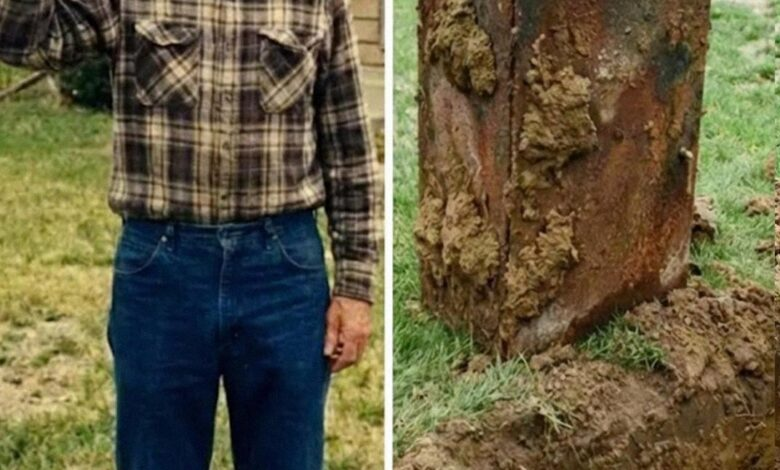
The yard was overgrown, the soil soft beneath the apple tree. Minutes later, a metallic clink broke the quiet. Kneeling in the dirt, I uncovered a rusted metal box, decades old. Inside were fragments of another life.
First came a photograph: a man in his thirties, holding a newborn under the harsh glare of hospital lights. Next to it, a tiny hospital bracelet. I didn’t need to read the name—the baby was unmistakably me. Tucked beneath the photograph was a letter:
“My darling Tanya, I did not abandon you. I was removed.”
The letter told a story systematically erased from my childhood. Mr. Whitmore, my quiet neighbor, was my father. My mother had been pressured by her family to sever contact, but he had remained close, silently watching me grow, attending milestones from across the fence, keeping his distance for forty years. “You deserve more than secrets,” he wrote. “You are my daughter.”
I collapsed into the dirt, the photograph clutched to my chest. The carefully ordered life I had known fractured instantly. When Richie found me an hour later, streaked with mud and tears, he read the letter in stunned silence. The neighbor who had once helped with bicycles and Halloween candy had been the father I never knew.
Confronting my mother was inevitable. She arrived, her usual composure intact, but when she saw the photograph, the color drained from her face. She explained that she believed she was protecting me, pressured by her family’s threats, and that my life would be simpler without a complicated father.
“You didn’t protect me,” I said, voice steady. “You protected yourself.”
The week that followed was a tense negotiation of truth and resentment. Family members defended my mother’s choices, but I refused to let the script dictate my reaction. I claimed my right to feel the anger and grief of a stolen relationship. My mother, for once, did not deflect. She simply nodded, whispering, “I’m sorry.”
On Sunday, I visited Mr. Whitmore’s grave, placing blossoms from the apple tree atop it. My grief was layered: the loss of a man I had known, and the father I had only just discovered. I wished he had spoken sooner, yet I also thanked him for loving me from the shadows, steadfast and quiet.
Trust may never be fully restored with my mother, but the secret is no longer buried. The straight lines of my life have been replaced by the messy, painful, and beautiful curves of truth. For the first time, the reflection in the mirror is not a managed image—it is me.