After Giving Birth to Her First Child, a Woman Faced the Ultimate Betrayal When Her Husband Demanded Proof of Paternity, But What Began as a Painful Test of Trust Quickly Unraveled Into a Much Deeper Secret That Exposed Lies, Shifted Power, and Forced Her to Rebuild Her Life From the Ground Up

The day her daughter entered the world should have been filled with relief, joy, and a sense of new beginnings. After nearly twenty hours of labor, she finally held her baby in her arms, overwhelmed by the quiet, powerful love that comes with meeting your child for the first time. The hospital room felt still, almost sacred. Naturally, she turned to her husband, expecting to share that moment—to see happiness reflected back at her.
But instead of warmth, she saw hesitation. His expression wasn’t soft or proud. It was tense, distant—wrong for the moment they were in.
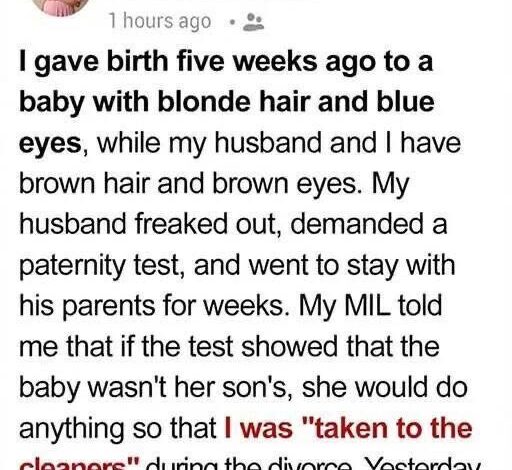
At first, she told herself it was exhaustion or nerves. Becoming a parent is a lot to take in. But as he continued staring at the baby, something in his demeanor shifted further. When he finally spoke, it wasn’t with wonder or reassurance. He questioned whether the child was his. Not casually, not uncertainly—but with a seriousness that cut through everything she had just experienced.
In that instant, something broke.
Still recovering, emotionally and physically drained, she didn’t argue. When he asked for a paternity test, she agreed—not because she doubted herself, but because refusing would only make things worse. Even so, the damage was done. Trust had been shaken in a way that couldn’t simply be repaired with time.
Once they returned home, the distance between them only deepened. He left soon after, saying he needed space while they waited for the results. The silence he left behind was heavier than any confrontation. Alone with her newborn, she moved through each day in a blur—feeding, resting, adjusting to motherhood—all while trying to process how everything had unraveled so quickly.
Her sister stepped in during that time, becoming her support system. She helped with the baby, the house, and, most importantly, the emotional weight that had suddenly fallen on her shoulders. In those quiet moments, one truth became harder and harder to ignore: this wasn’t just about a test. It was about a complete collapse of trust.
Then came a call from her mother-in-law that made things even clearer. There was no empathy in her tone, no concern for what she had just gone through. Instead, there were accusations and thinly veiled threats about what would happen if the child wasn’t her son’s. Sitting there, holding her baby, she realized something had fundamentally changed. The family she thought she belonged to no longer felt like one.
When the test results finally arrived, they brought the answer she had always known. Her husband returned with them in hand. The baby was his.
But instead of relief or remorse, his reaction was guarded—almost defensive. There was no real apology, no sense of accountability. If anything, his behavior felt even more unsettled, as though the truth hadn’t resolved anything for him.
That’s when her doubts shifted.
Over the next few days, his actions didn’t line up with someone who had just been proven wrong. There was tension, secrecy, and something else she couldn’t quite name—until she decided to look for herself. What she found on his phone answered everything. Messages, conversations, plans—clear evidence of an ongoing relationship with someone else.
Suddenly, his accusation made sense.
It hadn’t come from suspicion. It had come from guilt.
He had projected his own betrayal onto her, creating doubt where there had been none. And he had done it at the exact moment she needed him most.
That realization was painful—but also clarifying.
She didn’t confront him with anger or chaos. Instead, she acted. Quietly and deliberately, she began preparing to leave. With her sister’s help, she gathered what she needed, sought legal advice, and made a plan. Her focus was no longer on saving the relationship—it was on protecting herself and her daughter.
The separation that followed wasn’t easy, but it was necessary. When faced with the evidence, his denials eventually gave way to reality. The marriage ended, but in its place, she built something stronger: stability, independence, and a future free from doubt.
Looking back, what started as a painful question became a turning point. It forced the truth into the open and gave her the clarity she needed to move forward.
In the end, the test didn’t just confirm paternity. It revealed character.
And in seeing that clearly, she found the strength to choose a different path—one defined not by betrayal, but by resilience, honesty, and the life she would now build for herself and her child.