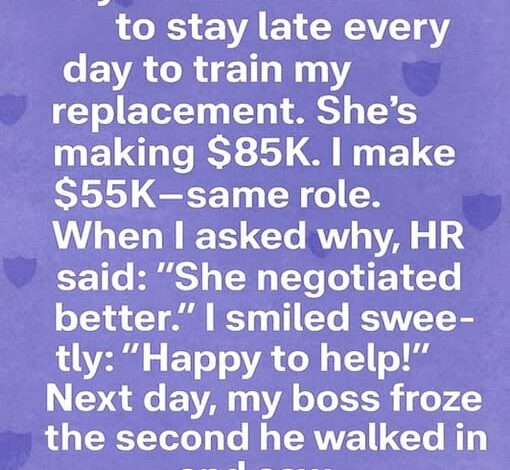
He believed I would continue carrying the unseen weight indefinitely—quietly dependable, endlessly accommodating, and satisfied with far less than I deserved. And for a while, that belief held. I showed up, solved problems before they escalated, and filled gaps no one officially acknowledged. I absorbed responsibilities that were never written into my role, treating them as part of some unspoken standard I was expected to meet.
From the outside, everything appeared to run smoothly. Deadlines were met, issues were resolved, and the team functioned without disruption. But that stability wasn’t accidental—it was built on hours of invisible effort that no one tracked and few recognized.
The turning point came during a conversation with HR. When my compensation came up, they dismissed the discrepancy with a casual remark: it was simply a matter of “negotiation.” That one word reframed everything. It made it clear that my situation wasn’t an oversight waiting to be corrected—it was a condition the system was perfectly comfortable maintaining.
In that moment, the narrative I had been telling myself collapsed. I hadn’t been patiently building goodwill that would eventually translate into recognition. I had been making it easy for the organization to extract more value than it returned. My willingness to go above and beyond hadn’t been rewarded—it had been normalized.
Once I saw it that way, I couldn’t unsee it. The late nights, the extra initiatives, the constant stepping in where others didn’t—none of it had been treated as exceptional. It had simply become expected. And expectations, once set, rarely come with additional compensation.
So I made a decision. Not out of anger, but out of clarity.
When it came time to transition out, I limited my efforts to what was formally defined in my role. I documented the core responsibilities I was paid for and ensured those were properly handed off. But the long list of unofficial duties—the ones I had quietly taken ownership of over time—were no longer mine to carry.
What happened next wasn’t dramatic, but it was revealing.
Without someone smoothing over every inefficiency and preemptively solving every issue, the cracks began to show. Tasks that had once been handled seamlessly started piling up. Processes that seemed efficient revealed their fragility. What had looked like a well-oiled system was, in reality, heavily dependent on unseen labor.
My replacement stepped into the role with the expectations that had been presented to her—expectations that didn’t fully reflect the scope of what I had been doing. Watching her encounter those gaps was difficult, not because I felt responsible, but because I understood exactly how that situation had been created. She hadn’t been misled intentionally; she had simply inherited a role shaped by someone else’s overextension.
Leaving wasn’t about making a statement or creating disruption. It was about drawing a line. For the first time, I separated what I was willing to give from what was being assumed of me.
The aftermath—the confusion, the backlog, the sudden realization of how much had been quietly managed—wasn’t the result of sabotage. It was the natural consequence of a system that had relied too heavily on unacknowledged effort.
In my next role, I approached things differently. I didn’t just negotiate a higher salary—I negotiated from a place of awareness. I understood the full scope of what I bring to the table, including the things that often go unseen. And more importantly, I made sure those contributions were recognized, defined, and compensated from the start.
Because the lesson wasn’t just about pay—it was about visibility, boundaries, and refusing to let value go unclaimed simply because it’s delivered quietly.