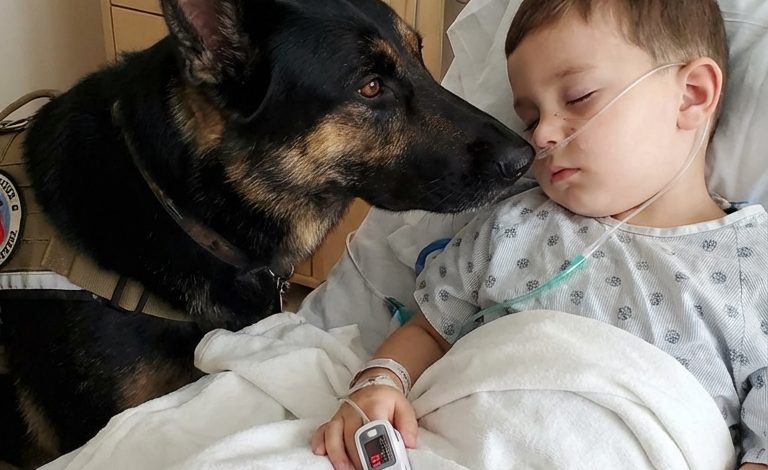
The b0y was being kept alive solely by machines, and the doctors had already given up hope but the moment his dog entered the room, everything changed.

The mother had stopped sleeping.
Hours blurred into days, and days into nights, yet she never left her son’s side. Her fingers remained wrapped around his small, fragile hand, as if letting go—even for a moment—might mean losing him forever. The steady rhythm of hospital machines filled the room, but to her, it sounded hollow, empty of promise.
The father stood nearby, silent and unmoving. He spoke only when necessary, his voice low, almost hesitant. It was as if saying too much might make the situation real—might give form to the fear he was desperately trying to contain.
Even the doctors, trained to remain composed in the face of the worst, had begun to change. Their reassurances grew quieter. Their eye contact shorter. Hope, once cautiously present, now seemed to slip through their fingers.
It felt like the room itself had given up.
But not everyone had.
Outside the hospital doors waited Rico—a loyal German Shepherd who didn’t understand diagnoses or probabilities, only absence. Every day, he sat by the entrance, watching, waiting. People passed by him constantly, but he barely noticed. His focus never shifted.
He was waiting for his boy.
When the parents came and went, Rico would rise, tail flicking with fragile hope, only to sit back down again when he realized the child wasn’t with them. Sometimes he let out a quiet whimper, soft and aching, as though calling out in a language only the boy could truly understand.
Hospital rules were strict. No animals in intensive care.
But one afternoon, something changed.
A nurse noticed Rico lying against the cold floor, his body still, his head resting on his paws. His eyes were closed, not in sleep, but in exhaustion—like someone who had waited too long and hoped too hard.
She hesitated before turning to the doctor.
“He’s suffering too,” she said gently. “At least let them see each other… even if it’s just once.”
After a long pause, the doctor gave a quiet nod.
That single decision would change everything.
When Rico was finally brought into the room, the atmosphere shifted instantly.
The mother looked up in shock, her breath catching as she saw him. She hadn’t dared to imagine this moment would be allowed.
Rico didn’t rush.
He walked slowly, carefully, as if he understood the weight of where he was. Step by step, he approached the bed. Then, rising onto his hind legs, he placed his front paws gently on the edge.
He leaned in close.
He didn’t bark. He didn’t whine.
He simply looked.
For a long moment, it was as if time itself had paused—just the boy and his dog, reunited in silence.
Then Rico moved.
He softly licked the boy’s head, a tender, instinctive gesture. He pressed himself closer, resting his paws lightly against the child’s chest, as though trying to feel his heartbeat… or perhaps share his own.
It felt like a goodbye.
And then—something no one expected happened.
The steady, almost lifeless rhythm of the monitor suddenly changed.
A sharper beep cut through the room.
The mother gasped, her heart lurching as fear surged through her. But the doctor didn’t move right away.
He was staring at the screen.
The heart rate… it had increased.
Just a little—but enough.
Rico leaned closer still, nudging the boy’s cheek with his nose, warm and persistent.
And then—
A movement.
So slight it could have been missed.
The boy’s fingers twitched.
The mother covered her mouth, her entire body trembling as hope—something she had almost buried—came rushing back all at once. The doctor stepped forward quickly, checking the machines, calling for assistance.
One by one, the readings began to shift.
Not dramatically. Not all at once.
But steadily.
As if something deep within the boy had been awakened… called back.
In the days that followed, the doctors searched for answers. They reviewed charts, analyzed data, and debated possibilities. But every timeline pointed to the same moment.
The exact second Rico entered the room.
From that day on, exceptions were made.
Rico was allowed to visit.
And each time he did, the boy responded—first with small movements, then with stronger signs of awareness. Progress that had once seemed impossible began to unfold, step by fragile step.
Until one morning, everything changed.
The boy opened his eyes.
The world returned to him slowly—light, shapes, sound.
And then something familiar.
Warm. Close.
Waiting.
Rico’s nose rested gently beside him, the dog watching as he had every day, every hour—faithful, patient, unwavering.
The first thing the boy saw… was his best friend.
The doctors called it a miracle.
The parents called it something else.
A rescue.