I Came Home with a Prosthetic Leg to Find My Wife Had Left Me with Our Newborn Twins – But Karma Gave Me a Chance to Meet Her Again Three Years Later

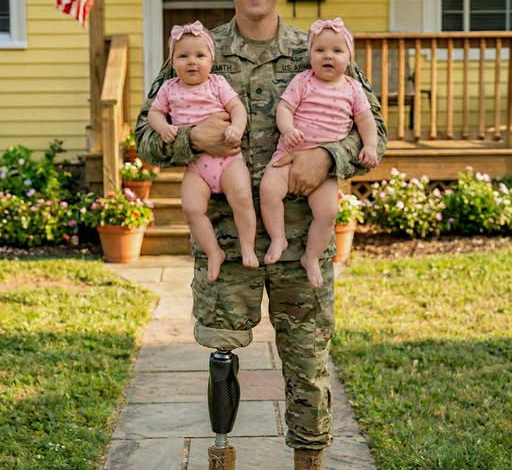
I came home carrying more than just luggage—I carried a secret I had chosen to keep to protect the people I loved. A prosthetic leg I hadn’t told my wife about. In my other hand, small gifts for our newborn daughters. I had imagined that moment over and over: the door opening, her face lighting up, finally holding my girls.
Instead, I walked into silence.
The house felt wrong before I even stepped inside. No lights, no voices, no signs of life. Just emptiness where our home used to be. Then I heard the crying upstairs.
That sound carried me forward.
In the nursery, my mother stood with one baby in her arms and the other in the crib. Her eyes met mine, then dropped to my leg, and she broke. I didn’t need her words to know something had gone terribly wrong—but I needed to hear it anyway.
There was a note.
Just a few lines. Cold. Final.
She had left. Not just me—but our daughters. And she hadn’t gone alone. The one person I trusted with my truth had handed it to her, and together they chose a different life.
I didn’t shout. I didn’t chase. I sat on the floor, holding my daughters as they cried, and let the reality settle in. Some pain doesn’t explode—it anchors itself quietly, reshaping everything in an instant.
That night, I made them a promise: I wasn’t going anywhere.
The years that followed weren’t easy, but they were clear. Every day had purpose. Every step forward mattered. I learned how to move again—physically, emotionally, mentally. I adapted. And in that process, I started building something.
What began as a need—to make my prosthetic work better—became an idea. Then a design. Then something real.
I didn’t chase recognition. I didn’t tell my story to the world. I focused on my daughters, my work, and the life we were building together. Quiet progress. Consistent effort. That was enough.
Over time, things changed. Stability replaced uncertainty. The life we had lost was no longer something to mourn—it was something we had outgrown.
Three years later, life brought me back to a place I never expected.
A property my company acquired.
An address I recognized.
Their address.
I didn’t rush. I didn’t react. I just showed up.
They weren’t who they used to be. Whatever they had built together had already begun to fall apart. The confidence was gone. The certainty, replaced with tension and blame.
When she opened the door and saw me, everything she had chosen came face to face with everything she had left behind.
I didn’t come for revenge. I didn’t need it.
I simply told them the truth: the house was no longer theirs.
Not because I had planned it. Not because I had chased it.
But because I had moved forward—and life had moved them in a different direction.
She asked about the girls.
I answered honestly: they had learned to live without her.
Walking away from that moment didn’t feel like victory. It felt like closure.
Because the real story wasn’t what happened to me—it was what I chose to build afterward.
A home filled with laughter instead of absence.
A life defined by presence instead of betrayal.
A future shaped by effort, not resentment.
The house I took back didn’t stay empty. It became something meaningful—a place for others who had lost parts of themselves to rebuild, just like I did.
Because some endings don’t need revenge.
They just need time, clarity, and the strength to move forward.