I Flew Across the Country to See My Son – He Looked at His Watch and Said, ‘You Are 15 Minutes Early, Just Wait Outside!’

I flew across the country with a suitcase full of carefully chosen gifts and a dress I bought just for this visit, convinced I was finally going to have the kind of time with my son I’d been hoping for. But within minutes of arriving, I found myself sitting alone in a cheap motel room, wondering if I had just discovered exactly where I stood in his life.
Nick had always said things like, “Come visit anytime, Mom,” but those words had stretched on for years without ever turning into a real plan. This time felt different. A month ago, his tone changed—more certain, more intentional.
“Pick a weekend,” he told me. “We’ll make it happen.”
So I did.
I booked the flight early, called to confirm, packed with care. I bought gifts for the kids—a stuffed rabbit for Emma, puzzle books and toy cars for the boys. I even bought a new dress. Blue, simple, but nice. I wanted to look like I belonged in my son’s home.
When the Uber dropped me off, the driver smiled and asked, “Big family visit?”
“I hope so,” I said.
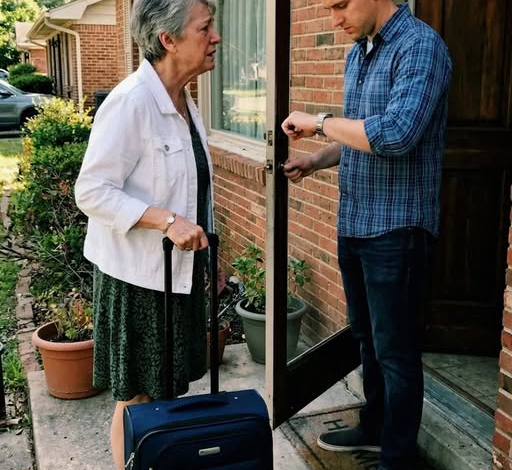
Nick told me to come at four. I arrived at 3:45—just a little early because I couldn’t wait. I stood on the porch, smoothing my dress, checking my reflection in my phone screen.
When he opened the door, there was no smile. No hug.
Instead, he glanced past me toward the street.
“Mom… we said four. It’s only 3:45.”
I laughed, thinking he was teasing. “I know, the Uber was fast. I just got excited.”
I could hear music inside. Kids laughing. Movement. Life.
But his expression didn’t change.
“Linda’s still getting things ready,” he said. “The house isn’t set up yet. Can you wait outside? Just fifteen minutes.”
“Outside?” I repeated, unsure I heard him right.
“It’s just fifteen minutes.”
I hesitated. “Nick, I just got here from the airport.”
“I know. We just want everything to be ready.”
Then he gave me that look—the one people give when they expect you to go along with something without question.
“Please, Mom.”
And before I could answer, he stepped back and closed the door.
I stood there staring at it.
At first, I told myself it was fine. Just a few minutes.
Five passed.
Then ten.
Then fifteen.
No one came.
I sat on my suitcase because my legs were aching. Inside, the laughter continued. Music played louder. I could hear children running back and forth.
That’s when it hit me.
I wasn’t early.
I wasn’t unexpected.
I was simply… not important enough to interrupt whatever was happening inside.
I pulled out my phone and opened his contact. Then I locked the screen.
I picked up my suitcase and walked down the driveway.
No one noticed.
At the corner, I called a cab.
“Where to?” the driver asked.
“Anywhere cheap,” I said.
He dropped me at a small motel ten minutes away. I sat on the edge of the bed in that blue dress, the gift bag untouched beside me, feeling more exhausted than I had in years.
I didn’t turn my phone on that night.
Not when I washed my face. Not when I lay down. Not when I woke up in the dark with my chest tight and my thoughts racing.
The next morning, I finally powered it on.
Twenty-seven missed calls.
Dozens of messages.
“Mom, where are you?”
“Please answer.”
“Mom, please…”
And then one that made my stomach drop:
“It was for you.”
I read further.
“Linda was hanging the banner. The kids were hiding to surprise you. Emma saw you leave and now she won’t stop crying. Please come back.”
I stared at the screen.
He hadn’t meant to send me away.
But he had.
I called him back, but when he answered, I said nothing.
“Mom?” His voice sounded smaller, uncertain.
Still, I stayed silent.
“I messed up,” he said. “I thought fifteen minutes wouldn’t matter. I thought you’d wait. I didn’t think…”
I pressed my hand to my mouth.
Then he said quietly, “Emma keeps saying, ‘Grandma thought we didn’t want her.’”
“She was right,” I said.
“No,” he said quickly, voice breaking. “That’s what I got wrong. I treated you like something to fit into the day. Like you’d understand no matter what. And I’m so sorry.”
I sat down slowly on the bed.
“I didn’t come here to be managed, Nick,” I said. “I came here to feel wanted.”
He didn’t argue.
“I know,” he said. “And I hate that I made you feel otherwise.”
There was a pause, then a small voice came through the phone.
“Grandma?”
My chest tightened instantly.
“Hi, sweetheart,” I said, my voice softer than I expected.
“Are you still coming?” she asked.
I closed my eyes.
“Put your daddy back on,” I said gently.
When Nick returned, I took a breath.
“You can come get me,” I said. “But this isn’t just about one visit. I want real effort. Real time. Not something squeezed in when it’s convenient.”
“You’re right,” he said. “I’ll do better.”
“And no one ever leaves me outside like that again.”
“Never,” he said.
An hour later, there was a knock on my motel door.
Nick stood there, rain in his hair, holding a crayon drawing. Emma peeked out from behind him.
The drawing showed a house, a bright sun, stick figures—and a woman in a blue dress standing in the middle. At the top, it said, in uneven letters: “WELCOME GRANDMA.”
“I should have opened the door,” he said.
Emma stepped forward and wrapped her arms around me. “I saw you leave and I cried,” she said.
“I’m sorry,” I whispered.
On the drive back, Nick didn’t try to fill the silence.
When we pulled into the driveway, the front door opened before I reached it. Linda stood there, eyes red, holding a banner. The boys crowded behind her, bouncing with excitement.
“I’m sorry,” she said immediately.
I nodded, not ready to smooth things over.
The banner read: “HOME IS FULL NOW.”
That nearly broke me.
Inside, the house wasn’t perfect. Decorations were crooked, tape was visible, one of the paper flowers was falling off the wall. The boys started arguing about who made it. And somehow, that imperfection made everything feel more real.
I stepped inside.
This time, no one asked me to wait.
Later, after cake and gifts and too many photos, after the kids were asleep, Nick and I sat at the kitchen table.
“I can’t fix yesterday,” he said. “But I want to do better in the small ways. Regular calls. Real plans. Not just promises.”
“Trust takes consistency,” I said.
“I know.”
The next morning, Emma climbed into my lap and asked, “You stayed. Does that mean pancakes?”
I smiled. “That’s exactly what it means.”
As I walked toward the kitchen, I passed the front door and paused.
Nick noticed.
Without saying a word, he walked over, opened the door wide, and stood there.
“Come in, Mom,” he said.
I looked at him for a moment.
Then I stepped forward.
This time, I believed him.