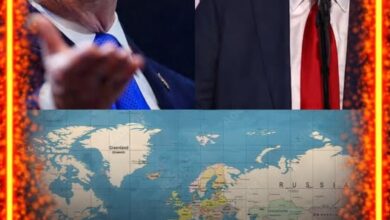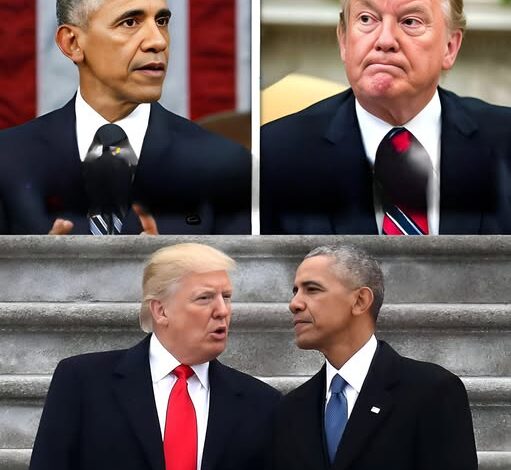
What started as a routine cable news interview quickly evolved into something far more revealing—a snapshot of how modern politics now operates in real time. Trump’s sharp criticism of Obama didn’t simply revisit old political divides; it functioned as a calculated moment, crafted for an audience that no longer consumes information passively. In today’s media environment, every word, pause, and expression can be clipped, shared, and reinterpreted within seconds.
Rather than a spontaneous exchange, the moment felt almost performative. It spoke directly to a deeply fragmented public, where different groups don’t just interpret events differently—they often experience entirely different versions of the same reality. Supporters praised what they saw as blunt honesty and a refusal to conform to traditional political restraint. Critics, on the other hand, viewed the remarks as another example of unnecessary provocation and the erosion of respectful discourse. Between those two poles sat millions of viewers replaying the footage, dissecting tone, intent, and subtext as if each detail might reveal a deeper strategy.
But the significance of the moment extends well beyond the immediate reaction cycle.
What the exchange truly highlighted is how the boundaries between live television and social media have effectively disappeared. A single interview is no longer confined to the moment it airs. Instead, it becomes raw material—instantly repackaged into clips, captions, and commentary that spread across platforms at a speed traditional journalism can’t match. Context often gets stripped away in the process, replaced by emotionally charged fragments designed to capture attention and provoke response.
This dynamic creates a feedback loop. Politicians are increasingly aware that their statements won’t just be heard—they’ll be remixed, amplified, and judged in multiple digital arenas simultaneously. As a result, communication itself becomes more strategic, sometimes prioritizing impact over nuance. The goal is no longer just to convey a position, but to generate a reaction that reinforces loyalty, drives engagement, or dominates the news cycle.
In that sense, the interview wasn’t an isolated incident—it was a reflection of a broader shift. Political discourse is no longer shaped solely by policy debates or long-form discussions. It is influenced just as much by viral moments, emotional resonance, and the ability to command attention in an oversaturated media landscape.
For viewers, this raises an important challenge. It’s increasingly difficult to separate substance from spectacle, or to distinguish between genuine expression and calculated messaging. Outrage spreads faster than explanation, and first impressions often become lasting ones, regardless of later clarification.
Ultimately, the moment serves as a reminder that leadership today is evaluated on multiple levels at once. It’s not just about decisions or policies, but about presentation—how conflicts are framed, how narratives are constructed, and how those narratives are carried forward by the public.
Seen through that lens, the interview was less about revisiting past political rivalries and more about illustrating where public discourse is headed. It underscores how easily conversations can be shaped by speed, emotion, and repetition—and how quickly audiences can be drawn into reacting before fully understanding.
If anything, it acts as a warning: in a world where every moment can be amplified and reinterpreted, the line between information and influence continues to blur—and we are all participants in that process, whether we realize it or not.