For Jordan Driskell, a 31-year-old father in the United States, everyday parenting comes with challenges most families never have to face. Raising five energetic five-year-olds at once means constant movement, constant attention, and very little room for error—especially in public spaces.
Outings that might feel simple for other families quickly turn into complex logistical operations. Every step requires planning, awareness, and the ability to keep five curious children safe at the same time.
At first, the Driskell family relied on a six-seat stroller to manage trips outside the home. While it provided structure, it wasn’t a perfect solution. The stroller was bulky, difficult to maneuver, and increasingly uncomfortable for the children during longer outings. It limited their ability to move, explore, and engage with the world around them.
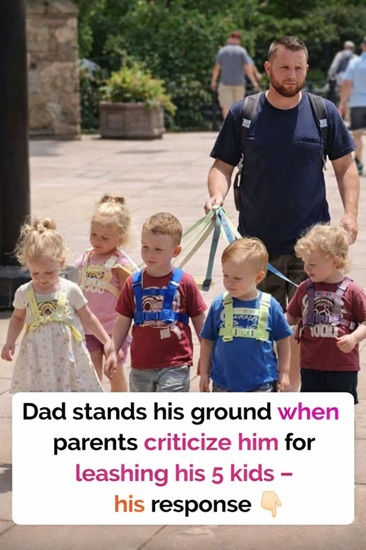
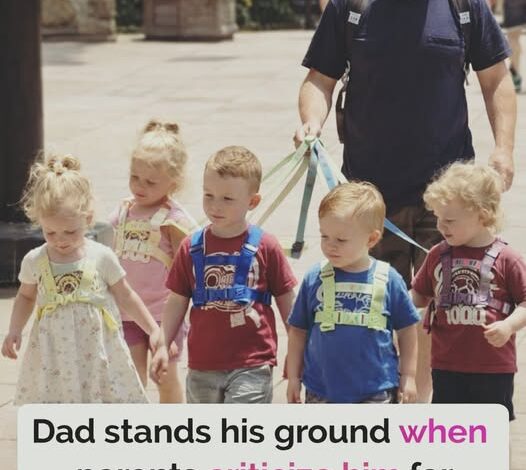
Looking for a better balance between safety and freedom, Driskell turned to an unconventional solution: child safety leashes.
Rather than keeping the children confined, the leashes allowed them to walk independently while staying within a safe distance. They could explore exhibits, interact with their surroundings, and move naturally—without the constant risk of wandering off in crowded or unpredictable environments.
The approach was put into practice during a family trip to a local aquarium. Driskell recorded the outing, showing his children walking freely, asking questions, and engaging with the exhibits—all while safely connected.
When the video was shared online, it quickly gained attention, drawing millions of views in just a few days. But with that attention came strong reactions.
Some viewers criticized the use of leashes, arguing that it was demeaning or compared children to animals. Others questioned whether it reflected poor parenting or a lack of control. The image of multiple children tethered together struck an emotional chord, sparking heated debates across social media.
Yet not everyone saw it that way.
Many parenting experts and supporters defended the decision, pointing out that context matters. Managing five young children in public presents unique challenges, and tools like safety leashes can offer practical support without harming development.
According to specialists like Dr. Deborah Gilboa, when used appropriately, such tools do not negatively impact a child’s emotional or physical growth. In fact, they may provide a safer alternative to restricting children indoors or limiting their ability to explore.
For highly active children—or those who are neurodiverse—these tools can reduce risks while still encouraging independence. They allow children to learn boundaries, interact with their environment, and develop confidence, all within a controlled and secure setting.
Importantly, leashes are not a substitute for parenting—they are an extension of it. Driskell remains actively involved, guiding his children, answering their questions, and staying engaged throughout their experiences. The tool simply helps him manage a situation that would otherwise be overwhelming.
This situation also highlights a larger issue: how quickly parenting decisions are judged without understanding the full picture.
Every family operates under different circumstances. What may seem unnecessary for one household can be essential for another. Raising multiples, in particular, requires adaptability and creative problem-solving.
For the Driskell family, the goal isn’t control—it’s balance.
Balance between freedom and safety.
Between independence and supervision.
Between allowing children to explore and ensuring they remain protected.
Over time, as children grow and develop awareness, reliance on tools like leashes naturally decreases. Parents can shift toward teaching responsibility, communication, and situational understanding.
But in the early years—especially in crowded or high-risk environments—practical tools can make a meaningful difference.
Driskell’s story ultimately serves as a reminder that parenting is not one-size-fits-all. It is shaped by circumstance, environment, and the unique needs of each family.
Rather than rushing to judgment, conversations around parenting could benefit from more empathy, more context, and a greater focus on outcomes rather than appearances.
Because at its core, the goal is simple:
To keep children safe, curious, and free to grow.
And sometimes, that requires solutions that look different—but work exactly as intended.