She Fought Her Own Father for the Right to Decide Her Fate, What Happened Next Divided an Entire Country

For much of her life, control was never truly hers.
Instead, it became a prolonged struggle—legal, emotional, and deeply personal—playing out not in silence, but in courtrooms, media coverage, and public debate. At the center stood a young woman whose voice had long gone unheard.
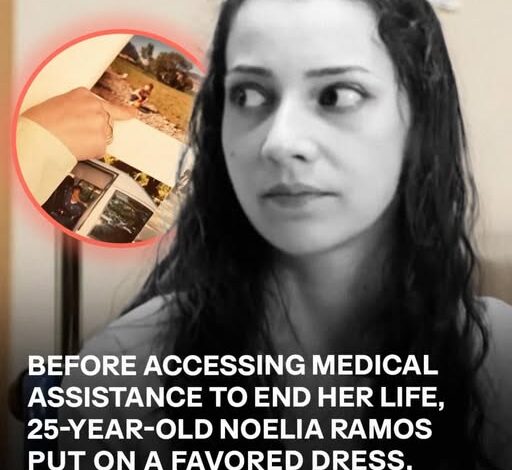
Her name was Noelia Castillo Ramos.
She was only 25 when her story reached its end. But that ending was shaped by years of trauma, hardship, and a relentless effort to reclaim control over her own life.
Her case didn’t simply raise difficult questions.
It forced a nation to face them directly.
From early adolescence, instability was already part of Noelia’s reality. Around the age of 13, following her parents’ separation, she entered psychiatric care. Over time, she was diagnosed with obsessive-compulsive disorder and borderline personality disorder—conditions that would influence much of her development and daily life.
Her years became defined by cycles of treatment, institutional care, and attempts to find balance in a system that never fully provided it.
By 2022, she was living in a supervised facility in Barcelona designed to support vulnerable young people. It was meant to offer safety.
Instead, it became the backdrop for one of the most devastating experiences she would endure.
That year, she was assaulted by three men—an event that profoundly changed the course of her life. It was not an isolated trauma. Before that, she had already experienced abuse in a long-term relationship, along with other incidents that eroded her sense of security over time.
The weight of those experiences accumulated.
Until it became too much.
In October 2022, she made a decision that would alter everything—she jumped from a fifth-floor rooftop.
She survived.
But survival came with irreversible consequences.
The fall left her paraplegic, living with constant physical pain layered onto years of emotional suffering.
From that point forward, her reality changed entirely. Pain was no longer occasional—it was continuous, shaping every moment of her day.
In her final months, she spoke openly about what that life felt like.
She described a state where even basic acts—sleeping, eating, leaving the house—felt overwhelming. Where exhaustion came not from activity, but from simply existing.
“I don’t feel like doing anything,” she said. “Sleeping is very difficult… and I have constant pain in my back and legs.”
Her words were direct.
Unfiltered.
She didn’t soften her reality for anyone.
And that honesty made it impossible to look away.
At the center of her final choice was something deeply personal: the desire to end her suffering on her own terms.
She chose euthanasia.
In Spain, where the practice is legal under strict conditions, her case underwent extensive review. Each stage required careful evaluation, legal approval, and confirmation of her capacity to decide.
Even so, it was far from simple.
Her family was divided.
Her mother, though heartbroken, chose to remain by her side.
“I do not agree… but I will always be with her,” she said.
Her father took a different stance. He challenged the decision through legal channels, arguing that her mental health should disqualify her from making such a choice. The case escalated through multiple courts, eventually reaching the European Court of Human Rights.
But the rulings were consistent.
Noelia was deemed capable of deciding for herself.
Yet legal clarity did not erase emotional conflict.
For Noelia, this was not just about rights—it was about being acknowledged.
And she spoke about it with striking clarity.
“The happiness of a parent should not come before the happiness of their child,” she said.
Her words resonated widely.
And unsettled many.
Because her story was no longer just personal—it had become public.
Across Spain, debates intensified. Some viewed her decision as an expression of autonomy and dignity. Others questioned whether more support, different care, or earlier intervention could have changed her path.
There were no easy answers.
Only perspectives shaped by belief, experience, and emotion.
In her final days, what stood out most was not just her decision—but the way she approached it.
She prepared carefully.
Deliberately.
She selected four photographs to be with her—images tied to moments of happiness, memory, and identity. A childhood memory. Her dog. Creative moments. Pieces of a life that once felt different.
She chose her clothing.
“I want to die looking beautiful,” she said.
It wasn’t about appearance.
It was about control.
About deciding how her final moment would be experienced and remembered.
She allowed her family to say goodbye.
But when the time came, she chose to be alone with her doctor.
That choice, too, was intentional.
On March 26, 2026, her life came to an end.
And with it, a story that continues to spark reflection long after its conclusion.
Because what happened was never just about one person.
It was about the delicate line between autonomy and protection.
Between suffering and intervention.
Between the right to choose—and the responsibility to care.
Her story does not offer resolution.
It raises questions instead.
For some, she represents the right to decide one’s own fate.
For others, a reminder of a system that may not have done enough before reaching that point.
But beyond debate, beyond headlines, there remains something simpler.
A young woman who spent years trying to be heard.
Who made a decision shaped by her experience of pain.
And who, in the end, was given the right to make it.
Her story stays with us—not because it answers everything,
but because it doesn’t.