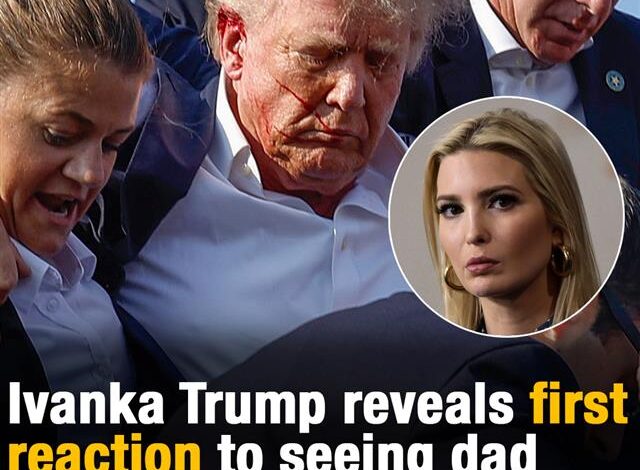
Ivanka’s account of that day feels less like a political statement and more like a deeply personal memory—one shaped by instinct, fear, and the quiet determination to hold her family together in a moment of chaos. She describes it not as a distant event, but as something immediate and overwhelming, unfolding in real time while she tried to make sense of what she was seeing and hearing.
At the center of it all was a powerful emotional contrast. There was the raw shock of witnessing her father in danger—something no daughter is ever prepared for—and at the same time, an almost unshakable belief that he would survive. That sense of certainty didn’t erase the fear or the urgency of the moment, but it anchored her. It gave her something to hold onto when everything else felt uncertain and out of control.
As events continued to unfold, much of it broadcast across screens and discussed in real time, she found herself navigating multiple roles at once. She wasn’t just a daughter reacting to a frightening situation—she was also a mother, focused on protecting her children from the emotional weight of what was happening. Shielding them, staying composed, and trying to maintain a sense of normalcy became just as important as processing her own emotions.
That internal balancing act—between fear and composure, between instinct and responsibility—defined the experience for her. It wasn’t a single moment, but a series of seconds and minutes where everything felt heightened, where every update mattered, and where uncertainty lingered in the background of every thought.
In the aftermath, when the immediate crisis had passed, her reflections took on a different tone. Rather than focusing on the fear or the violence itself, she began to frame the experience as a stark reminder of how fragile life can be. How quickly things can change. How close loss can come without warning.
She has spoken about the emotional crossroads that followed—acknowledging that it would have been easy to remain in that place of fear, to let anger or trauma take hold. Those reactions would have been understandable, even expected. But instead, she made a conscious and deliberate choice about how to move forward.
She chose gratitude.
Not because the experience wasn’t painful, but because it could have been far worse. The possibility of loss reframed everything. It shifted her focus away from what almost happened and toward what remained—time, family, connection.
In that sense, the moment became transformative. It deepened her awareness of what truly matters and reinforced a perspective centered on presence and appreciation. Rather than allowing the darkness of that day to define her, she used it as a lens through which to see her life more clearly.
Her reflection also touches on something broader—the way moments of crisis can strip away distractions and reveal what is essential. Titles, public roles, and outside perceptions fall away, leaving only the core relationships that define who we are. In her case, that meant being a daughter first, a mother always, and a person trying to hold onto hope in the middle of uncertainty.
Ultimately, her account is not about the event alone, but about the meaning drawn from it. It’s about the quiet, personal decision to respond to fear with perspective, to answer uncertainty with resilience, and to meet the possibility of loss with a deeper appreciation for what still exists.
In the end, she frames that day not just as a moment of danger, but as a turning point—a reminder that while we cannot control what happens to us, we can choose how we carry it forward.