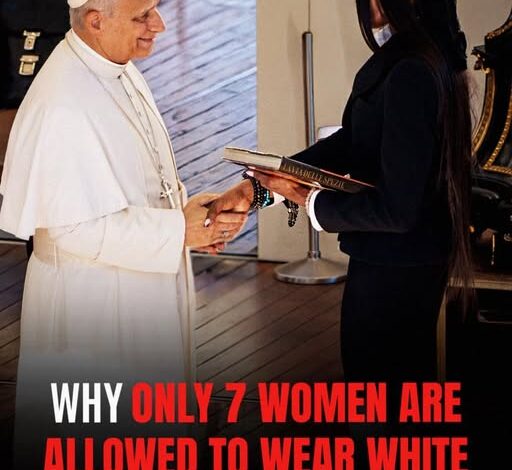
Within the ornate and tradition-bound world of the Vatican, where symbolism often speaks louder than words, even clothing carries centuries of meaning. For most women granted an audience with the Pope, the expectations are clear and unchanging: modest, floor-length black attire paired with the delicate lace of a mantilla, a visual expression of humility and reverence that has endured for generations. Yet, within this sea of black, there exists a rare and striking exception—an honor so exclusive that only a handful of women in the world are permitted to claim it. Known as le privilège du blanc, or “the privilege of the white,” it allows certain women to stand before the Pope dressed entirely in white, a distinction rooted not in fashion, but in history, lineage, and the enduring relationship between throne and Church.
This privilege is not granted lightly. Its origins trace back to an era when monarchies and the Catholic Church were deeply intertwined, and when rulers who demonstrated unwavering loyalty to the Holy See were bestowed with the title of Rex Catholicissimus—“Most Catholic Majesty.” From that legacy emerged a visual code that still survives today. The right to wear white is reserved for Catholic queens and princesses from a select group of historically recognized royal houses, and it is typically passed down through lineage or conferred through marriage into those dynasties. Even in a modern world shaped by diplomacy rather than divine right, the Vatican continues to preserve this tradition as a living link to its past.
As of today, the circle remains exceptionally small. Among those entitled to the privilege are Queen Sofía of Spain and Queen Letizia, along with Belgium’s Queen Paola and Queen Mathilde. They are joined by Grand Duchess Maria Teresa of Luxembourg, Princess Marina of Naples, and Princess Charlene of Monaco. Each of these women represents more than individual status; they embody centuries of historical alignment between their nations and the Church. When they appear in white at Vatican ceremonies or private audiences, the gesture is both symbolic and deeply codified—an acknowledgment of their unique place within this longstanding relationship.
In recent years, Princess Charlene of Monaco has brought renewed attention to this rare distinction. Her path to the privilege was shaped not only by marriage to Prince Albert II, but also by her conversion to Catholicism prior to their union. During a high-profile visit to the Vatican, her appearance in white—complete with a matching veil—stood out as a vivid reminder of the tradition’s enduring power. Against the rich reds and golds of the Apostolic Palace, the image carried a visual clarity that needed no explanation. It was not simply a matter of attire; it was a statement of identity and belonging within a system that values continuity above all else.
Yet what makes this tradition particularly fascinating is that it is not strictly enforced. The privilege of the white is exactly that—a privilege, not an obligation. Some women entitled to it have chosen, at times, to wear black instead, signaling humility or aligning with the tone of a specific occasion. Princess Charlene herself opted for black during Pope Francis’s inauguration, while Queen Letizia has modernized the tradition by wearing tailored white ensembles without the customary mantilla. Even Queen Sofía has, in recent years, stepped away from the veil, reflecting a subtle evolution in how ancient customs are interpreted in a contemporary context.
The exclusivity of this honor becomes even more apparent when considering who does not qualify. It is not extended to all Catholic women, no matter how prominent or influential they may be. Female heads of state, high-profile public figures, and even devout Catholics married into non-designated monarchies must adhere to the traditional black dress code. Queen Máxima of the Netherlands, for example, remains bound to black attire despite her Catholic faith, as the Dutch monarchy does not fall within the historically recognized group. The rule is precise, and in the eyes of the Vatican, non-negotiable.
Occasionally, when these boundaries are crossed—intentionally or otherwise—the response can be swift. Past moments of deviation from protocol have sparked criticism, underscoring just how seriously these traditions are taken. In this environment, attire is not a matter of personal expression; it is a form of communication, governed by centuries-old expectations.
Even those outside the Catholic faith have demonstrated an understanding of this symbolic language. Queen Elizabeth II, as head of the Church of England, was never entitled to the privilege of the white. Yet in her later visits to the Vatican, she subtly adapted her attire, choosing softer tones like lavender—an understated gesture interpreted by many as a sign of evolving diplomatic warmth between institutions historically divided by doctrine.
Ultimately, the privilege of the white endures as one of the last visible remnants of a world where status, faith, and history were inseparably linked. In an era defined by rapid change and shifting norms, it stands as a quiet but powerful reminder that some traditions resist reinvention. They are preserved not because they are practical, but because they carry meaning—layered, deliberate, and deeply rooted in the past.
And so, when one of these few women steps forward in white within the Vatican’s ancient halls, it is more than a visual contrast. It is a living symbol of continuity—an echo of history that still speaks, clearly and unmistakably, in the present.