Joe Biden Finally Breaks His Silence With Emotional Oval Office Announcement That Has The Entire World In Tears

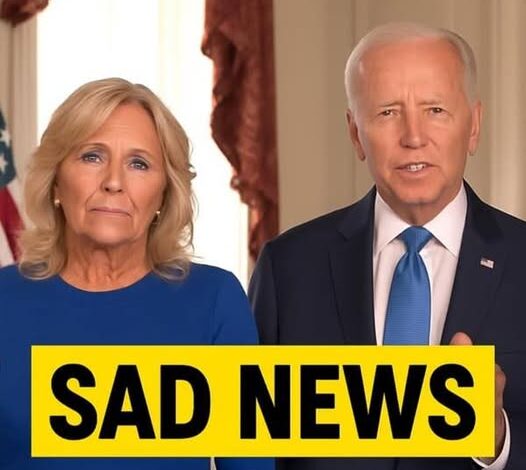
The Oval Office has long been a stage for history, but on the evening of July 24, 2024, it became something quieter and more personal. Sitting behind the Resolute Desk, Joe Biden addressed the nation not with triumph or urgency, but with reflection. After more than five decades in public life, he announced he would withdraw from the 2024 presidential race—a decision that carried both political consequence and personal weight.
The moment had been anticipated, but not fully absorbed. In the weeks leading up to it, scrutiny had intensified following a difficult debate performance, raising questions about age, stamina, and the demands of the presidency. Public discussion grew louder, but the decision itself appeared to take shape in a more private space. When Biden spoke, he framed it not as a reaction to pressure, but as a choice guided by a broader responsibility—to the office, the country, and the stability of the political system.
His message was direct: the presidency, and the democratic system it represents, matters more than any individual holding it.
The setting reinforced that tone. He was surrounded by family—First Lady Jill Biden, children, grandchildren—figures who have been present through both political milestones and personal loss. Their presence underscored the reality that public service, especially at that level, is never purely institutional. It carries a personal cost that unfolds over time.
Biden reflected on his path from Scranton, Pennsylvania, invoking a narrative that has long defined his political identity. But in this context, it felt less like messaging and more like closure—a recognition of a career that had come full circle. The story of a boy with a stutter rising to the presidency has been told many times, but here it served a different purpose: to mark an ending shaped by choice rather than circumstance.
At the same time, the speech pointed forward. Biden formally endorsed Vice President Kamala Harris, signaling his support for continuity within his party. The endorsement carried both political and symbolic significance, positioning Harris at the center of the next phase of the campaign. It also reflected an attempt to manage transition in a way that avoided prolonged uncertainty.
Reactions followed familiar lines, but with a notable degree of respect across perspectives. International leaders described the decision as a demonstration of restraint—an uncommon gesture in modern politics, where stepping aside is often seen as weakness rather than judgment. Domestically, responses were more varied. Supporters expressed disappointment and gratitude, while critics framed the move as inevitable. Yet even among disagreement, there was recognition that the moment itself was unusual.
In the weeks that followed, Biden remained fully engaged in the responsibilities of the presidency. With the campaign behind him, his focus narrowed to governing—policy, diplomacy, and the remaining priorities of his administration. The shift was subtle but visible: less about positioning for the future, more about managing the present.
The longer-term significance of the decision will likely be debated. For some, it will stand as an example of prioritizing institutional stability over personal ambition. For others, it will be viewed through the lens of political pressure and timing. But regardless of interpretation, it represents a departure from a pattern in which leaders hold on to power as long as possible.
What made the moment resonate was not just the announcement itself, but the tone in which it was delivered. There was no attempt to dramatize or reframe it as something else. It was a straightforward acknowledgment of limits—political, personal, and temporal.
In that sense, the image of Biden at the Resolute Desk that night may endure less as a moment of loss and more as one of transition. Not dramatic, not abrupt—but deliberate.
And in a political environment often defined by urgency and conflict, that kind of decision carries its own form of weight.