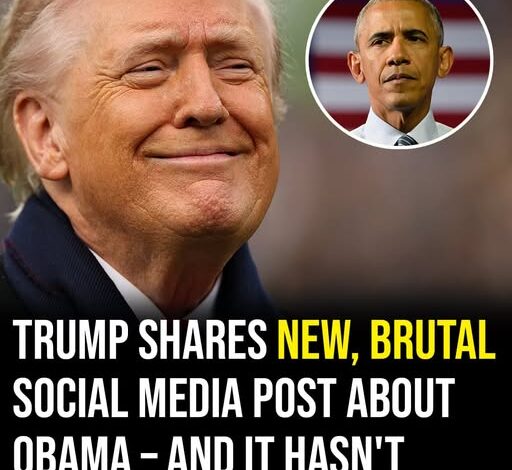
The reposted meme showing Donald Trump “winning” over Barack Obama may have flashed across screens in seconds, but its impact lingered far longer. What might once have been dismissed as a passing jab quickly grew into something more—a cultural moment that drew together years of political tension, personal rivalry, and public fatigue into a single, highly charged reaction.
On its surface, the image was simple. Like many memes, it was designed for immediacy—quick to understand, quick to share, and quick to provoke. But the responses it generated revealed just how layered even the most casual political content has become.
For Trump’s supporters, the meaning wasn’t tied to the literal accuracy of the image. It was symbolic. The meme fit into a broader narrative they had long embraced—one where Trump’s rise represented a challenge to an established political order often associated with figures like Obama. To them, the image wasn’t about a single comparison; it was a shorthand for disruption, a reminder of a political shift that defied expectations.
There’s also an element of identity woven into that reaction. Moments like these function as signals—affirmations of alignment and continuity. In a political environment where consistency is often equated with authenticity, even when that consistency comes in the form of confrontation, the meme reinforced the idea that Trump remained unchanged in the ways that first drew support.
But for critics, that same consistency carried a different meaning.
Instead of confidence, they saw fixation. Rather than humor, they saw a continued reliance on past rivalries. Revisiting Obama in this way, in their view, suggested a political style still rooted in grievance rather than forward-looking ideas. It wasn’t just about the content—it was about what the content implied.
And that implication tapped into something larger.
Over the past decade, the nature of political communication has shifted dramatically. The line between governance and performance has blurred, accelerated by social media platforms that reward content designed to provoke, divide, or entertain. In that context, a meme is no longer just a joke—it becomes part of a broader messaging ecosystem, whether intentional or not.
The reaction reflected that reality.
Some responses reached back to earlier moments in political culture, such as White House Correspondents’ Dinner appearances, where humor—though pointed—operated within a shared set of expectations. That comparison has become a recurring reference point, highlighting a perceived shift from controlled satire to a more open, unfiltered style of public engagement.
Others focused on accuracy, questioning the message behind the meme and pushing back against what they viewed as a casual relationship with truth. But even these critiques often carried a deeper frustration—not just with the image itself, but with how quickly such content spreads and shapes perception.
Because the real tension lies there.
It’s not just about what was posted—it’s about how it resonates in an already divided environment.
For some, the meme was energizing.
For others, it was exhausting.
That divide reflects a broader sense of political fatigue that has taken hold over time. People are no longer reacting to isolated moments; they are responding to patterns. A single post becomes a symbol of something larger—a confirmation of trends they feel have been unfolding for years.
And those trends are interpreted very differently depending on perspective.
Supporters may see strength: a refusal to conform, a willingness to speak directly, and an approach that cuts through traditional media filters. Critics, on the other hand, may see erosion: a weakening of norms, a loss of restraint, and a shift away from shared standards of leadership.
This disagreement is not only political—it is cultural.
It reflects competing expectations about what leadership should look like. Should it prioritize clarity and policy, or energy and confrontation? Should it aim for unity, or for decisive victory? These underlying questions shape how moments like this are understood.
In that sense, the meme becomes less about Trump or Obama as individuals and more about what they represent.
For many, Obama still symbolizes a measured, institutional style of leadership—careful, rhetorical, and rooted in established norms. Trump represents something different: disruptive, personal, and often intentionally provocative. When those two figures are placed in contrast, even through something as simple as a meme, it activates these broader associations.
That’s why the reaction feels disproportionate.
Because it isn’t really about the image.
It’s about everything people project onto it.
And, perhaps most importantly, it’s about what people believe is becoming normal.
For critics, the concern is not disagreement or even mockery—both have always existed in politics. It is the tone and intensity of that mockery, and the way it dominates public discourse. A shift toward moments that prioritize reaction over reflection, and spectacle over substance.
For supporters, the concern often runs in the opposite direction—that calls for civility can sometimes suppress directness or shield institutions from necessary criticism. From that perspective, confrontational communication is not a flaw, but a feature.
These perspectives do not simply differ—they often fail to connect.
And that disconnect is what gives moments like this their staying power.
Even after the meme disappears from timelines, the interpretations remain. The debates continue. The broader divide—over what politics is and what it should be—deepens.
In the end, this was never just about a repost.
It was about recognition.
People saw in that image what they already believed—either confirmation of a leader challenging the system, or confirmation of a political culture drifting further from shared norms.
And somewhere within that divide lies a more difficult question:
Not just who is right, but what kind of political environment is being shaped—one moment like this at a time.
Because while a single meme may seem insignificant, the patterns it reflects—and reinforces—are anything but.