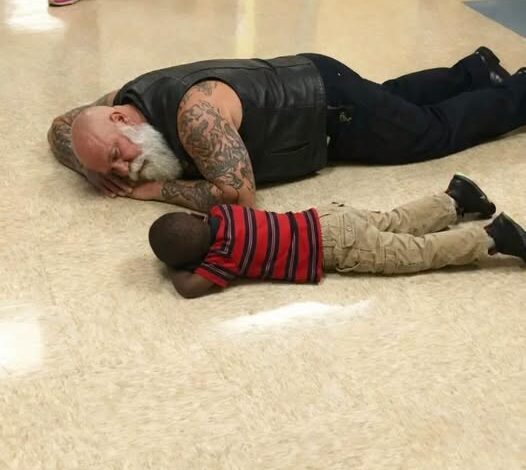
The man who chose to lie down on the waiting room floor beside my son didn’t arrive like a hero, and he didn’t try to solve anything with carefully crafted words or dramatic reassurance. There was no sense of urgency in him, no attempt to pull Marcus out of what he was feeling or rush him back into what the world would consider “normal.” Instead, he offered something far more uncommon—something that felt almost invisible at first, but later revealed itself to be deeply powerful. He offered presence. Steady, unintrusive, and without expectation.
By lowering himself to the floor—both physically and emotionally—he met Marcus exactly where he was. Not above him, not guiding him from a distance, but beside him, grounded in the same space. In that simple act, he shifted the entire atmosphere. It wasn’t about control or correction. It was about connection. His breathing was slow and even, almost rhythmic, like an anchor in the middle of chaos. The soft hum that escaped him wasn’t meant to distract or entertain—it was a quiet signal, a reminder that calm could exist here too, even in a place filled with fluorescent lights, hard chairs, and restless tension.
What struck me most was his willingness to be seen in that vulnerability. An adult, stretched out on a waiting room floor, not concerned with how it looked, not trying to maintain a sense of authority or composure. He allowed himself to enter Marcus’s world instead of demanding that Marcus return to his. And in doing so, he showed me something I hadn’t fully understood before—that regulation doesn’t always begin with words. It often starts in the body, in the nervous system, in the subtle exchange of energy between people who are willing to stay present with one another.
At the time, I didn’t have the language for what I was witnessing. I only knew that something had shifted. The tension in Marcus softened, not all at once, but gradually, like a storm losing its edge. And I realized that what this man—Bear—was offering wasn’t a solution. It was permission. Permission for Marcus to exist exactly as he was in that moment, without needing to perform or improve or explain.
Months passed, and life moved forward in its usual uneven way. But that moment stayed with me, quietly reshaping how I understood care and support. Then one afternoon, I saw it again—this time through Marcus.
Tyler, a younger child, was struggling. The room carried that same tight, fragile energy I remembered so clearly. And instead of trying to fix it, instead of offering quick reassurances or distractions, Marcus did something unexpected. He lowered himself to the floor beside him. He didn’t speak right away. He didn’t rush. He simply stayed.
I watched as he matched Tyler’s pace, his breathing, his stillness. There was no instruction, no correction—just quiet companionship. And in that moment, it became clear to me what Bear had truly given us.
It wasn’t a method or a strategy. It wasn’t something you could write down in steps or teach through explanation alone. It was a way of being. A model that lived in action rather than words. Compassion, when it is patient and unforced, doesn’t need to announce itself. It teaches through presence. It communicates something deeper than reassurance ever could: “You don’t have to change for me to stay here with you.”
In a world that often feels driven by urgency—the need to fix, to improve, to resolve—what Bear demonstrated felt almost radical. He showed that sometimes the most meaningful support comes not from doing more, but from doing less. From resisting the instinct to intervene and instead choosing to remain.
That kind of presence doesn’t erase struggle, and it doesn’t promise immediate transformation. But it creates something just as important: safety. And from that safety, change can begin on its own terms.
Looking back, I understand now that what happened in that waiting room was not small. It was a quiet turning point. A reminder that care doesn’t always need to be loud to be powerful. That sometimes, the most transformative thing one person can offer another is the simple, steady act of not walking away.