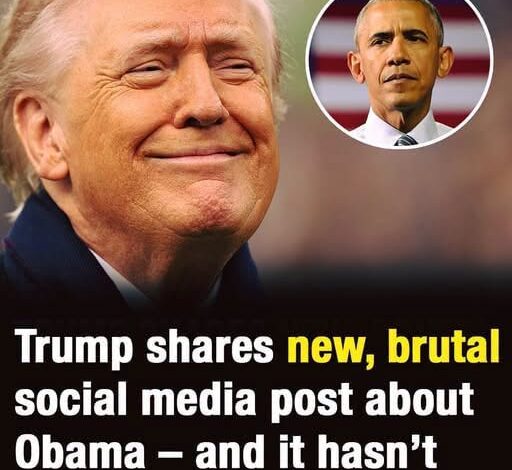
What unfolded in the wake of that post quickly moved beyond the boundaries of a single meme and into something far more revealing about the modern American psyche. It became less about humor or provocation and more about authorship—who has the authority to frame the story of the nation’s recent past, and whose version of events gains traction in a fragmented, hyperconnected public sphere.
Trump’s decision to reintroduce Obama into the conversation was not случай or incidental. It functioned as a deliberate recall of a political and cultural rivalry that never fully dissolved. Obama, for many, represents a set of ideals—composure, institutional trust, a certain vision of progress—while for others he symbolizes overreach, division, or unmet promises. By placing Obama back into the spotlight, even indirectly, Trump effectively reopened a chapter that remains emotionally charged. The meme, then, became a kind of symbolic battleground where those competing interpretations could once again collide.
What made the moment especially potent was how quickly it escaped its original context. In earlier media eras, a message might travel outward but remain relatively stable in meaning. Now, each interaction reshapes it. A retweet isn’t just amplification—it’s reinterpretation. A comment reframes intent. An outrage cycle doesn’t simply respond; it reconstructs. Within hours, the meme had splintered into countless versions of itself, each one reflecting the biases, frustrations, and loyalties of the person sharing it. It ceased to belong to its creator and instead became communal property—malleable, contested, and constantly evolving.
The silence from both Trump and Obama added another layer of complexity. In a landscape where every statement is dissected and every response fuels the next cycle, silence can be just as powerful as speech. Without official clarification or rebuttal, there was no definitive anchor for interpretation. This absence created a vacuum, and as is often the case, the public rushed to fill it. People projected meaning onto the meme based not on what was explicitly said, but on what they already believed. Supporters saw strategy or humor; critics saw manipulation or provocation. The lack of resolution allowed the moment to stretch, to linger, and to deepen in significance.
In that vacuum, the meme became something closer to a psychological test. It exposed how quickly individuals sort information into preexisting narratives. It revealed how easily digital content can be weaponized—not necessarily by its originator, but by the ecosystem that surrounds it. Outrage, in particular, proved to be a powerful accelerant. The more emotionally charged the reactions became, the more visibility the content gained, reinforcing the very dynamics that made it controversial in the first place.
At a deeper level, the episode underscores a shift in how political meaning is constructed. Leadership today is no longer communicated solely through speeches, policies, or formal channels. It is performed, interpreted, and contested in real time across platforms that reward immediacy over reflection. A meme—once considered trivial—can now carry symbolic weight, functioning as both message and medium. It blurs the line between intentional communication and ambient noise, between strategy and spectacle.
This raises an unsettling question: in an environment where meaning is so fluid, how do people distinguish between signal and distortion? When every piece of content is subject to endless reinterpretation, the idea of a shared understanding becomes harder to sustain. What one group sees as satire, another sees as threat. What one interprets as commentary, another reads as misinformation. The result is not just disagreement, but parallel realities shaped by different streams of content and reaction.
Ultimately, the aftermath of that post reveals less about the individuals involved and more about the system through which their messages travel. It shows how digital spaces have transformed political communication into an ongoing, participatory process—one where the audience is not just consuming information but actively reshaping it. The meme may have been the spark, but the fire was fueled by collective engagement, by the constant feedback loop of attention, emotion, and interpretation.
In that sense, the moment serves as both a reflection and a warning. It reflects a society still grappling with unresolved tensions, where the past is never fully settled and can be reactivated with a single post. And it warns of how easily those tensions can be amplified in a media environment that prioritizes speed, visibility, and reaction above all else. The question is no longer just what is being said—but who controls how it is understood, and whether that understanding can ever be shared again.