I went to the store and bought some ham. When I got home and started slićing it, I saw this.

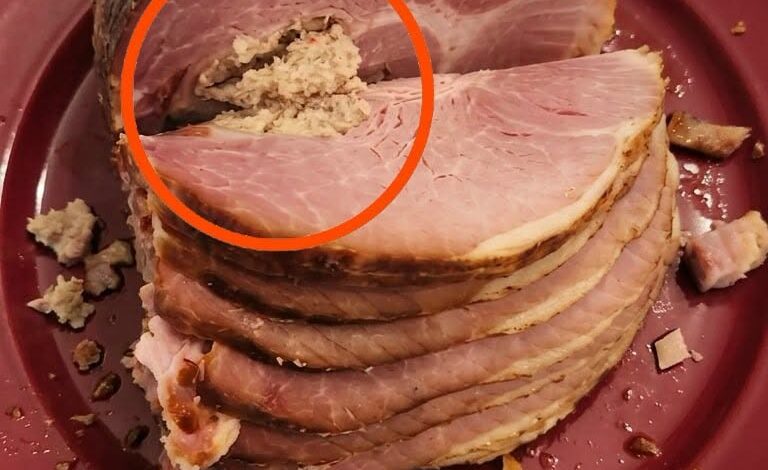
What began as a routine trip to the grocery store quickly turned into a moment that unsettled everyone at the table. The ham looked perfectly normal—until it didn’t. Right at the center was a dense, grainy mass that didn’t belong, at least not in our understanding of what food should look like. The mood shifted instantly. What was supposed to be a simple meal became a quiet investigation, each of us staring at it, trying to make sense of something that felt wrong.
In that moment, logic took a backseat to instinct. Everyone had a theory, and none of them were comforting. Contamination. Parasites. A sign of poor processing or something worse. The kitchen, usually a place of routine and warmth, felt tense. No one wanted to be the first to dismiss it, but no one wanted to admit how uneasy it made them feel either. It’s strange how quickly familiarity can turn into suspicion when something breaks expectation.
But the answer, when it finally came, was almost anticlimactic.
After searching online, comparing images, and digging into food safety explanations, we found out it wasn’t anything dangerous at all. The odd core was simply a concentration of salt, fat, and protein—something that can form naturally during the curing process. Not common, not particularly appealing to look at, but completely harmless. No hidden threat. No deeper issue.
The relief was immediate, but it came with a quiet realization. The fear hadn’t come from the object itself—it came from what we imagined it could be. Faced with something unfamiliar, our minds filled in the blanks with worst-case scenarios, turning a harmless imperfection into something almost alarming.
In the end, the experience wasn’t really about the ham. It was about perception—how quickly we assign danger to the unknown, and how powerful that reaction can be. Sometimes, what looks unsettling is just a natural variation, something ordinary seen from an unfamiliar angle.
And more often than not, the real threat isn’t on the plate—it’s in the story we build around it.