MASSIVE 7.7 EARTHQUAKE RIPS THROUGH BORDER REGIONS LEAVING MILLIONS IN TERROR AND DEVASTATION

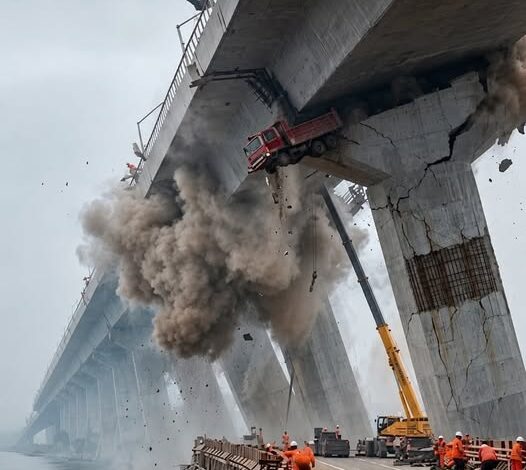
The earth tore open before dawn with a force that seemed almost impossible to comprehend.
In the darkness of early Monday morning, while families slept and entire towns rested under the fragile quiet of night, a massive 7.7 magnitude earthquake ripped through the border regions of China, Thailand, and Myanmar. What began as ordinary sleep turned within seconds into terror — walls cracking, floors buckling, windows exploding, and buildings shaking so violently that people barely had time to understand what was happening before survival became the only thought left.
The tremor struck with brutal suddenness.
One moment, homes were silent.
The next, the ground itself seemed to roar.
Across the affected region, millions of residents were jolted awake by a force powerful enough to turn familiar streets into scenes of chaos. Concrete split. Power lines snapped. Roofs collapsed. Hillsides loosened. Entire neighborhoods were plunged into darkness as electricity failed and clouds of dust rose from broken buildings.
For many, the first sound was not the earthquake itself, but the screams that followed.
Parents searched for children in pitch-black rooms. Elderly residents struggled to crawl from damaged homes. Families ran barefoot into streets filled with debris, unsure whether the structures behind them would still be standing by sunrise. In some places, people had no time to escape at all.
By morning, peaceful communities had been transformed into disaster zones.
The earthquake’s shallow depth made its violence especially destructive. When a quake strikes close to the surface, less of its energy is absorbed deep underground. Instead, the force surges upward directly into roads, homes, schools, hospitals, bridges, and everything built above the fault line.
That is why the damage spread so quickly.
In the mountainous border areas near the epicenter, the shaking was catastrophic. These regions are already difficult to reach under normal conditions, with winding roads, steep slopes, isolated villages, and limited infrastructure. After the quake, that difficult geography became an obstacle course of landslides, broken roads, collapsed bridges, and blocked mountain passes.
Some villages were cut off almost instantly.
For residents in rural communities, the experience felt apocalyptic. Traditional homes, often built to withstand seasonal rain, wind, and daily wear, were no match for the violent motion of a major seismic event. Walls crumbled under the strain. Roofs caved inward. Entire family compounds collapsed into piles of timber, brick, dust, and twisted metal.
The physical destruction was staggering.
But the emotional destruction was just as severe.
Survivors emerged from the wreckage disoriented, covered in dust, calling out names into the darkness. Some found neighbors alive. Others found only silence. The familiar geography of their lives — homes, markets, temples, schools, clinics, roads — had changed in minutes into something unrecognizable.
That kind of trauma does not end when the shaking stops.
It lingers in the body.
Every aftershock becomes another wave of fear. Every cracking sound sends people running. Every damaged wall looks like a threat waiting to fall. Families who survived the first quake now face the terrifying uncertainty of whether the ground will move again.
Emergency teams mobilized rapidly, but the conditions facing them were severe from the beginning.
Roads needed for rescue vehicles were fractured or buried beneath landslides. Communications were down across large sections of the affected area. Cell towers failed. Power grids collapsed. In many communities, officials had little immediate information about the scale of the destruction because the disaster had turned entire districts into communication black holes.
Rescuers were forced to improvise.
Some teams moved by helicopter where landing zones could be found. Others traveled on foot, carrying supplies across broken roads and unstable ground. Local volunteers joined professional responders, digging through rubble with bare hands, shovels, metal rods, and anything else they could find.
The search for survivors became a race against time.
In the first hours after a major earthquake, every minute matters. People trapped beneath debris may still be alive, but injured, dehydrated, unable to move, or unable to call for help. Rescuers must listen carefully for faint sounds beneath collapsed walls: tapping, crying, breathing, voices barely strong enough to answer.
In many places, those sounds were the only guide.
Teams worked through dust, darkness, and aftershocks, trying to reach people before exhaustion, injury, or lack of oxygen claimed them. The work was dangerous. Unstable buildings could collapse further without warning. Landslides could shift again. Broken electrical lines, leaking gas, shattered glass, and damaged water systems added new hazards to an already desperate mission.
Hospitals quickly became overwhelmed.
Emergency rooms filled with patients suffering from crush injuries, broken bones, head wounds, severe bleeding, dehydration, shock, and trauma. In some towns, hospitals themselves were damaged, forcing doctors and nurses to treat people outside under temporary tents, tarps, and open skies.
Schoolyards and town squares became triage centers.
Doctors worked under portable lights. Nurses moved between rows of injured survivors. Volunteers carried water, blankets, bandages, and whatever supplies could be gathered. Families waited anxiously for news, hoping missing relatives might be found alive and brought in for treatment.
The medical crisis grew by the hour.
Crush injuries required urgent surgery. Open wounds carried infection risk. Patients needed clean water, antibiotics, pain medication, blood supplies, and safe transportation to larger hospitals. But moving the injured was difficult when roads were damaged and ambulances could not reach many of the worst-hit areas.
Authorities began coordinating emergency supply chains to bring in medicine, surgical equipment, tents, generators, clean water, and food. But disaster logistics in mountainous border regions are painfully complicated. Supplies do not simply arrive because they are needed. They must be transported across damaged terrain, through blocked routes, and into areas where communication may still be limited or nonexistent.
Meanwhile, thousands of families had nowhere safe to sleep.
Temporary shelters were set up as quickly as possible. Schools, community centers, religious buildings, and open fields became places of refuge for people whose homes had collapsed or were too dangerous to reenter. Families huddled together under blankets, surrounded by whatever belongings they had managed to carry out.
For children, the confusion was especially frightening.
Many had awakened to darkness, noise, and fear without understanding what was happening. Some were separated from parents. Others watched homes disappear in front of them. In shelters, aid workers tried to provide food, warmth, reassurance, and a sense of order in a world that had suddenly become unstable.
The threat did not end with the first quake.
Aftershocks continued to rattle nerves and damage weakened buildings. Authorities warned residents not to return to unsafe structures, even to retrieve valuables or documents. In earthquake zones, buildings that survive the initial shaking can still collapse later if their foundations, walls, or support beams have been compromised.
Secondary disasters also became a growing concern.
Landslides remained possible in the mountains. Damaged roads could fail further. Cracked slopes might give way after rain. Water systems could be contaminated. In some areas, officials worried about damage to dams, bridges, and other critical infrastructure.
The immediate disaster was devastating enough.
The aftermath threatened to create new emergencies.
As daylight spread over the region, the scale of destruction became clearer. Aerial images showed broken roads, collapsed structures, and villages buried beneath debris. Rescue workers moved through scenes of ruin, marking searched buildings, calling for silence to listen for survivors, and carrying the injured toward makeshift medical stations.
The international response began to build.
Aid organizations prepared shipments of food, water purification systems, emergency shelters, sanitation supplies, blankets, medical kits, and field equipment. Neighboring countries and humanitarian groups offered assistance as the affected governments worked to assess the full scope of need.
But rebuilding will not be quick.
Disasters of this magnitude do not end when the rubble is cleared. The recovery will likely stretch across months and years. Homes must be rebuilt. Roads repaired. Schools reopened. Hospitals restored. Water and power systems stabilized. Families reunited or supported through grief. Local economies revived after markets, farms, transport routes, and workplaces are disrupted.
For communities already living in vulnerable conditions, the earthquake may deepen hardship long after global attention fades.
That is one of the cruelest realities of natural disasters.
The world watches the dramatic first days — the rescues, the ruins, the urgent appeals for aid. But survivors must live through everything that comes afterward: displacement, paperwork, rebuilding, mourning, debt, uncertainty, and the slow emotional process of trusting the ground beneath them again.
Still, amid the devastation, stories of courage have already begun to emerge.
Neighbors pulled one another from collapsed homes. Families shared food even when they had little left. Volunteers formed human chains to clear debris. Medical workers continued treating patients despite exhaustion. Strangers offered blankets, water, phone chargers, rides, and comfort.
In moments of disaster, humanity often reveals itself most clearly.
Not as grand speeches or distant promises, but as simple acts repeated under impossible conditions.
A hand reaching through rubble.
A bottle of water passed to a stranger.
A child wrapped in someone else’s coat.
A survivor refusing to leave until another voice beneath the debris is found.
The death toll remains uncertain, and officials continue to warn that the numbers may rise as rescuers reach remote communities. For families waiting for news, uncertainty is its own kind of agony. Every hour without contact deepens fear. Every rescue brings hope. Every body recovered brings another wave of grief.
The coming days will be critical.
Rescue teams will continue searching collapsed buildings. Engineers will assess dangerous structures. Medical workers will fight to stabilize the wounded. Aid groups will try to prevent hunger, dehydration, exposure, and disease from compounding the tragedy.
And through it all, survivors will begin the first difficult steps toward rebuilding lives that changed forever in seconds.
The 7.7 magnitude earthquake is a brutal reminder of how fragile human certainty can be. Cities, homes, roads, and routines may feel permanent, but beneath them the earth is always moving, carrying forces far older and stronger than anything people build above it.
For now, the region waits, searches, mourns, and works.
Bound by shared trauma.
Driven by urgent hope.
Held together by the instinct to save whoever can still be saved.
The road ahead will be long.
But even in the shadow of destruction, the first act of recovery has already begun:
people reaching for one another in the ruins.