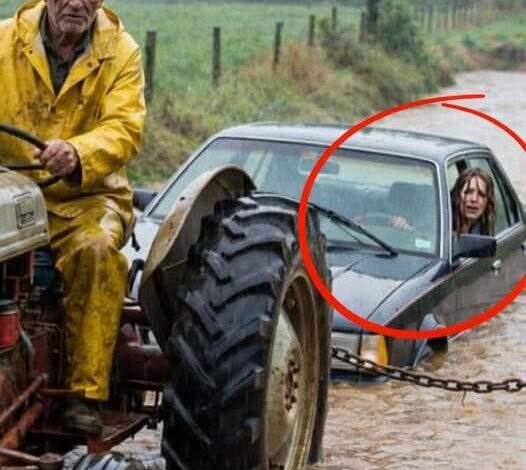
Hank Mercer didn’t have time to think about his debts, the quiet ache of losing his wife, or the steady pressure from the bank when the sharp, desperate blare of a car horn cut through the storm.
It was the kind of storm that felt unnatural—violent, relentless, as if the sky had opened and refused to close. Rain crashed down in thick sheets, turning the familiar roadside ditch along County Road 18 into a churning, dangerous current. From his porch, Hank saw something that made everything else disappear.
A car.
Half-submerged. Spinning. Being dragged by the rushing water toward a narrow culvert that would swallow it whole.
Inside, a woman pounded against the window, her panic visible even through the storm.
Nothing else mattered.
Not the overdue bills on his table. Not the silence in his house since Ellen was gone. Just that moment—and the life slipping away in front of him.
Hank didn’t hesitate.
At fifty-two, his body wasn’t as forgiving as it once had been, but instinct pushed him forward. He ran into the rain, boots sinking into the mud, and climbed onto his tractor. The engine roared to life, cutting through thunder as he drove straight into the flood.
Water surged around him, resisting every movement. The tractor groaned under the pressure, but Hank pushed on.
When he reached the car, he climbed down.
The water hit him like a wall—cold, powerful, rising to his hips and pushing hard enough to knock him off balance. Each step was a fight. The current clawed at him, trying to drag him sideways, but he kept moving, gripping a heavy logging chain with numb, shaking hands.
Time blurred.
There was no room for fear, only action.
He reached the car and struggled to wrap the chain around the front axle, his fingers slipping against metal slick with rain and mud. The vehicle jerked under the force of the current, threatening to tear free before he could secure it.
Finally, it held.
Hank pulled himself back toward the tractor, lungs burning, body trembling, and signaled for the pull.
The engine strained.
For a moment, nothing happened.
The car felt glued to the earth, trapped by mud and water.
Then—suddenly—a violent jolt.
It broke free.
Slowly at first, then with force, the tractor dragged the car back toward solid ground, just seconds before it would have disappeared into the culvert.
Hank rushed forward and yanked the door open.
Inside, the woman—Rachel Whitaker—was shaking uncontrollably, her body weak from cold and shock. Without thinking, Hank wrapped her in the first thing he had within reach: an oversized flannel shirt that had once belonged to his wife.
It still carried her warmth.
Rachel clung to it like it was the only steady thing left in the world.
“I won’t forget this,” she whispered.
Before Hank could answer, headlights cut through the rain.
A dark SUV pulled up. People moved quickly—efficient, quiet, almost too practiced. They ushered Rachel away with urgency, leaving behind only tire tracks in the mud and a silence that felt heavier than the storm itself.
Hank stood there, soaked, breathing hard, watching them disappear.
Then he went back inside, expecting life to continue as it always had.
But it didn’t.
Morning brought something worse than the storm.
Officials.
Vehicles lined his property before sunrise. Men in dark jackets stepped out, carrying clipboards and authority that left no room for argument. They moved across his land, marking it with bright flags and yellow tape, transforming his farm into something unrecognizable.
They called it inspection.
They called it safety.
Hank called it something else entirely.
Everything they pointed to—drainage issues, fuel residue, his use of machinery during the flood—wasn’t new. It was the result of years spent trying to keep the farm alive with limited resources.
But to them, it was violation.
And their decision came quickly.
Thirty days.
A stop-work order.
To them, it was procedure.
To Hank, it was the end.
“You shut me down for thirty days,” he said, voice tight with disbelief, “there won’t be anything left to come back to.”
But it didn’t matter.
The paperwork had already decided.
Soon after, more officials arrived—this time from rural development. They spoke of environmental mitigation, excavation, necessary intervention. Words that sounded clean, reasonable… until they told him he had to leave.
The farmhouse wasn’t “safe.”
The land needed to be “cleared.”
And just like that, Hank packed a single bag.
He left his dog with a neighbor. Walked away from the land his family had worked for generations. And was relocated to a distant lodge that felt more like a holding place than a home.
The lodge was quiet. Too quiet.
Clean. Ordered. Empty of meaning.
At night, Hank sat by the window, staring out at a still lake that felt foreign—nothing like the land he had known his entire life.
Back home, machines tore through his fields.
Every passing day erased something.
Standing at the edge of that lake, coffee gone cold in his hands, Hank felt the weight of it all.
The storm had passed.
But something else had taken its place.
He had risked everything—without hesitation—to save a life.
And now, he was watching his own life be dismantled piece by piece.
When he called his neighbor, hoping for some kind of reassurance, he got something else instead:
“They’ve already started digging,” Roy told him.
The ditch. The place where it all happened.
Gone.
Replaced by machinery and orders.
Hank stood there in silence, the memory of Rachel’s voice still echoing in his mind. He wondered if she remembered his name. If she knew what had happened after she left.
If the Mercer farm—once built on generations of work, sacrifice, and stubborn resilience—would survive at all.
And in that quiet moment, one truth settled in:
Sometimes, the most devastating floods don’t come from rain.
They come from systems that move forward—
and never look back.