My Son Fell into a Coma After a Walk with His Dad – In His Hand Was a Note: ‘Open My Closet for the Answers, but Don’t Tell Dad’

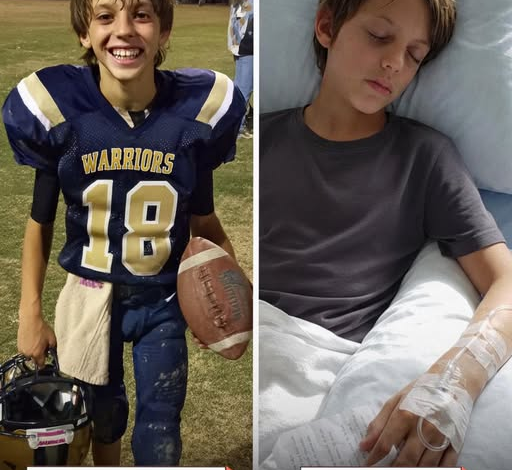
When my thirteen-year-old son didn’t wake up, the world didn’t shatter all at once—it narrowed. It shrank to the sound of machines, the smell of antiseptic, and the sight of his small body lying still beneath hospital lights. But what I found later—a note clenched in his hand and a message I had almost overlooked—forced me to face a truth I wasn’t ready for… and decide just how far I was willing to go to protect him.
I remember the hospital at three in the morning—the brightness, the silence, the way everything felt too clean, too sharp.
Just hours earlier, Andrew had left the house with his father for a simple walk. Nothing unusual. Nothing alarming.
“Take your inhaler, just in case,” I had called after him.
He rolled his eyes like he always did, but he smiled.
That was the last normal moment.
After that, there was only the phone call.
By the time I reached the ER, Andrew was already unconscious.
Brendon—my ex-husband—sat slumped in a chair, pale and shaken. When he looked at me, I barely recognized him.
“I don’t know what happened,” he kept repeating. “One second he was fine, the next he collapsed.”
His words felt rehearsed, like he was trying to convince himself as much as me.
A doctor approached, her voice calm but heavy with urgency.
“Andrew went into cardiac arrest briefly. We were able to revive him, but he’s unresponsive. We’re still trying to determine the cause.”
Every word felt like it landed somewhere deep inside my chest and stayed there.
I stood by Andrew’s bed, watching the rise and fall of his chest, listening to the steady rhythm of machines that now spoke for him.
Brendon cried behind me—loud, uncontrolled—but something didn’t sit right.
He had always minimized Andrew’s health. Skipped appointments. Brushed off symptoms.
And now, suddenly, he was overwhelmed?
My instincts stirred, quiet but persistent.
When the room finally emptied and silence settled, I took Andrew’s hand.
“I’m here,” I whispered. “You don’t have to do this alone.”
That’s when I noticed his fist.
Tightly closed.
I gently pried his fingers open, my heart racing.
Inside was a small, crumpled piece of paper.
His handwriting.
“Mom, open my closet for the answers. BUT DON’T TELL DAD!”
I felt something cold settle in my chest.
At home, everything felt wrong.
Too quiet. Too still.
Andrew’s room still smelled like him—soap, laundry detergent, something familiar and comforting that made my throat tighten.
His closet door was slightly open.
Inside, everything looked normal at first. Clothes. Shoes. Nothing out of place.
Then I saw the shoebox.
Tucked high on a shelf, hidden behind old things.
Inside it, my world shifted again.
There were medical papers.
Appointment confirmations.
And one document that made my hands go numb.
“Appointment canceled by parent — Brendon.”
Not missed.
Canceled.
On purpose.
Beside it, a small note from Andrew:
“Dad said I don’t need it. Mom is going to freak out.”
My breath caught.
My phone buzzed.
Brendon.
I answered.
“Why did you cancel his appointment?” I asked, my voice tight.
“He didn’t need it,” he said quickly. “You always overreact.”
Overreact.
The word echoed in my head.
“He trusted you,” I said. “And you ignored him.”
He hung up.
Then I saw the notification.
A message I hadn’t opened.
A video.
From Andrew.
My hands trembled as I pressed play.
His face filled the screen.
He looked pale. Scared.
“Hey, Mom… I don’t feel good. My chest hurts, and I feel dizzy. Dad says it’s nothing… but I’m scared.”
My heart broke in slow motion.
In the background, Brendon’s voice cut in:
“Put that away, Andrew! You’re fine. Stop making a scene.”
The video ended.
I sat there, frozen.
He had reached out.
He had trusted me.
And I hadn’t seen it in time.
The guilt hit like a wave—but it didn’t stop me.
It pushed me forward.
By morning, everything changed.
I went back to the hospital with the evidence—the note, the records, the video.
The doctor listened carefully.
The social worker took notes.
And then, quietly but firmly, they made a decision.
“You’ll be listed as Andrew’s primary medical decision-maker moving forward,” the doctor said. “We’re updating his care immediately.”
For the first time, I felt something shift.
Not relief.
But control.
Brendon didn’t argue.
He just sat there, smaller somehow.
“I thought he’d be okay,” he said quietly.
But “thinking” wasn’t enough.
Not when Andrew had asked for help.
Not when he had been afraid.
Back in Andrew’s room, I held his hand again.
“I found it,” I whispered. “I found what you wanted me to see.”
The monitors continued their steady rhythm.
Proof that he was still here.
Still fighting.
Later, the doctor returned.
“We’ve adjusted his treatment plan,” she said. “There’s reason to be hopeful.”
Hope.
It felt fragile.
But it was enough.
That night, I stayed by his side.
The room dim. The machines steady.
My hand on his.
“If you wake up,” I whispered, “you’ll know I chose you.”
Because I did.
And I will.
Every single time.