A Quiet Moment At A Family Barbecue Turns Into A Powerful Lesson When A Young Girl’s Simple Words About Fairness And Shared Responsibility Gently Challenge An Outdated Belief, Reminding Everyone Present That True Respect Isn’t Demanded Through Authority But Reflected Through Actions, Values, And The Example We Set For The Next Generation

At first, it didn’t feel like something worth holding onto.
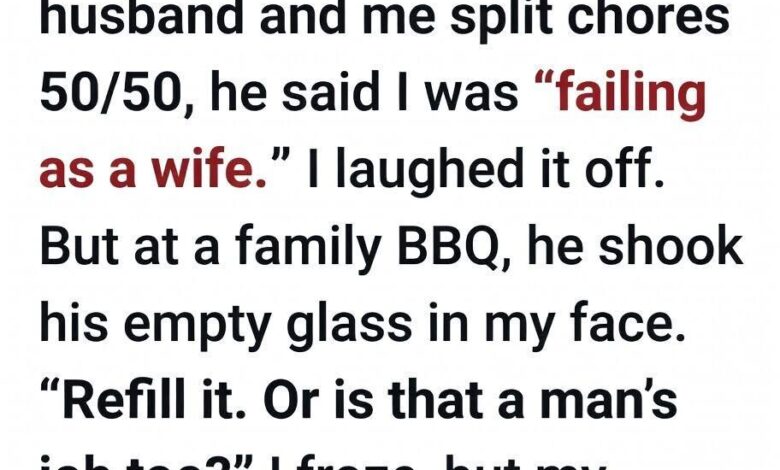
When my father-in-law laughed after hearing that my husband and I shared responsibilities at home, I told myself it was just a passing comment.
“You’re failing as a wife,” he had said, shaking his head as if it were something amusing.
I smiled politely and let it go.
In our home, things were different. My husband and I didn’t divide life into “his” and “hers.” We cooked together, cleaned together, made decisions together. It wasn’t perfect, but it was fair—and it worked. That mattered more than fitting into someone else’s expectations.
Still, even the things we ignore have a way of staying with us.
His words lingered—not loud enough to upset me, but not quiet enough to disappear. I chose not to dwell on them. Peace felt easier than confrontation.
A week later, we were all together again.
The barbecue was simple—good food, warm air, familiar laughter. For a while, everything felt easy. I relaxed, reminding myself that not every opinion deserved space in my mind.
Then it happened again.
In the middle of conversation, my father-in-law stepped closer and held out his empty glass.
“Refill it,” he said casually. Then, with that same half-smile, “Or is that a man’s job too?”
This time, it landed differently.
The conversations around us slowed. Then stopped. I could feel the shift without even looking up—the quiet weight of attention, of expectation.
For a moment, I froze.
Not because I didn’t know what to say—but because I was deciding whether I should say anything at all.
Silence would’ve been easier.
I had chosen it before.
But before I could choose it again, a chair scraped softly against the ground.
I turned.
My daughter was standing.
She was only seven—small, quiet most of the time—but steady in that moment. There was no hesitation in her face, no uncertainty.
She looked directly at her grandfather.
“Grandpa,” she said calmly, “in our house, everyone helps. That’s what makes it fair.”
No anger. No defiance.
Just truth.
Simple and clear.
The silence that followed was different.
Not tense—thoughtful. Like everyone needed a second to sit with what she had just said.
My father-in-law lowered his glass.
For the first time, his expression shifted. Not into laughter. Not into defense.
Just… quiet.
No one rushed to speak. No one tried to smooth it over.
Eventually, conversation returned—but softer. More aware.
Something had changed.
Later that evening, as we walked home, I reached for my daughter’s hand. She took mine without a second thought, as if nothing unusual had happened.
To her, it hadn’t.
She hadn’t spoken up to prove a point. She hadn’t tried to challenge anyone.
She had simply said what she knew to be true.
What she had seen.
What she had learned.
What we had shown her.
And that stayed with me.
Because the most powerful lessons aren’t always the ones we explain.
They’re the ones we live.
Children notice everything—the way we treat each other, the way we share responsibility, the way we show respect without needing to say it out loud. They take those quiet patterns and turn them into their understanding of the world.
In that moment, my daughter wasn’t just speaking for herself.
She was reflecting the life we had built together.
And somehow, her words carried more weight than anything I could have said.
There was no argument. No raised voices.
Just a simple reminder—
that respect isn’t about roles.
It’s about fairness.
It’s about partnership.
It’s about recognizing that everyone matters.
As we kept walking, something became clear in a way it hadn’t before.
We weren’t just building a home where responsibilities were shared.
We were building a home where respect was understood.
Not as a rule.
Not as something forced.
But as something natural.
Something lived.
And in doing that, we were raising someone who didn’t just accept fairness—
she expected it.
Someone who didn’t need to raise her voice to be heard.
Someone who understood that strength doesn’t always come from being loud—
but from being certain.
That night, I didn’t think about the comment that started it all.
I thought about what came after.
Because sometimes, change doesn’t come from confrontation.
Sometimes, it comes from something much simpler—
a child standing up,
telling the truth,
and reminding everyone what respect really looks like.