A Simple Handshake Symbol Appearing in Parking Spaces Is Quietly Changing How People Buy and Sell Online, Turning Ordinary Lots Into Safer Meeting Points That Help Prevent Scams, Reduce Risk, and Build Trust Between Strangers in an Increasingly Digital Marketplace

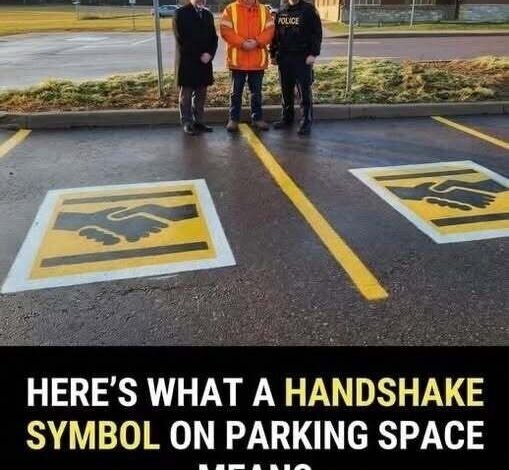
In a world where so much of daily life has shifted online, the moment when two strangers finally meet face-to-face has become one of the most unpredictable parts of the process. Digital marketplaces have made buying and selling faster, easier, and more accessible than ever—but they’ve also introduced a layer of uncertainty that many people underestimate. What feels like a simple transaction on a screen can quickly become uncomfortable, or even risky, once it moves into the real world. Against that backdrop, a small and easily missed detail—a handshake symbol painted onto a parking space—is beginning to carry much more meaning than it first appears.
In communities like Pembroke, Ontario, these marked spaces are being introduced as designated safe exchange zones, often positioned outside facilities like the Ontario Provincial Police station. The idea behind them is straightforward but effective: instead of arranging to meet a stranger in an isolated or unfamiliar location, buyers and sellers are encouraged to use a neutral, public space designed with safety in mind. It’s a subtle shift in behavior, but one that can significantly reduce the chances of something going wrong.
The rapid growth of online marketplaces has changed not only how people shop, but how they interact with one another. Transactions that once took place in stores or through known networks now often happen between complete strangers. While this opens up opportunities—better prices, wider selection, greater convenience—it also creates vulnerabilities. Reports of scams, robberies, and deceptive meetups have made many users more cautious, but not always more prepared. The handshake symbol acts as a quiet intervention, reminding people that safer alternatives exist and are often just as convenient.
What makes these zones effective is not just their visibility, but their environment. They are typically located in well-lit, high-traffic areas with clear lines of sight, often within close proximity to law enforcement. Officers are not directly involved in the exchanges, but their presence nearby changes the dynamic. It introduces a sense of accountability, making it far less likely that someone will attempt dishonest or harmful behavior. For many, that added layer of reassurance is enough to transform a potentially stressful interaction into a routine one.
The initiative—commonly known as Project Safe Trade—reflects a broader shift in how safety is approached. Rather than waiting for incidents to occur and responding afterward, programs like this focus on prevention. They aim to shape behavior by making safer choices more obvious and accessible. It’s a recognition that public safety isn’t only about enforcement—it’s also about design, awareness, and giving people the tools to protect themselves before problems arise.
There’s also something symbolic about the handshake itself. Long before digital transactions, a handshake represented agreement, trust, and mutual respect. By placing that image in a physical space, communities are bridging the gap between online interaction and real-world accountability. It’s a visual cue that requires no explanation, signaling clearly that this is a place where transactions should be conducted openly and respectfully.
Of course, these spaces are not a complete safeguard. They work best when paired with basic precautions—meeting during daylight hours, informing someone of your plans, and keeping communication within the platform when possible. Safety, in this context, is layered. The designated zones provide a strong foundation, but individual awareness and good judgment remain essential.
As more towns and cities adopt similar measures, the handshake symbol may become increasingly familiar—a quiet but powerful marker of how communities are adapting to modern habits. It represents an evolution in everyday safety, one that acknowledges how technology has reshaped human interaction while still emphasizing the importance of trust and personal security.
In the end, the concept is remarkably simple, yet its implications are meaningful. A painted symbol on a parking space may not seem groundbreaking, but it reflects a deeper understanding of how people live today. It shows that sometimes the most effective solutions aren’t complex—they’re thoughtful, visible, and built around the small decisions people make every day.