UNPRECEDENTED GLOBAL SHOWDOWN AS TRUMP UNLEASHES CHILLING TWO WORD ATTACK ON POPE LEO AMID INTERNATIONAL CRISIS

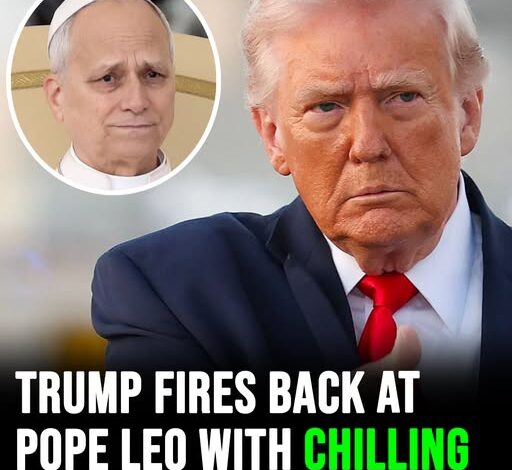
The world is watching an unusually intense clash unfold—one where political power and spiritual authority have collided in full public view. What began as criticism has quickly escalated into something far deeper: a battle over influence, values, and who gets to define truth in a time of global uncertainty.
This is no longer just about policy or military decisions. It has become a high-stakes confrontation shaped by ideology, personality, and competing visions of leadership—played out on a global stage.
A Moral Challenge That Sparked the Fire
The tension ignited when Pope Leo XIV stepped away from the usual cautious tone of diplomacy and delivered a strong moral critique of ongoing conflict. Rather than focusing on strategy or geopolitics, he framed the situation as a test of human conscience.
He spoke about the cost of war—not in terms of territory or power, but in human lives. Children, the elderly, and the vulnerable became the center of his message. He warned against what he described as a dangerous focus on power and control at the expense of compassion and responsibility.
It was a call not just to leaders, but to the world: to look beyond politics and remember the human consequences.
A Political Counterattack
Donald Trump responded in a very different tone.
Rather than engaging with the moral argument, he reframed the situation as a challenge to his authority. His reaction shifted the focus away from humanitarian concerns and toward power, influence, and personal credibility.
By questioning the Pope’s strength and authority, Trump attempted to reposition the debate—not as a moral discussion, but as a contest of dominance. In doing so, he turned what began as a plea for restraint into a highly personal and political exchange.
Two Visions of Leadership
At the heart of this conflict is a deeper divide.
- Pope Leo XIV’s approach emphasizes empathy, restraint, and the protection of human life. It reflects a belief that leadership carries a moral responsibility to shield the vulnerable.
- Trump’s approach prioritizes strength, control, and assertiveness, viewing challenges—especially public ones—as something to confront directly and forcefully.
These are not just different strategies—they are fundamentally different philosophies about what leadership should look like in times of crisis.
A Growing Global Divide
The impact of this clash extends far beyond the two figures involved.
Across the world, reactions have been sharply divided. Religious communities, political leaders, and everyday citizens are finding themselves pulled between two perspectives—one rooted in moral accountability, the other in political strength.
This polarization reflects a broader reality: modern society is increasingly fractured, with even shared values becoming points of contention.
Meanwhile, the real-world consequences of conflict continue to unfold, often overshadowed by the intensity of the rhetoric.
The Risk Beneath the Rhetoric
What makes this situation particularly concerning is not just the disagreement itself, but what it represents.
When moral appeals are dismissed as political attacks, and when leadership becomes defined primarily by dominance, the space for meaningful dialogue begins to shrink. The usual boundaries that guide international conduct—respect, restraint, and mutual understanding—start to erode.
And in that environment, the voices of those most affected by conflict—the civilians—risk being drowned out entirely.
Who Holds the Real Influence?
One of the central questions emerging from this confrontation is simple, yet profound:
Where does true authority come from?
Is it rooted in moral guidance and long-standing tradition?
Or in political power and the ability to command attention and loyalty?
The answer is not clear—and that uncertainty is part of what makes this moment so significant.
What Gets Lost in the Noise
As the exchange continues, one reality remains unchanged: the people most affected by global conflict are rarely the ones shaping the conversation.
While headlines focus on sharp words and public reactions, the human cost persists in the background—families, communities, and lives disrupted by forces far beyond their control.
In many ways, that is the most important part of the story—and the easiest to overlook.
A Defining Moment
This clash is more than a headline. It’s a reflection of a world struggling to balance power and principle, influence and responsibility.
As the situation evolves, one thing is certain:
The outcome won’t just shape political narratives—it will influence how leadership itself is understood in the years ahead.
And in that sense, this isn’t just a disagreement.
It’s a defining moment.