An Elderly Woman Tried to Pay for Her $15 Pizza with a Plastic Bag of Change – So I Made a Decision I Can’t Undo

I delivered a pizza to an elderly woman that night, thinking it would be just another quick stop before the end of my shift. But the moment I stepped onto her porch, something felt off.
The March air was biting, the kind that cuts straight through your jacket, but what really unsettled me was the house itself—dark, quiet, almost forgotten. The yard was overgrown, the windows black. I checked the address twice, balancing the pizza box in one hand and my phone in the other. It matched. The note on the order read: “Please knock loud.”
I hesitated, then knocked harder than usual.
“Come in,” a voice called from inside.
Every instinct told me that was a bad idea. But I was behind on deliveries, and the voice didn’t sound threatening—just tired. So I pushed the door open.
Inside, it was colder than outside. The only light came from an open refrigerator in the kitchen, casting a pale glow across the room. I stepped in, the floor creaking under my feet, and felt a chill that had nothing to do with the weather.
“Back here,” she called again.
I followed the voice into a small living room. An older woman sat in a recliner, wrapped in layers of blankets. A single candle flickered beside her, barely lighting her face. Her eyes went straight to the pizza.
“Ma’am… are you okay?” I asked carefully. “It’s freezing in here.”
“I’m fine,” she said, almost too quickly. “Heat costs money. Medication comes first.”
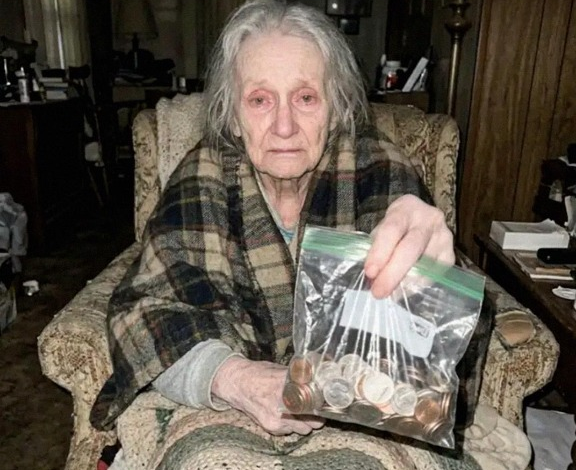
Then she pushed a small plastic bag toward me.
It was filled with coins—quarters, dimes, nickels, pennies. Carefully saved, carefully counted.
“I think this should cover it,” she said.
I looked at the bag, then back toward the kitchen. The fridge held almost nothing—just water bottles and a pharmacy bag. That’s when it hit me.
This wasn’t a treat. This was survival.
“Don’t worry about it,” I said, gently pushing the coins back. “It’s already paid for.”
She frowned. “I don’t want you getting in trouble.”
“I won’t,” I said, forcing a smile. “I own the place.”
I don’t know why I said that. Maybe because it was easier than letting her spend what little she had.
She studied me for a moment, then nodded. “Thank you… Kyle.”
I set the pizza on her lap. When she opened the box, steam rose into her face, and she closed her eyes like she was soaking in the warmth. That moment stuck with me—the way something so simple meant everything.
I left soon after, but I couldn’t shake the feeling that I was walking away from something wrong.
Sitting in my car, staring at her dark house, I knew I couldn’t just leave it like that. No heat. No food. No one checking on her.
So I made a call.
At the police station, I explained everything—the cold house, the empty fridge, the way she said she was “fine” like it was something she’d practiced. They listened, then sent someone to check on her.
I left feeling like I’d done the right thing.
But when I drove past her house, I saw the ambulance.
Lights flashing. Neighbors gathered. Paramedics helping her out.
And then she saw me.
“You!” she shouted, pointing. “This is your fault.”
I stepped closer, trying to explain. “I was worried about you.”
“I told you I was fine!” she snapped. “They’re taking me out of my home because of you!”
The neighbors turned on me, accusing, angry. Like I’d crossed a line I had no right to cross.
I drove away that night with my hands shaking, her words echoing in my head.
This is your fault.
For days, I couldn’t stop thinking about it. Every delivery felt different. Every quiet house made me wonder what I wasn’t seeing.
I kept telling myself I’d done the right thing.
It didn’t feel like it.
Then, about a week later, I got another delivery.
Same address.
I almost didn’t go. But I did.
When I got there, the porch light was on. The house looked… alive.
Inside, it was warm. Bright. Full of people.
Neighbors moved around the kitchen, unpacking groceries, setting up heaters. Kids sat on the floor, laughing. And there she was, in her chair—but without all the blankets.
She looked stronger.
When she saw me, her face lit up.
“I’m glad you came,” she said, smiling. “Come here.”
One of the neighbors took the pizza and handed me cash. Another stepped forward and said quietly, “We’re sorry. We didn’t realize how bad it had gotten.”
“We all missed it,” someone else added.
No one argued.
The woman reached for my hand. “I owe you an apology,” she said. “I was scared. Angry. But the doctors told me… if I’d stayed like that much longer…”
She didn’t finish the sentence.
“But you’re home now,” I said.
“Because of you,” she replied. “You were the only one who saw it.”
Around us, the neighbors explained—visits every day, meals, help from local services. They weren’t pretending anymore. They were showing up.
And for the first time since that night, the guilt in my chest started to lift.
Standing there, in that warm room filled with people who had finally stepped in, I understood something I hadn’t before.
Doing the right thing doesn’t always feel right.
Sometimes it feels like betrayal.
Sometimes it makes people angry.
Sometimes it costs you the comfort of being liked.
But sometimes, what you interrupt isn’t someone’s independence—
it’s the quiet, dangerous lie that everything is okay when it isn’t.