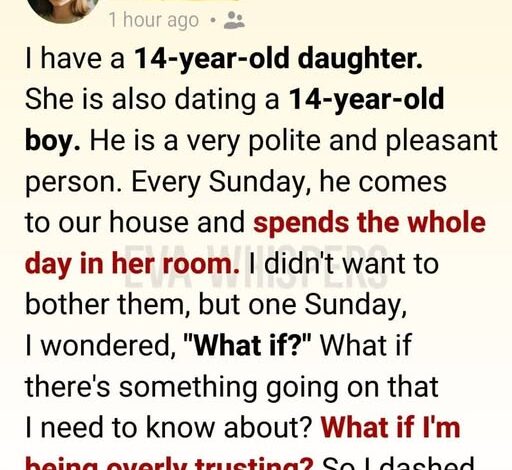
Parenting is built on a fragile balance between trust and watchfulness. When my daughter turned fourteen, that balance began to shift. The easy openness of childhood slowly gave way to the layered complexity of adolescence. With that change came a quiet, constant undercurrent of worry—the kind that hums softly in the background of every decision and interaction.
So when she started spending her Sunday afternoons with Noah—a boy so polite and thoughtful he almost seemed too perfect—I found myself caught between two instincts. One part of me wanted to give her the independence she deserved. The other part stayed alert, scanning for signs that something might be wrong.
What unsettled me wasn’t anything Noah did. It was the silence.
Every Sunday, without fail, they would retreat to her room and close the door. And then—nothing. No music drifting through the walls, no bursts of laughter, no familiar chatter of teenage life. Just a stillness that felt unnatural in a house usually alive with noise.
To a parent, silence isn’t always peaceful. Sometimes, it feels like a question waiting to be answered.
Over time, that quiet began to weigh on me. It felt intentional, like a wall being built just out of reach. And inside that silence, my imagination started filling in the blanks with possibilities I couldn’t ignore.
One afternoon, I reached my limit.
I was folding laundry, but my thoughts were fixed on the closed door down the hall. Eventually, the voice telling me to “be responsible” drowned out the one urging me to respect her privacy. I set down the towels and walked toward her room, my heartbeat picking up with every step.
I told myself I was just checking in. That it was my job to make sure everything was appropriate.
I braced myself for what I might find.
But when I opened the door, everything I expected fell apart.
They weren’t sitting on the bed or staring at their phones. Instead, they were on the floor, surrounded by notebooks, markers, and a large piece of cardboard covered in notes, drawings, and photos.
They looked up, startled—but not guilty. Just surprised, like I had interrupted something important.
My daughter hesitated for a moment before explaining.
What they had been working on wasn’t a secret relationship or something they were hiding.
It was something much bigger.
A year earlier, my father—her grandfather—had suffered a stroke. It changed everything. He had once been a passionate teacher, someone who found purpose in helping others learn. After the stroke, that part of his life seemed to disappear.
He struggled—not just physically, but emotionally. The world he knew no longer felt like it had a place for him.
My daughter had noticed.
And quietly, without telling anyone, she and Noah had spent their Sundays trying to fix that.
The board on the floor wasn’t just a project—it was a plan.
They had designed a small literacy program for the neighborhood. They’d researched community spaces, outlined lesson ideas, gathered books, and even worked out a simple budget.
They called it “Grandpa’s Reading Corner.”
Their goal was simple: give him a way back to what he loved, in a way that worked with his new limitations.
They hadn’t been silent because they were doing something wrong.
They’d been silent because they were focused. Because what they were building required care, patience, and thought.
Standing there, I felt something shift inside me.
All the worry I had carried down that hallway didn’t just fade—it dissolved completely. In its place was something else entirely.
Humility.
I had expected to step in as the parent who needed to correct something.
Instead, I had walked into a space where something deeply good was already growing—without me.
When I left the room, the quiet didn’t feel heavy anymore.
It felt meaningful.
Back in the living room, I sat for a moment, thinking about how easily fear narrows our perspective. How quickly we assume the worst when we don’t understand what’s happening.
That closed door hadn’t been hiding trouble.
It had been protecting something beautiful.
Parenting often feels like planting seeds and hoping they take root. We worry constantly—wondering if we’ve done enough, said the right things, set the right example.
But sometimes, the real growth happens where we can’t see it.
In quiet rooms.
In moments we almost interrupt.
In choices our children make when we’re not watching.
The literacy program eventually became real.
And one day, I saw my father sitting in a small chair, surrounded by children, reading to them. His voice wasn’t perfect, but it was steady. Alive again.
It was a moment I could have missed entirely—if I had stayed focused only on what I feared instead of what was quietly being built.
I still guide my daughter. I still pay attention. That part of parenting never goes away.
But now, I carry a different kind of trust.
A quieter one.
The kind that reminds me that even behind closed doors, something good might be taking shape.
And sometimes, the most important thing a parent can do… is step back, listen less for trouble, and believe that their child is capable of creating something meaningful—even in silence.