BEYOND THE MIRROR, The Shocking Truth Your Favorite Lipstick Shade Reveals About Your Hidden Personality

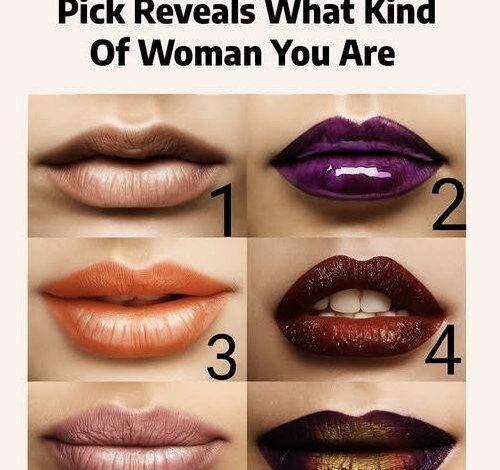
It’s rarely just lipstick.
That quick, almost automatic choice—the shade your hand reaches for without thinking—often says more than we realize. It isn’t only about aesthetics or routine. It’s about identity. About how you feel, or how you want to feel. About the quiet, personal decisions that shape how you step into the world.
Color, in this sense, becomes a kind of language.
Not loud or obvious, but present. It reflects mood, intention, confidence—even the version of yourself you’re choosing to embody that day. And while most of these choices happen unconsciously, they’re rarely random.
Psychologists have long explored the connection between color and emotion. While it’s not an exact formula, certain patterns do appear. The shades we gravitate toward tend to mirror internal states—sometimes revealing things we haven’t fully articulated to ourselves.
Your “go-to” lipstick isn’t just a preference. It can act like a signal.
Part armor.
Part expression.
Part invitation.
Take the nude lip.
Soft, natural, effortless. It doesn’t try to dominate attention, and that’s precisely its strength. People drawn to nude tones often value authenticity over performance. There’s a grounded quality to this choice—a sense of being comfortable without needing embellishment.
It suggests quiet confidence. The kind that doesn’t need validation. The kind that feels stable, consistent, and real.
A nude lip doesn’t say, “Look at me.”
It says, “This is me.”
Now consider bold purple.
This is not an accidental choice.
Whether it leans toward bright violet or deep plum, purple carries intention. It signals creativity, individuality, and a willingness to stand apart from the expected. People who choose it often aren’t interested in blending in—they’re interested in redefining the space they occupy.
There’s courage in that.
It’s a color that invites curiosity, sometimes even challenge. And those who wear it tend to be comfortable with both.
Then there’s deep red.
Few shades carry as much symbolic weight.
Red is deliberate. Timeless. It doesn’t fade into the background—it claims presence. Wearing it is rarely passive; it’s an active decision to be seen.
It suggests clarity and intensity. A person who chooses red often knows what they want, or at the very least, isn’t afraid to pursue it openly. There’s emotional strength here, and a willingness to take up space unapologetically.
Red doesn’t whisper.
It announces.
Orange brings something entirely different.
Energy. Warmth. Playfulness.
It’s bold in a way that feels less serious and more alive. Not everyone feels comfortable wearing orange, and that’s part of its meaning. It reflects a personality that embraces spontaneity, visibility, and optimism.
There’s a certain fearlessness in choosing it—a refusal to shrink or soften.
Orange doesn’t just show up.
It radiates.
Mauve, on the other hand, lives in the in-between.
It’s subtle but layered. Soft, yet not simplistic.
People drawn to mauve often carry a thoughtful, introspective energy. They notice things. They feel deeply. They don’t necessarily seek attention, but they create space for connection.
It’s a color that invites closeness rather than demanding recognition.
Quiet, but not invisible.
And then there are the unconventional shades.
Metallics. Unexpected blends. Colors that don’t sit neatly in one category.
These choices often reflect complexity. A personality that resists being defined too quickly. There’s independence here—a comfort with ambiguity, with evolving identity, with not needing to explain everything at once.
It’s less about fitting in.
More about existing on your own terms.
But here’s the truth:
None of these are fixed identities.
You’re not “a red lipstick person” or “a nude lipstick person” in any permanent sense. What you choose can shift with your mood, your environment, your confidence, or even the role you’re stepping into that day.
Some days, you want to feel grounded.
Other days, powerful.
Other days, playful, invisible, experimental, or entirely new.
Lipstick becomes adaptive—a tool you use, not a label you wear.
And that’s where the real insight lies.
It’s not that you are your lipstick shade.
It’s that you are constantly, quietly deciding how you want to show up.
Sometimes consciously.
Sometimes instinctively.
But always in motion.
So the next time you reach for a color—pause for just a second.
Not to overthink it.
Just to notice.
Because in that small, routine moment, you’re doing something more intentional than it seems.
You’re not just choosing a shade.
You’re choosing a version of yourself to meet the world with.