China’s “Nostradamus” Claims to Know How the US‑Iran War Will End After Two Predictions Came True, Sparking Viral Debate Online, Bold Forecasts, and Global Curiosity About What His Third Prophecy Could Reveal About Future Conflict Outcomes and Global Power Shifts Amid Rising Tensions Between Washington and Tehran

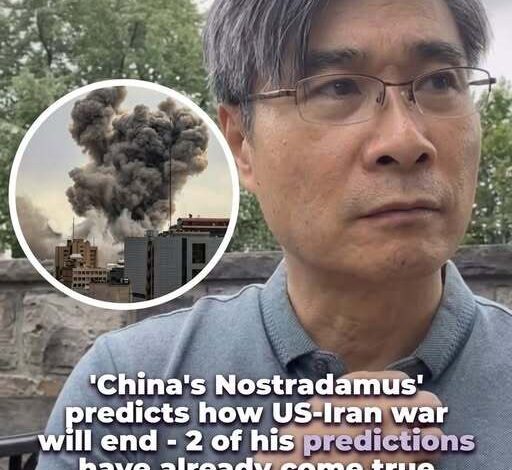
A reserved academic has unexpectedly sparked a wave of discussion online. His message isn’t dramatic or sensational—it’s measured, analytical, and, for many, quietly unsettling. There’s no attempt to shock or provoke. Instead, his tone is calm and methodical, which, paradoxically, makes his warning feel more serious. He suggests that if a major conflict involving global powers emerges, it may unfold in ways that challenge common expectations—particularly in the United States. What’s drawing attention isn’t just his current view, but his past observations. He had previously pointed to the possibility of Trump’s political resurgence when many dismissed it, and he noted rising U.S.–Iran tensions before they returned to headlines. Now, as some of those earlier assessments appear to align with recent developments, his latest analysis is fueling debate among those unsure whether to dismiss him or take a closer look.
Professor Xueqin Jiang doesn’t claim to predict the future. Instead, he focuses on identifying patterns—historical, political, and strategic—that he believes are often overlooked. His work centers on how powerful nations behave when confidence begins to edge into overconfidence, and how those moments can lead to decisions with long-term consequences. In his view, major powers rarely collapse suddenly. More often, they wear down over time through misjudgments, prolonged conflicts, and the gradual erosion of resources and influence.
From this standpoint, he argues that the United States, despite its strength, is not exempt from these broader historical dynamics. At the same time, he emphasizes that countries like Iran are often misunderstood. Rather than a straightforward opponent, Iran operates through layered strategies—regional partnerships, asymmetric approaches, and a deep understanding of its own terrain and political environment. In Jiang’s analysis, this creates conditions where any confrontation could become extended and complex, rather than quick or decisive. What might begin as a controlled engagement could evolve into something far less predictable, where outcomes are unclear and resolution becomes difficult.
Part of what makes his perspective compelling—and controversial—is that it doesn’t offer easy reassurance. Many people prefer to view global conflicts in terms of clear outcomes, where strength leads to swift success. Jiang challenges that assumption, suggesting that modern conflicts are shaped by a wide range of factors beyond military capability—economic pressures, public opinion, alliances, and internal politics all play significant roles.
Reactions to his comments have been mixed. Some critics argue that he is overstating risks or presenting an overly cautious view, emphasizing uncertainty at the expense of confidence. Others see value in his approach, interpreting it as a reminder to think more carefully about complex situations rather than relying on simplified narratives. They suggest that ignoring such perspectives can be as risky as accepting them without question.
Beneath the debate lies a broader point. Jiang’s argument is less about forecasting a specific event and more about highlighting recurring patterns in how nations make decisions. History, he notes, offers many examples of leaders who believed they were acting decisively, only to find themselves in prolonged and difficult situations. These lessons are well documented, but they are not always fully considered in moments of urgency or strong confidence.
In that sense, his message extends beyond strategy into something more reflective. It raises questions about whether societies are willing to learn from past experiences or whether similar patterns may reappear under new circumstances. The concern is not just the possibility of conflict, but the possibility of repeating familiar missteps.
Ultimately, the discussion around Professor Jiang’s views reflects a wider uncertainty. People are trying to understand a complex and evolving global landscape, balancing reassurance with realism. Whether his analysis proves accurate or not, the attention it has received highlights a common challenge: deciding how much weight to give to perspectives that question established assumptions.
His central idea is straightforward, if somewhat unsettling. The greatest risk may not come from a single opponent, but from the confidence that prevents risks from being fully recognized. And history suggests that overlooking that possibility can carry consequences that are difficult to anticipate.