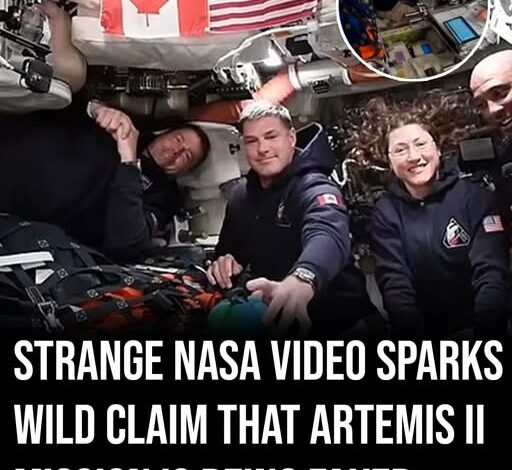
For some viewers, the Artemis II clip has become more than just a brief moment from a space mission—it’s been turned into supposed “evidence” that nothing seen beyond Earth can be taken at face value. In the footage, a small toy named “Rise” floats effortlessly through the capsule, behaving exactly as you’d expect in microgravity. But it’s not the toy that sparks debate—it’s what appears behind it. Letters flicker, shift, and momentarily distort, almost like a poorly rendered visual effect from a low-budget film. To those already inclined to doubt, this tiny visual inconsistency feels significant. It looks, to them, like a slip-up—like catching a magician mid-trick, exposing the illusion.
Once that suspicion takes hold, it tends to grow. The mind starts connecting dots that may not actually be related: if this looks fake, what else might be? The astronauts? The spacecraft? The entire mission? For skeptics, moments like these don’t exist in isolation—they reinforce a larger narrative that space exploration is staged, curated, or manipulated for public consumption.
But the reality behind this “glitch” is far less dramatic—and far more human.
What’s being seen is not evidence of deception, but a simple technical artifact. Broadcast overlays, like the text used by networks such as CNN, rely on compositing techniques similar to chroma keying—the same technology used in weather reports and film production. These systems layer graphics over live video feeds in real time. Occasionally, due to timing mismatches or refresh delays, elements of that overlay can briefly desynchronize. When that happens, fragments of text may appear, disappear, or flicker in ways that look unnatural—especially when viewed frame by frame or out of context.
In other words, what looks like something being “revealed” is actually just something failing to render smoothly.
It’s not a hidden message. Not a green screen mistake. Not a secret slipping through. Just a momentary hiccup in a complex chain of digital processing—something that happens more often than people realize, but usually goes unnoticed.
There’s something almost poetic about it. A mission designed to showcase the extraordinary—humans preparing to return to deep space—momentarily disrupted by something so ordinary: imperfect technology. And in that brief flicker, reality becomes suspicious, not because it is false, but because it isn’t perfectly polished.
In a way, that imperfection is the most authentic part of all.