“Donald Trump Calls White House Reporter a Surprising Nickname, Suggests Possible Legal Steps.”

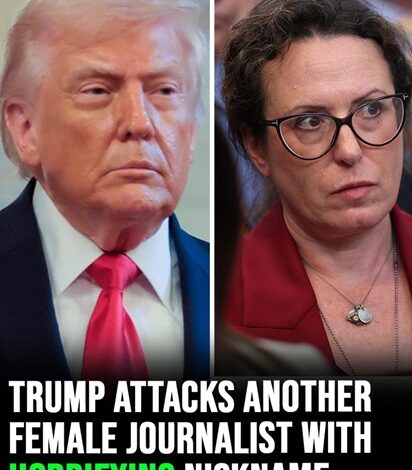
President Donald J. Trump has once again brought attention to his long, often strained relationship with the press—this time directing criticism at Maggie Haberman.
A well-known political reporter whose work has kept her at the center of national conversations for years, Haberman became the focus of Trump’s remarks following a March 6, 2026 post on Truth Social. In that message, Trump used pointed and derogatory language while suggesting she could somehow be connected to a Florida-related lawsuit involving The New York Times. Notably, the post did not reference any specific article or factual claim, leaving observers to interpret the context rather than respond to a clearly defined dispute.
This approach—criticizing journalists without identifying a precise grievance—has been a consistent feature of Trump’s communication style over the past decade, particularly toward media organizations he views as adversarial. During both his presidency and the years since, he has frequently portrayed coverage as biased or misleading, often without directly engaging with the substance of the reporting itself.
Major outlets such as CNN and The Washington Post have regularly appeared in his critiques, alongside The New York Times, forming what he characterizes as a broader media environment aligned against him.
Haberman, a Pulitzer Prize–winning journalist, has built a reputation through extensive reporting on the White House and national politics. Her work often focuses on political strategy, internal decision-making, and behind-the-scenes dynamics, making her one of the most closely followed reporters covering Trump’s political career.
In 2022, she published Confidence Man: The Making of Donald Trump and the Breaking of America, an in-depth account of Trump’s life, business ventures, and presidency. Drawing on years of reporting, interviews, and documentation, the book generated significant discussion in both media and academic circles for its detailed portrayal of his leadership style and influence.
Trump’s relationship with Haberman has remained complicated. While he has granted her interviews—including several for her book—he has also publicly criticized her reporting and questioned her credibility, often in strong and personal terms. At various points, he has dismissed her work as biased and suggested possible investigations into journalists’ sources or legal action against media figures, though such efforts have rarely advanced in court.
Haberman’s reporting itself has also sparked debate. Some critics argue that aspects of her coverage were overly cautious or shaped by the need to maintain access to sources during the Trump years, though these critiques remain part of an ongoing discussion rather than a settled judgment.
Even so, her reporting has been widely cited across media, policy, and academic communities as part of the broader documentation of Trump’s political trajectory.
Trump’s criticism of Haberman fits into a larger pattern of confrontational exchanges with journalists, particularly when reporting challenges his narratives. Similar moments have occurred in interactions with reporters like Kaitlan Collins and Natalie Allison, both of whom have faced public pushback from Trump during interviews or press interactions.
Media analysts often point out that these confrontations serve multiple purposes. They reinforce Trump’s direct communication style while framing unfavorable coverage as part of a hostile or unreliable media system. By speaking directly to his audience—often through platforms like Truth Social—he bypasses traditional editorial channels and shapes how supporters interpret news coverage.
This strategy can strengthen loyalty among his base while also contributing to broader polarization, as audiences increasingly filter information through political perspectives rather than neutral frameworks.
Legal experts note that references to lawsuits or defamation claims—especially involving public figures and major media organizations—face significant hurdles under U.S. law. To succeed in such cases, plaintiffs must demonstrate that false statements were made knowingly and with malicious intent, a high standard designed to protect free expression and investigative reporting.
Although Trump has pursued legal action against journalists and media outlets in the past, many cases have been dismissed or have not resulted in major legal precedents. As a result, public mentions of litigation are often interpreted more as strategic messaging than as indicators of imminent courtroom action.
The ongoing tension between Trump and journalists like Haberman reflects a broader reality in modern politics: the relationship between those in power and those who report on them has always involved friction. What has changed is the scale and immediacy of that conflict, amplified by digital platforms that allow real-time, unfiltered communication.
Platforms such as Truth Social and others have accelerated the pace of interaction, creating an environment where reporting, reaction, and counterreaction unfold almost simultaneously. This dynamic can blur the distinction between news, analysis, and political messaging.
For journalists, this presents a dual challenge—maintaining rigorous standards of verification and accountability while operating under heightened scrutiny and, at times, direct personal criticism. For audiences, it introduces added complexity in interpreting information within an increasingly fast-moving and polarized media landscape.
Within this context, Haberman’s work continues to reflect the traditional role of investigative journalism: examining power, providing context, and documenting developments that extend beyond official narratives.
Her reporting, along with that of her peers, contributes to a broader historical record—one that shapes how current events are understood both in the moment and over time.
Trump’s latest remarks about Haberman, while consistent with his established approach, ultimately highlight a larger dynamic at play. The exchange is less about any single comment and more about the ongoing interplay between political messaging and journalistic inquiry.
On one side is the effort to shape narratives and maintain influence; on the other is the attempt to investigate, contextualize, and inform. The tension between these roles remains a defining feature of contemporary public life.
As debates continue, the relationship between political figures and the press will remain central to how people understand accountability, governance, and the evolving function of media in a rapidly changing information environment.