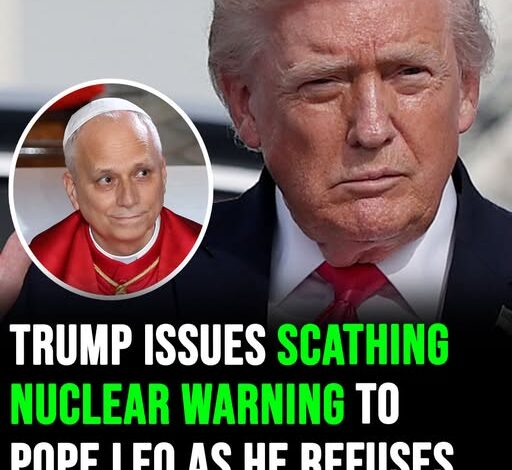
What unfolded was more than a passing disagreement between a president and a pope; it revealed a deeper fracture—two fundamentally different moral frameworks colliding in full public view.
On one side stood Pope Leo, speaking not from a position of political calculation but from a centuries-old moral tradition rooted in human dignity, restraint, and the sanctity of life. In a cathedral in Cameroon, before a crowd that knew firsthand the cost of instability and neglect, he condemned what he called the “logic of tyranny”—a world order where governments pour unimaginable sums into weapons and war while entire populations are left without food, healthcare, or hope. His words were not directed at one nation alone but at a global system he sees as morally inverted, where fear is funded and compassion is deferred.
On the other side stood Donald Trump, speaking in the language of power, deterrence, and national survival. He cast himself as a necessary shield—someone willing to take hard, even controversial positions to prevent what he framed as an existential threat: a nuclear-armed Iran. In his telling, strength is peace’s prerequisite, and hesitation is danger. Yet even as he insisted he was “not fighting with” the pope, he reframed Pope Leo’s stance in a way that blurred its meaning, suggesting the pontiff was soft on nuclear proliferation—an interpretation that runs counter to the Vatican’s long and consistent position.
That position, in fact, is strikingly clear. Pope Leo has repeatedly and explicitly condemned nuclear weapons—not only their use but their very possession. He has called for total disarmament, for renewed diplomacy, and for a global moral awakening that recognizes the inherent contradiction of seeking security through the threat of annihilation. For him, peace is not maintained through fear but built through trust, justice, and shared responsibility.
Trump’s characterization, then, does more than misstate a viewpoint—it transforms a moral argument into a political liability. By doing so, it pulls a spiritual voice into the gravitational field of geopolitical conflict, where nuance is often sacrificed for clarity, and clarity for advantage.
What emerges from this clash is not simply a disagreement over Iran or nuclear policy. It is a broader question about authority and legitimacy in shaping the idea of peace itself. Is peace the product of strength, enforced through dominance and deterrence? Or is it the result of moral courage, sustained through dialogue and mutual restraint?
The tension between these visions is not new, but in moments like this, it becomes sharply visible. One speaks in the language of strategy and survival; the other in the language of conscience and humanity. Both claim to act in the interest of peace, yet they define that peace in profoundly different ways.
And so the question lingers—unanswered and perhaps unanswerable in simple terms: when power, fear, and faith intersect on the global stage, who truly speaks for peace?