The human brain is an extraordinary pattern-detection system. Over thousands of years, it has evolved to quickly identify shapes, relationships, and hidden meanings in the world around us. It constantly scans our environment, organizing chaos into recognizable patterns. But occasionally, that powerful system encounters a strange and intriguing obstacle — a moment when our eyes see everything clearly, yet our mind fails to interpret what’s right in front of it.
This peculiar mental struggle is exactly what makes the “Four Hidden Objects” visual puzzle so fascinating. Recently, this clever challenge has been circulating widely online, drawing in thousands of curious viewers eager to test their observation skills.
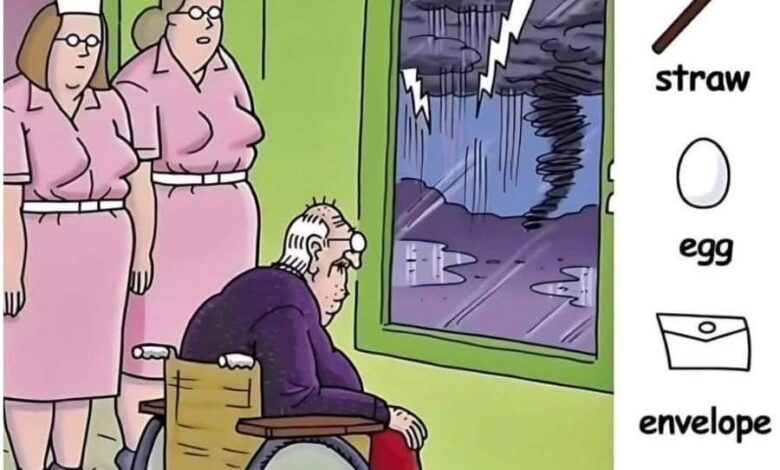
At first glance, the illustration appears simple and straightforward. It shows a quiet yet dramatic indoor scene: a man sitting in a wheelchair, accompanied by two nurses who appear to be watching over him. Outside the window, a storm rages violently, lightning flashing across a dark sky. The entire image feels cinematic and emotionally charged.
But beneath this seemingly ordinary scene lies something far more complex. Hidden within the drawing are four cleverly disguised objects: a straw, an egg, an envelope, and a knife. Each object is carefully blended into the image, designed to challenge the viewer’s perception and force the brain to question its assumptions.
The brilliance of this puzzle lies in a psychological phenomenon called inattentional blindness. This occurs when our brain overlooks something obvious simply because our attention is focused elsewhere. In this case, viewers are naturally drawn to the most dramatic elements of the scene: the wheelchair, the nurses’ uniforms, and the bright lightning outside the window.
These strong visual elements act as attention magnets, absorbing the brain’s focus. While our mind processes these larger details, the smaller hidden objects quietly disappear into the background.
To successfully solve the puzzle, the viewer must do something counterintuitive: ignore the story being told in the image. Instead of seeing the illustration as a hospital scene with people and furniture, it must be viewed as a collection of shapes, shadows, and lines.
The first three objects usually reveal themselves relatively quickly once the viewer adjusts their focus.
The straw is often hidden within straight vertical elements of the picture, such as chair legs, rails, or window frames. Its long, narrow shape blends naturally into these structural lines, making it easy to overlook unless one is actively searching for repeating patterns.
The egg, with its smooth oval shape, tends to be concealed within folds of clothing, shadows, or rounded objects. Our brains are excellent at recognizing organic shapes like eggs, but only when they appear where we expect them. When placed inside a shadow or disguised within fabric folds, the egg can remain invisible for surprisingly long.
The envelope relies on one of the most familiar geometric shapes — a rectangle intersected by diagonal lines. Designers often hide it within surfaces like tabletops, wall panels, or floor tiles where these angles already exist. Because our brain assumes these shapes are simply part of the environment, we rarely question them.
Finding these first three objects often creates a surge of excitement. Each discovery provides a small reward for the brain, a burst of satisfaction that encourages the viewer to keep searching.
But the real challenge — the one that separates casual observers from sharp-eyed puzzle solvers — is the final hidden item: the knife.
In professional puzzle design, this fourth object represents the ultimate form of visual camouflage. Unlike the other objects, which are simply hidden, the knife is fully integrated into the image itself.
It does not appear as a separate object resting somewhere in the scene. Instead, it is created by the very shapes and shadows that form the environment. The blade might be formed by empty space between the spokes of the wheelchair, while the handle could blend seamlessly into the storm clouds outside the window.
This design method is known as feature integration. The brain can see all the individual components that form the object, but it fails to combine them into a recognizable whole because those same components are also part of larger shapes within the scene.
For viewers struggling to locate the final object, puzzle experts recommend changing the way the image is examined.
One effective strategy is the grid method. Instead of scanning the entire picture randomly, mentally divide the image into four sections and analyze each part separately. This helps prevent the brain from becoming distracted by the overall story being told in the illustration.
Another useful approach is to search for unnatural lines or intersections. In carefully designed illustrations, every line typically serves a purpose. If a line appears slightly out of place — not matching the curve of a wheel or the outline of a hand — it may actually be part of the hidden object.
In this particular puzzle, the knife is subtly embedded near the wheelchair and the stormy window. Its metallic edge blends almost perfectly with the gray tones of the scene, making it extremely difficult to distinguish from the surrounding shadows.
The popularity of puzzles like this in recent years reflects something deeper about modern life. In a world filled with constant notifications, endless scrolling, and fragmented attention spans, people rarely get the chance to focus on a single task for more than a few seconds.
Hidden-object puzzles offer a rare moment of deep concentration. For a short time, the brain enters a state of focused curiosity where nothing matters except solving the visual mystery.
There is also a strong social element behind their popularity. People often share these puzzles with friends, family, or coworkers, turning the experience into a friendly competition. Who can find the hidden objects the fastest? Who spots the knife first?
When the final object is finally discovered, most people experience a powerful “aha!” moment — a sudden realization that instantly makes the hidden shape obvious. Psychologists call this insight learning, a moment when the brain reorganizes visual information and suddenly understands what was previously invisible.
What’s fascinating is that once the object is found, it becomes impossible to ignore. The brain permanently updates its interpretation of the image.
Interestingly, this type of mental flexibility isn’t just useful for puzzles. The same cognitive skill is used in many real-world professions. Doctors rely on it when identifying subtle abnormalities in medical scans. Engineers use it when detecting hidden flaws in technical designs. Artists use it to imagine possibilities within blank spaces.
In that sense, these puzzles are more than simple entertainment. They act as small mental exercises that strengthen the brain’s ability to question its first impressions.
So when you look again at the stormy scene — the man in the wheelchair, the nurses beside him, and the lightning outside the window — remember that the hardest things to see are often the ones hidden within what we believe we already understand.
The knife is not just another hidden object. It’s a reminder that reality often contains layers waiting to be uncovered.
And whether it took you seconds or several minutes to find it, the real reward isn’t just the answer — it’s the process of searching.
Because once you begin training your eyes to question what they see, you’ll start noticing hidden details everywhere.