I Brought Nanas Heavy 18-Karat Gold Heirloom Earrings to a Pawn Shop to Pay My Mortgage – The Appraisers One Sentence Left Me Trembling in the Middle of the Store!

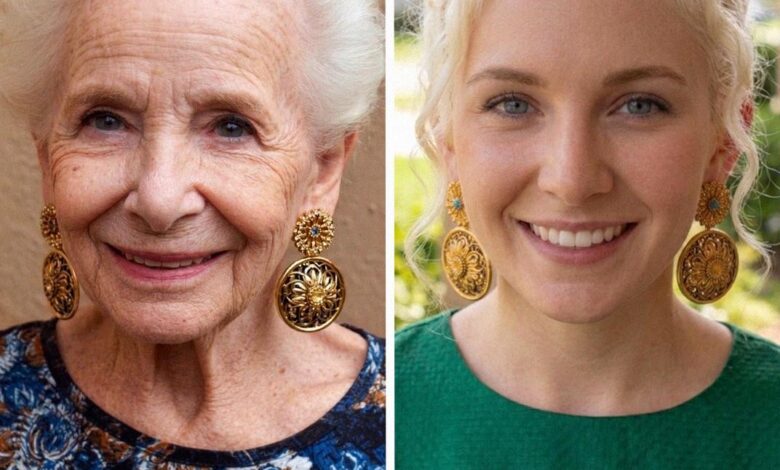
I walked into that pawn shop already convinced I was about to let go of the last piece of my grandmother I still had. I told myself it was just a thing, that holding onto it wouldn’t keep the lights on or pay the bills. When you’re out of options, you learn how to quiet the part of you that wants to hold on. What I didn’t expect was that the man behind the counter would look at it—and everything would change.
My name is Meredith. I’m 29, and I’m raising three kids on my own. Two years ago, my husband left. He chose a different life, one that didn’t include us. I stayed behind and held everything together—school schedules, groceries, rent, all of it. I kept going, even when it felt like I was barely keeping things from falling apart.
Then my youngest got sick.
The medical bills came fast. Faster than I could handle. I borrowed money, thinking I could catch up later. I couldn’t. And just when things couldn’t get worse, I lost my job—over a quick, impersonal phone call. “Company restructuring,” they said. Just like that, I was on my own.
That’s when I pulled out the box.
Inside were my grandmother’s earrings—18-karat gold, delicate, beautiful. I remembered the day she gave them to me. The way she smiled and said, “These will take care of you someday.”
I always thought she meant financially. Like a backup plan I’d hopefully never need.
But here I was.
The pawn shop was quiet, smelling faintly of old wood and metal. The man behind the counter didn’t seem particularly interested at first.
“What can I help you with?” he asked.
“I need to sell these,” I said, placing the box in front of him.
He opened it without much thought. But when he picked up one of the earrings and held it up to the light, something shifted.
His hands trembled.
He leaned in, studying it carefully with a jeweler’s loupe, turning it slowly. The silence stretched long enough to make my chest tighten.
“What is it?” I asked.
Instead of answering, he looked at me closely. “Where did you get these?”
“They were my grandmother’s.”
“What was her name?”
I told him.
He shut his eyes for a moment, like he was steadying himself, then reached under the counter and pulled out an old photograph.
When he placed it in front of me, my breath caught.
It was her.
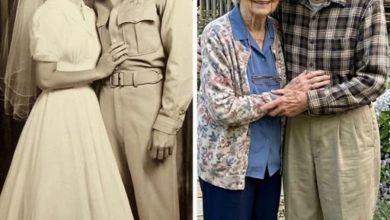
My grandmother, younger than I had ever seen her, smiling in a way that felt completely new to me. Standing beside her was the same man now in front of me—only decades younger. And on her ears… the earrings.
I looked up, my voice shaking. “Who are you?”
“My name is Walter,” he said softly. “And I’ve been waiting a long time to meet someone from her family.”
I didn’t know what to say.
“I made those earrings,” he added.
He flipped one over and pointed to a tiny marking near the clasp. I leaned closer. A small “W” was stamped there.
“I made them for her,” he said.
My thoughts were spinning. “But… she was married.”
He nodded. “Just not to me.”
He motioned for me to sit, and I did. My legs felt unsteady anyway.
He began to tell me about them—how they had loved each other deeply, how they had planned a future together. But her family had pushed her in a different direction. She married someone else, built a life from that choice.
“I don’t blame her,” he said quietly. “Sometimes people don’t get to choose the life they really want.”
I shook my head. “She never told us any of this.”
“I know,” he replied.
Then he pulled out a folded piece of paper, worn and fragile, and slid it toward me.
“She came back once,” he said. “Years later. She still had the earrings.”
I unfolded the paper with trembling hands.
It was her handwriting.
“If one of mine ever comes to you hurting,” it said, “don’t turn them away.”
My vision blurred.
Walter looked at me gently. “Tell me what’s going on.”
And I did.
Everything. My husband leaving. The kids. The hospital bills. The loans. Losing my job. The foreclosure notice. How close I was to losing everything.
When I finished, he quietly closed the box and pushed it back toward me.
“I’m not buying these,” he said.
My heart sank. “I need the money.”
“I understand,” he said. “But selling them isn’t the only way forward.”
I felt frustration rise. “With respect, you don’t know what I’m dealing with.”
He nodded. “You’re right. But I do know I can help.”
Then he said something I never expected.
“I have some savings,” he said. “And a lawyer who’s very good at untangling situations like this. It won’t fix everything overnight, but it can give you time.”
I stared at him. “Why would you do that for me?”
“Because I loved her,” he said simply. “And she asked me to.”
That was all.
No hesitation. No conditions.
I broke down right there.
The rest of that day felt unreal. Phone calls, paperwork, plans. His lawyer, Denise, joined us over speakerphone, sharp and focused, asking the right questions. Walter made tea while we went through every bill. He spotted errors I had missed. Denise mapped out a plan—delay the foreclosure, challenge certain charges, negotiate the medical debt.
For the first time in a long time, I wasn’t carrying everything alone.
The weeks that followed weren’t easy. Nothing disappeared overnight. But things started to shift. The foreclosure was paused. Some debts were reduced. I found part-time work through one of Walter’s contacts.
It wasn’t a miracle.
But it was progress.
Months later, life is still complicated. My son is still in treatment. Money is still tight. But we still have our home. My kids are laughing again.
Sometimes I stop by Walter’s shop with coffee. He shows me old photos of my grandmother—parts of her life I never knew about. It doesn’t change who she was to me. It just adds depth to her story.
One evening, after the kids were asleep, I opened the box again.
The earrings caught the light.
I traced the small “W” with my finger and remembered her voice.
“These will take care of you someday.”
I used to think she meant their value.
Now I know she meant something else.
She meant the kind of love that doesn’t disappear.
The kind that keeps its promises, even after years have passed.
For the first time in a long while, I didn’t feel like I was drowning.
I felt supported.
I felt seen.
And somehow, that mattered more than anything I could have sold.